|
|
|
|
Good morning. The movie industry is facing an uneasy era of change. Last week in Las Vegas at an annual film industry conference, ideas for the future were centre stage. That’s in focus today, along with a blow to balloons and bending stock market rules. |
|
|
|
|
|
|
|
|
|
|
|
|
|
|
|
|
Artificial intelligence: Canada’s Cohere Inc. and Aleph Alpha GmbH in Germany announced a merger to create an AI company to compete with U.S. tech |
|
|
|
|
|
|
|
|
|
|
Finance: Sources say that Bay Street fund manager Picton Investments is soliciting interest for a sale or a minority investor |
|
|
|
|
|
|
|
|
|
|
|
|
|
|
|
Executives Matt Kalavsky, left, and Andrew Cripps speak during the Walt Disney Studios presentation at CinemaCon at Caesars Palace on April 16, in Las Vegas. VALERIE MACON/AFP/Getty Images
|
|
|
|
|
|
|
|
|
|
|
|
|
|
|
|
|
Hi, this is Barry Hertz, film editor for The Globe. Last week, I spent four glorious secondhand-smoke-heavy days inside the Caesars Palace hotel and casino in Las Vegas for the annual film-industry confab known as CinemaCon. |
|
|
|
|
Every spring, movie theatre owners from across North America gather to chat with, and sometimes not-so-gently interrogate, the Hollywood studio executives who are responsible for delivering new movies to their auditoriums. Essentially, it is a giant dog-and-pony show, but in this case the puppies are exclusive trailers and extended looks at all the would-be blockbusters coming down the pike, and all the pretty horses are represented by such movie stars as Tom Cruise, Dwayne Johnson, and Zendaya, who come to gladhand the exhibitors. |
|
|
|
|
|
|
|
|
Every edition of CinemaCon rides its own unique wave of economic anxiety. Last year,
exhibitors and their ancillary business partners – food and drink providers, companies specializing in sound and digital projection, etc. – were fretting over the potential disruption of tariffs. A year before that, everyone was up in arms about the effect of the 2023 actors’ and writers’ strike. |
|
|
|
|
|
|
|
|
|
Cast member Tom Cruise, left, and director Alejandro González Iñárritu of the upcoming film Digger at Caesars Palace, April 14. Chris Pizzello/The Associated Press
|
|
|
|
|
This year, the big talking point was how Paramount’s proposed acquisition of Warner Bros. might impact the industry – from the possibility of fewer films being released under a combined studio, to the hundreds, if not thousands, of layoffs that might result from such consolidation. But the other big conversation-starter at this edition of CinemaCon took on a slightly sunnier tone. |
|
|
|
|
Ever since the pandemic shut down theatres and accelerated a shift in consumer viewing habits further toward streaming,
the major North American exhibitors – such as the U.S. power players AMC and Regal, and the Canadian giant Cineplex – have been fretting about the length of the “theatrical window,” a.k.a. how long it takes for a film to move from exclusively playing cinemas to the home-entertainment market, including subscription video on demand (SVOD) services such as Netflix and Prime Video. |
|
|
|
|
Over the years, that window has been shortened from the industry-standard 90 days to 45 days to 15 days to sometimes nothing at all, or what’s called “day and date” releasing (when a movie opens in theatres the same time that it is available to watch at home). Not incorrectly, exhibitors argue that shortening the window cannibalizes their business, and also trains consumers to expect even the biggest of blockbusters to arrive on their television or laptop screens shortly after opening in theatres. Why go out to the cinema when you can just wait a week or two to watch a movie at home – and all without paying for parking, babysitting, or severely up-charged soda? |
|
|
|
|
|
|
|
|
|
David Ellison, CEO of Paramount Skydance, speaks during the Paramount Pictures presentation at CinemaCon. Caroline Brehman/Reuters
|
|
|
|
|
For studios, shortening windows can help boost revenue. If Warner Bros. can punt a film to their streaming service HBO Max quickly, then they can reap the benefits of a larger subscription base who are enticed to sign up in order to gain quick access to a title. And if a studio like Universal can put one of their movies on transactional SVOD just two weeks after opening in theatres, they can get a larger cut of the digital rental revenue than they would if they had to share the box-office revenue with exhibitors (typically, the split is 50/50 between distributor and exhibitor, a far more even split than when a movie makes its way to, say, iTunes or Amazon). |
|
|
|
|
Yet after years of experimentation with shortening windows, almost every major studio has come around to the idea that the longer a movie stays exclusively in theatres, the better it is for the industry at large. Which is why this year’s CinemaCon saw a number of reversals from previously short-window-happy studios, providing much needed relief for theatre owners. |
|
|
|
|
A few weeks before the CinemaCon event kicked off, Universal announced it had extended the window for its 2027 releases to 45 days, a notable shift from its previous strategy of 17 days (for movies that opened to less than US$50-million at the North American box office) or 30 days (for movies that opened north of US$50-million). During Paramount’s splashy presentation inside Caesars, new chief executive David Ellison surprised the room by announcing that, starting immediately, its theatrical releases would also receive a 45-day exclusive window. |
|
|
|
|
Still, exhibitors would like to see even longer windows. Michael O’Leary, head of the theatre lobbyist group Cinema United, which hosts CinemaCon, pointed out how Disney leads the way in terms of windows, to the benefit of the studio’s bottom line: “Last year, for the 12th time in the past 15 years, they led the industry in total box office. In 2025, they were the only studio to have a movie gross over $1-billion. Disney’s average theatrical window last year? 62 days.” |
|
|
|
|
|
|
|
|
|
|
|
|
|
|
|
|
|
|
|
|
|
|
|
|
|
|
|
|
|
|
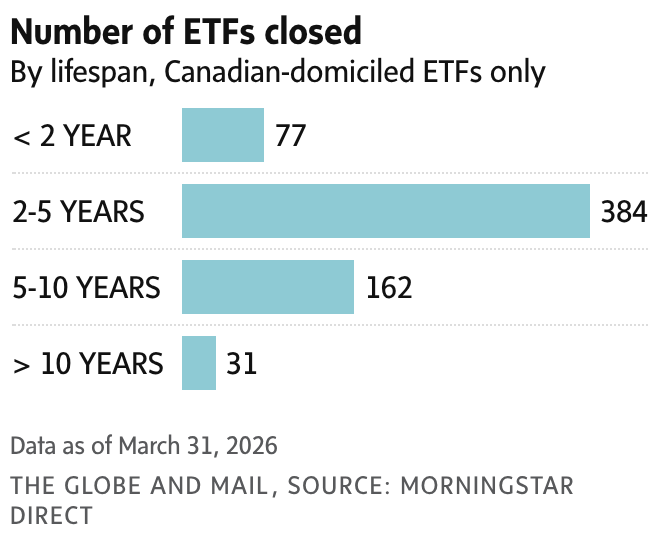
Exchange-traded funds were once a simple alternative to the mutual fund. Canada might have pioneered ETFs, but the journey has been marked by frequent launches and closures and has evolved into a hot mess of products. The chart above shows us that new funds are, statistically speaking, risky propositions. Here are four lessons from the Canadian ETF graveyard. |
|
|