| | In this edition, an entrepreneur is using AI to automate almost every facet of his life, and recent ͏ ͏ ͏ ͏ ͏ ͏ |
| |  | Technology |  |
| |
|
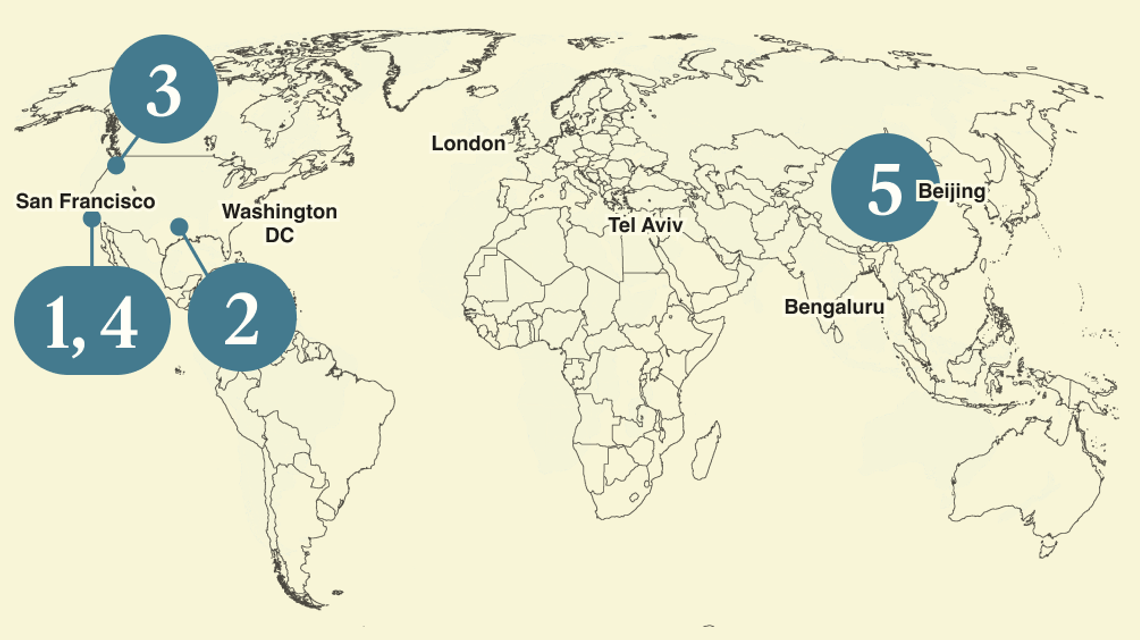 - Tech CEOs pitch UBI
- Vibe-coded M&A
- Not-so-unexpected layoffs
- Could AI find life in space?
- Robots take on sports
 The man who asked AI to “be him,” and the exponential rise of AI-generated code in Big Tech. |
|
 I recently sat down for lunch with Bill Nguyen, a respected, serial entrepreneur who wanted to pitch me on his startup, Olive. And it is an interesting startup, but I was even more struck by how Nguyen is, personally, using AI. I hear almost every day from at least one person who wants to impress me with how they have implemented AI, either personally or professionally. This was different. Nguyen has turned his life over to the machine in a way that sounds, honestly, reckless. I’ve written before that large language models can’t be trusted for anything truly important. And Nguyen had given them control over everything, including the most important things. I honestly didn’t get it. Then I bumped into him at an event a couple of weeks later and got an update. It had become crazier. The AI was doing even more, like emailing people on his behalf and setting up in-person meetings — without even checking with him. I asked Nguyen if he was scared something would go wrong. He said he fully expected something to go wrong, and that was part of the appeal. He was learning what AI could do — not today, but some time in the future. How is that possible? The truth is that most people are not using a lot of compute when they use AI. They’re paying a monthly subscription fee, or maybe even using a free chatbot. They’re getting a little bit of compute power for what amounts to a very advanced search engine. That search engine product hasn’t changed much, and it still hallucinates. If you use a lot more compute power, you can get more reliable results. That’s what software developers are doing when they use AI: One chatbot writes a bunch of code, and other chatbots check it over, rewrite it, and so on. The process can go on seemingly forever, and the end result gets better and better. As the price of AI comes down, these power users just use more and more tokens. But if, like Nguyen, you’ve got effectively unlimited resources, you don’t have to wait for the price to go down. You can also just … use more tokens, no matter what it costs. In that sense, you’d be paying to see the future. That’s what Nguyen is doing, and why it’s worth it to him to become a human guinea pig for his own experiment in how powerful AI is going to be in, say, a year or two. And if you take his word for it, the answer is … pretty powerful. You can read the whole story on Nguyen here. I think you’ll enjoy it. |
|
Musk pitches ‘universal high income’ |
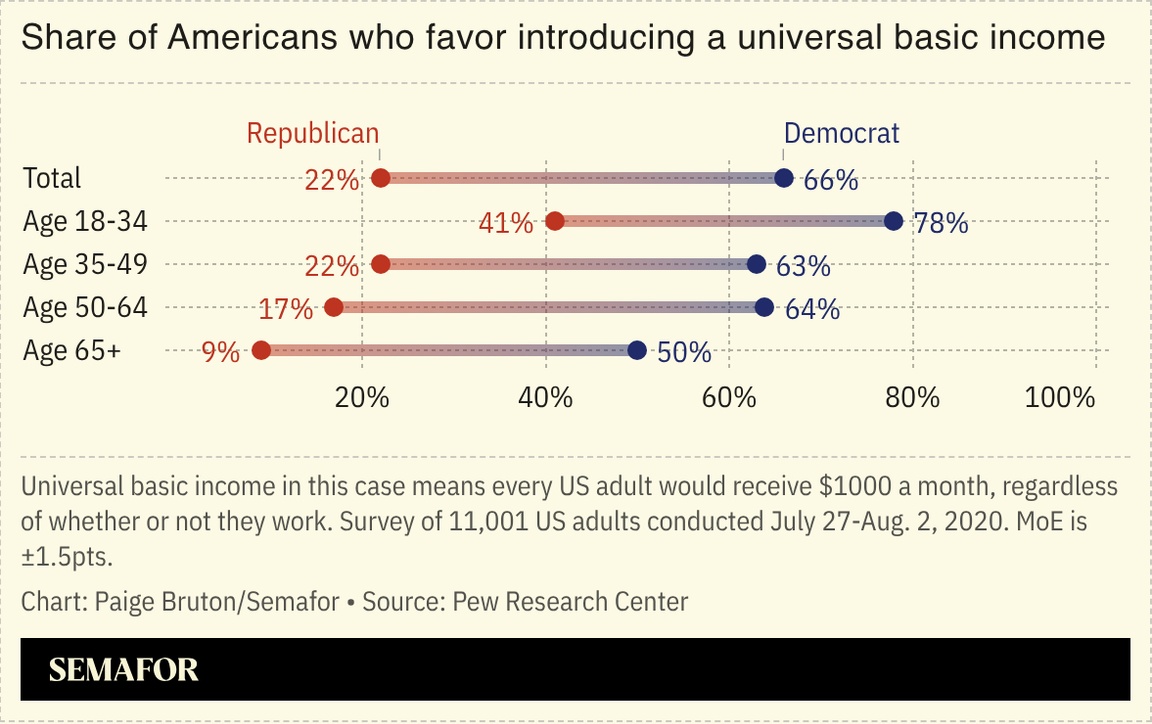 Elon Musk wants to give everyone “universal high income.” The new spin on universal basic income is the least he can do, considering how much money AI will make him when his Optimus robots start replacing all human jobs. The concept: Robots and AI will mean a massive increase in the amount of goods that can be produced, which essentially brings costs down enough so that everyone can afford to live the good life … in a penthouse, of course. Universal basic income proposals would guarantee a paycheck to Americans, issued by the federal government, and would, in Musk’s words, be a solution to “the unemployment caused by AI.” Universal basic income is not a new idea in the AI world — Sam Altman also recently voiced support for it, or even a “Universal Basic Compute” plan to give Americans a share of AI productivity. But these kinds of proposals are rooted in a lack of imagination and a misunderstanding of human nature. Humans never take new tools and technology and use them to maintain the status quo. If we did, we would still be hunter-gatherers — the original universal basic income system. There’s a very good chance AI means quality of life increases for everyone on the planet, but don’t underestimate humanity’s ability to find something to do, and to invent new things to value. Remember the NFT? |
|
SpaceX-Cursor deal signals rise of vibe-coded M&A |
  OpenAI CEO Sam Altman and Brad Smith, vice chair and president of the Microsoft Corporation. Jonathan Ernst/Reuters. OpenAI CEO Sam Altman and Brad Smith, vice chair and president of the Microsoft Corporation. Jonathan Ernst/Reuters.SpaceX’s deal for Cursor marks a rewiring of the market for corporate control. The standard M&A options — buyers paying cash or stock — have been replaced by a choose-your-own-adventureland where tokens are the new currency, employees are vital assets, antitrust is an afterthought, speed is everything, chokepoints matter more than control, and often the math doesn’t even pretend to add up. The coding-software startup will get acquired for $60 billion, maybe, sometime, if Elon Musk feels like it. The $10 billion that Cursor keeps even if the deal doesn’t happen is either the largest breakup fee on record or the biggest option premium in history. In the Before Times, a company preparing for the largest IPO ever would simply decide it wasn’t the right moment to spend $60 billion on an unprofitable startup. In the AI Times, things are moving too fast for SpaceX to wait. The new M&A vocabulary is being written in real time: acquihires, equity-for-compute, and the massive amounts of capex (see Tesla’s recent $25 billion announcement) that has squeezed out traditional takeovers. There will still be some AI-tinged, normal-ish M&A, but the industry’s frontmen are upending deal-making just like they are upending everything else. |
|
Tech layoffs were a long time coming |
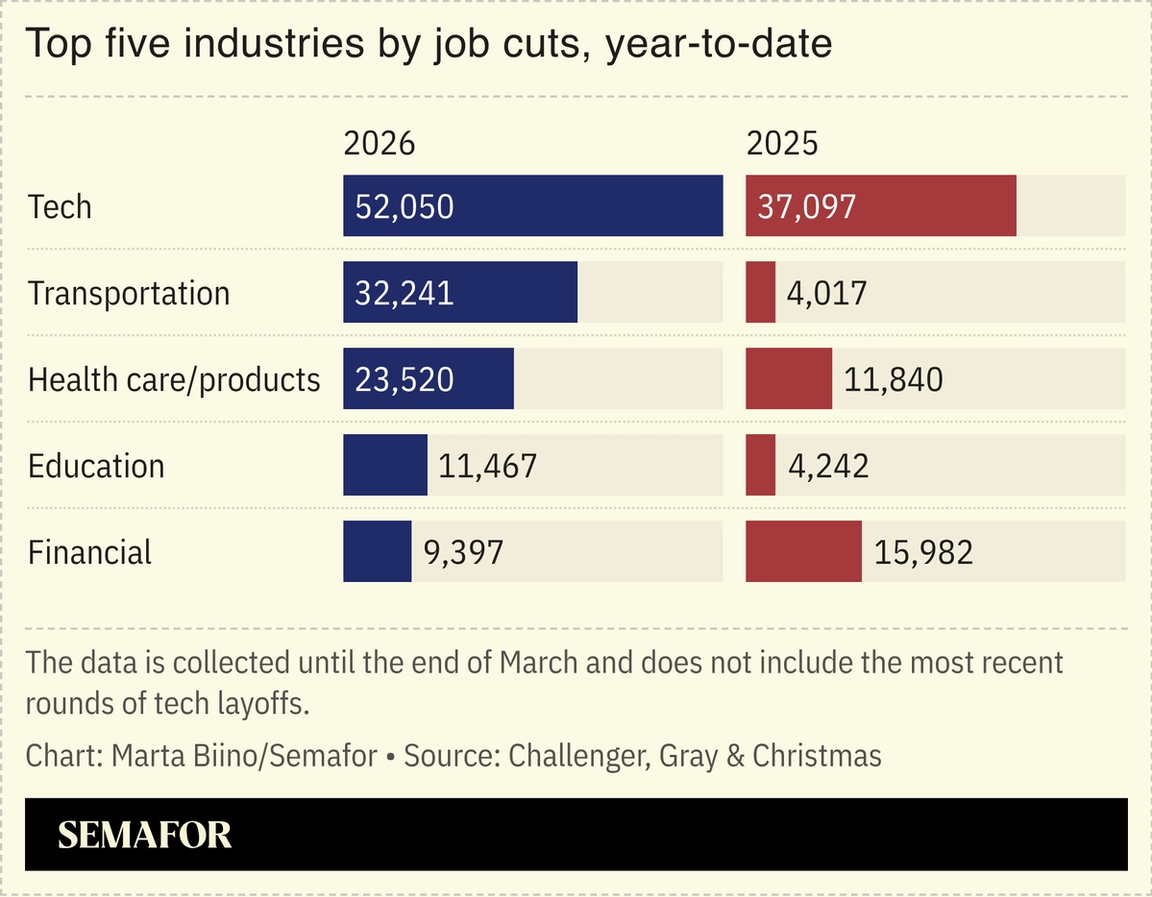 In the past, when tech companies laid off employees, the markets reacted approvingly. Cutting costs means more profit. But in the upside-down world we live in, Microsoft and Meta both suffered on Wall Street Thursday after news of their layoffs broke. Microsoft closed down nearly 4%, while Meta lost more than 2% (though both were starting to recover Friday). If you look at this like the layoffs were a desperate move to trade employees for data centers, you might argue the sell-off makes sense. The truth is that Microsoft, Meta, and other tech giants aren’t really giving up other revenue opportunities when they jettison employees. What they are giving up is padding that makes recruiting a little less painful and expensive. Tech companies had such rapid growth over the past decade that they were in constant battles for talent with one another. At one point, they even had a “no poaching” agreement in place so they could bring down costs and salaries of employees. These were the absolute most profitable companies in human history. They had such high margins that they could afford to keep employees around, even if they weren’t really needed. And so they did. The market has yet to come to terms with how few employees tech companies actually need to keep the cash spigots flowing. Elon Musk said he cut X’s staff by 80%, for instance, and it’s still humming along. Cutting staff is just one lever tech companies can pull to pay for the $100 billion-per-year data center bills they’re now fielding. We should expect to see more layoffs, and it’s a good thing for the tech ecosystem. Talent hoarding always had a negative impact. Some of those employees will found startups, and some of those that were laid off will go work for the startups. Big tech companies will be forced to innovate or face disruption — just the way it should be. |
|
AI’s hunt for signs of intelligent life |
 Astrophysics simulations visualized using an Nvidia tool. Courtesy of Nvidia. Astrophysics simulations visualized using an Nvidia tool. Courtesy of Nvidia.During a conversation at Los Alamos labs in 1950, physicist Enrico Fermi famously asked why, if the universe is so large, we have never seen any signs of extraterrestrial life. Well, maybe we just needed some GPUs. There is now so much data streaming in from powerful telescopes like the James Webb that it is impossible for humans to parse through it in a reasonable amount of time. Scientists are using Nvidia GPUs to examine the data and regularly discovering the oldest galaxies in the universe. UC Santa Cruz astrophysicist Brant Robertson told TechCrunch his team is now using transformer architecture — like the models that power large language models — to expand the capabilities of AI and find the hidden galaxies among the blurry, pixelated images that come in among gigabytes of data each day. The tech can also render some impressive imagery of distant galaxies that would otherwise be invisible to the human eye. There are still no signs of intelligent life in distant galaxies, but with a little more compute power, who knows what we might find? |
|
China’s humanoid robots make strides |
 Sony AI’s autonomous robot plays table tennis. Sony AI/Handout via Reuters. Sony AI’s autonomous robot plays table tennis. Sony AI/Handout via Reuters.Scientists at Sony built a robot they say can beat elite table tennis players, days after Beijing hosted a half marathon in which humanoid robots ran alongside humans, with the top bot finishing faster than any person has run 13.1 miles. These milestones evoke a people-versus-bots world in which human sporting accomplishments are rendered obsolete by robots, one by one. But this “better than humans” framing is missing the point; technology has always been better than people at certain tasks. Instead, we should leave humans out of it and look at how the humanoids are improving over time. The winning robot in the Beijing race finished in less than 51 minutes (after a stumble at the end), compared to two hours and 40 minutes last year. That speaks to China’s robotics innovation much more potently than any human comparison. — J.D. Capelouto |
|
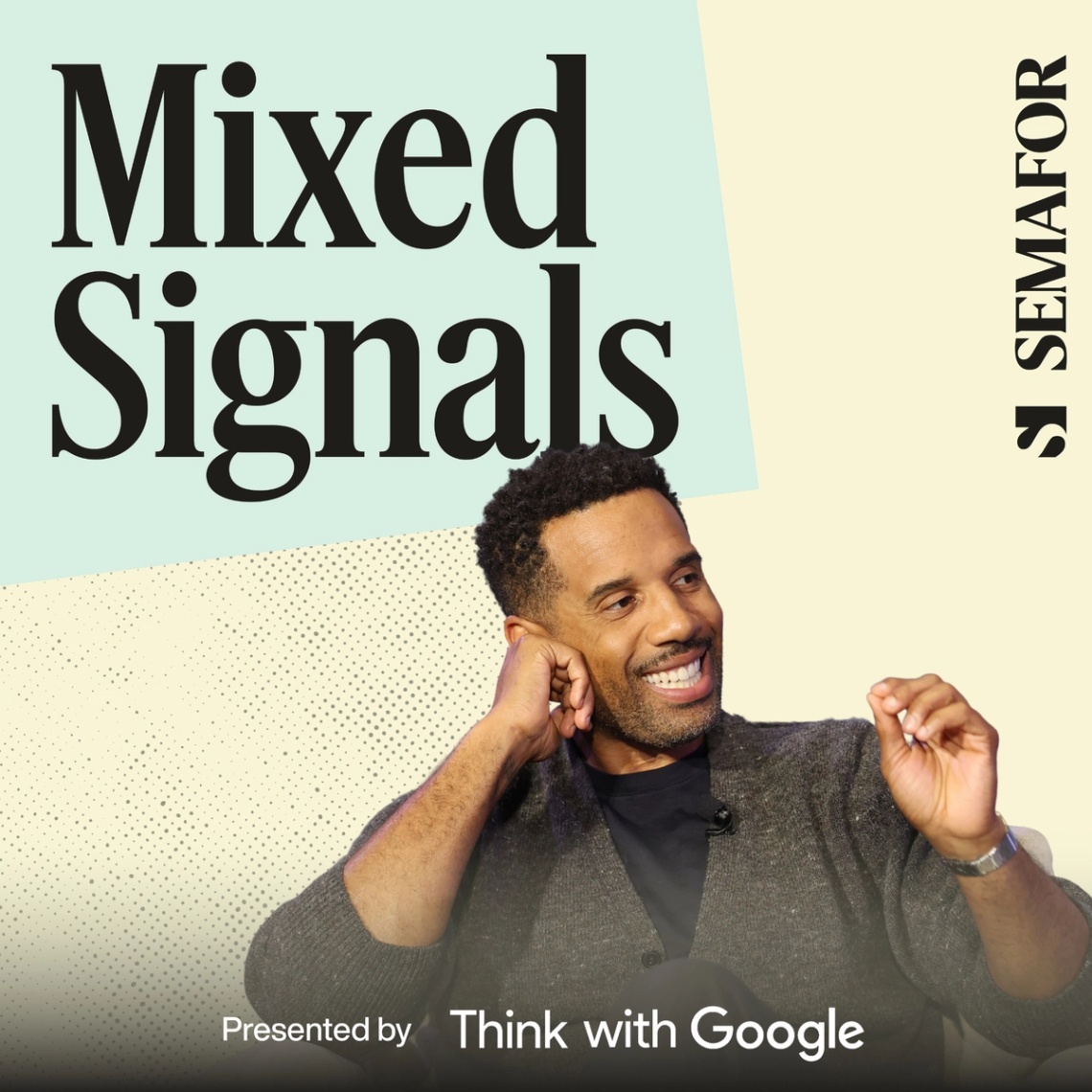 Could a more global basketball game be the NBA’s biggest opportunity? On this week’s episode of Mixed Signals, sports media mogul Maverick Carter shares his perspective on what comes next — from scaling SpringHill Company into a global content powerhouse to rethinking how fans engage with sports. Plus, his take on the NBA’s attention economy and his foray into live and digital entertainment.
|
|
 Bhawika Chhabra/Reuters Bhawika Chhabra/ReutersGoogle chief Sundar Pichai said 75% of the company’s new code is AI-generated. The trajectory is fast: In 2024 that figure was 25%, rising to 50% last fall. Meta targets similar levels by midyear. Perhaps more startlingly, Pichai said the workflow was now “truly agentic” — rather than engineers giving prompts which AI completes, engineers now supervise autonomous digital teams. While these time horizons are pretty impossible to fact-check, one complex code migration task, he said, was accomplished six times faster than would have been possible a year ago. The rapid pace of AI adoption at tech companies is leaving junior engineers an endangered species, Human-Readable AI reported: Snap reached 65% AI-generated code this month and immediately cut planned headcount; a Stanford analysis found that employment rates among younger software developers have fallen 20% since its late-2022 peak. |
|
|


