
|
 |
We are living in an information oligarchy.
Trump-friendly billionaires control major TV networks, newspapers, and social media platforms. Is it any surprise that powerful corporations and individuals get so much less media scrutiny than they deserve?
Popular Information fills this void with people-powered, accountability journalism — unbought and unbossed.
There is so much more to do, which is why we are planning our most ambitious reporting ever this year. You will see us dig deeper into the money corrupting our political system, expose the corporations undermining democracy, and break stories that the corporate press won’t touch.
You can help make this work possible by upgrading to a paid subscription for $50 per year or $6 per month.


 |
Last week, the Justice Department indicted Master Sgt. Gannon Ken Van Dyke for misappropriating classified information to profit on the prediction market Polymarket. Van Dyke was a member of the U.S. Army Special Forces unit that captured former President of Venezuela Nicolás Maduro on January 3, 2026. Over the span of eight days just before the operation, Van Dyke allegedly leveraged his access to classified information to make more than $400,000 on Polymarket.
According to the prediction market industry and its advocates in the Trump administration, Van Dyke’s arrest is proof that the “system works.” In reality, Van Dyke’s experience is highly unusual. Van Dyke was not caught because of a robust system that protects prediction markets against insider trading. Rather, it was a combination of the specific kind of information that Van Dyke exploited and his own hamhandedness.
Van Dyke allegedly became aware of Maduro’s impending capture around December 8, 2025, when he was assigned to the team planning the operation. According to the indictment, on December 26, 2025, Van Dyke personally created an account on Polymarket, funded it with about $35,000, and began placing bets on Maduro-related markets under the username “Burdensome-Mix.” For example, Van Dyke allegedly placed large “YES” bets on “Maduro out by… January 31, 2026” and “Will the U.S. invade Venezuela by… January 31,” among others.
Van Dyke made these bets, according to the indictment, after he signed non-disclosure agreements in which he promised “to never divulge, publish, or reveal by writing, words, conduct, or otherwise . . . any classified or sensitive information.”
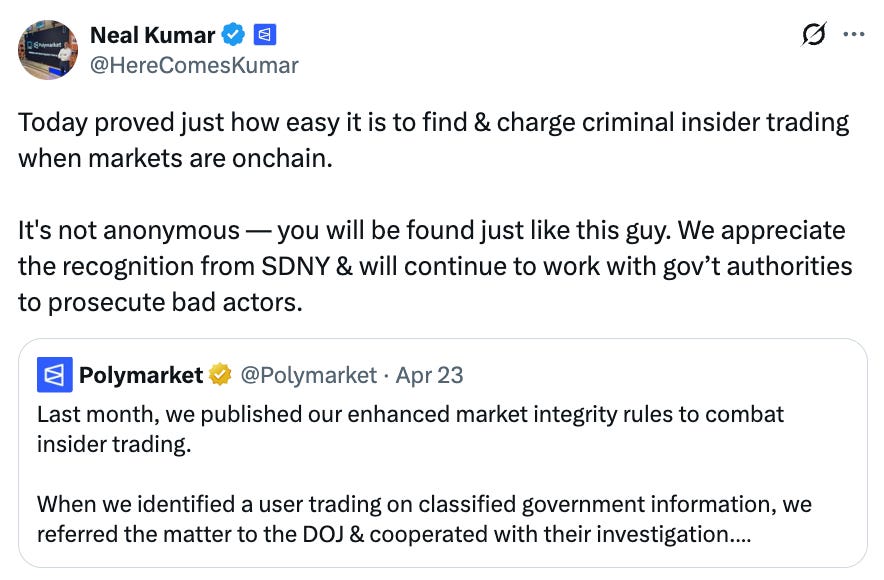
Polymarket claimed this was a validation of the integrity of its platform. Neal Kumar, Polymarket’s Chief Legal Officer, posted on X that Van Dyke’s arrest “proved just how easy it is to find & charge criminal insider trading when markets are onchain.” A separate X post by the official Polymarket account says it was the company that “identified a user trading on classified information.”
Kumar said that others who tried to trade on insider information “will be found just like this guy.”
 |
Polymarket CEO Shayne Coplan posted: “We flagged this, referred it, and cooperated throughout the process.”
Polymarket’s story does not add up. The indictment credits “reports of unusual trading in Maduro-related contracts on Polymarket [that] appeared in the press and on social media” with bringing scrutiny to Van Dyke’s conduct. Polymarket’s internal systems are not mentioned.
The issue was that, according to the indictment, Van Dyke did not take basic steps to conceal his activity. He opened brand-new accounts to place trades and immediately placed large bets on a narrow range of contracts, all related to Maduro. Had Van Dyke spread smaller bets across several accounts with established betting histories, his conduct would have been difficult or impossible to detect. An even more effective tactic would have been to pass the information to a third party who would execute that strategy. Van Dyke allegedly took none of these precautions.
Further, all the charges in the indictment rest on the fact that the information used by Van Dyke was classified and that he had a duty not to disclose or misuse it. Many of the markets offered by Polymarket do not involve this kind of information.
For example, Polymarket is currently taking bets on whether Clavicular, a “looksmaxxing” online influencer, “announces that he and a partner are expecting a baby through pregnancy between market creation and December 31, 2026.”
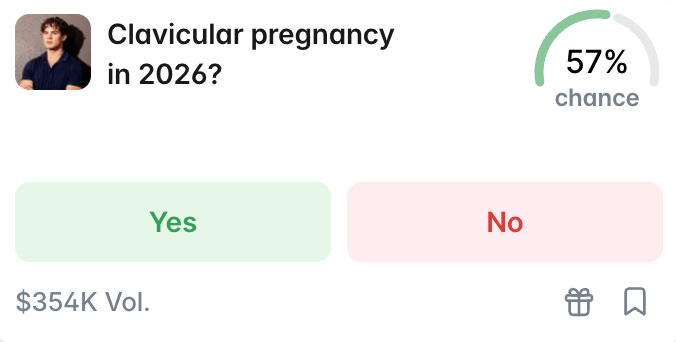 |
Clavicular has no obligation to keep the timing of any potential pregnancy announcement secret. Similarly, if Clavicular informed a friend in advance of an announcement, the friend would have no “duty” not to share or act on that information. In other words, the roadmap for prosecuting Van Dyke would not apply to insiders gaming the Clavicular market — or the vast majority of markets offered on Polymarket and Kalshi.
Notably, Coplan told 60 Minutes in November 2025 that trading on insider information was beneficial. “I think that people going and having an edge to the market is a good thing,” Coplan said. “Obviously… you need to be really clear and stringent on where the line is drawn… But it’s sort of an inevitability that this will happen, and there’s a lot of benefits from it.”
The truth about Kalshi
Kalshi, Polymarket’s chief rival, attempted to use the indictment to portray itself as the prediction market with real protections against insider trading. CNBC reported that Kalshi “blocked Van Dyke from opening a Kalshi account.” Notably, a Kalshi spokesperson “could not give details of when the 38-year-old Van Dyke tried to open an account or why he was prevented from doing so.”