
|
 |
When Joe Rogan Is in Charge of Health Care
Psychedelics have genuine potential as psychiatric tools, which is why separating them from politics is so important.
|
| ||||||||||||


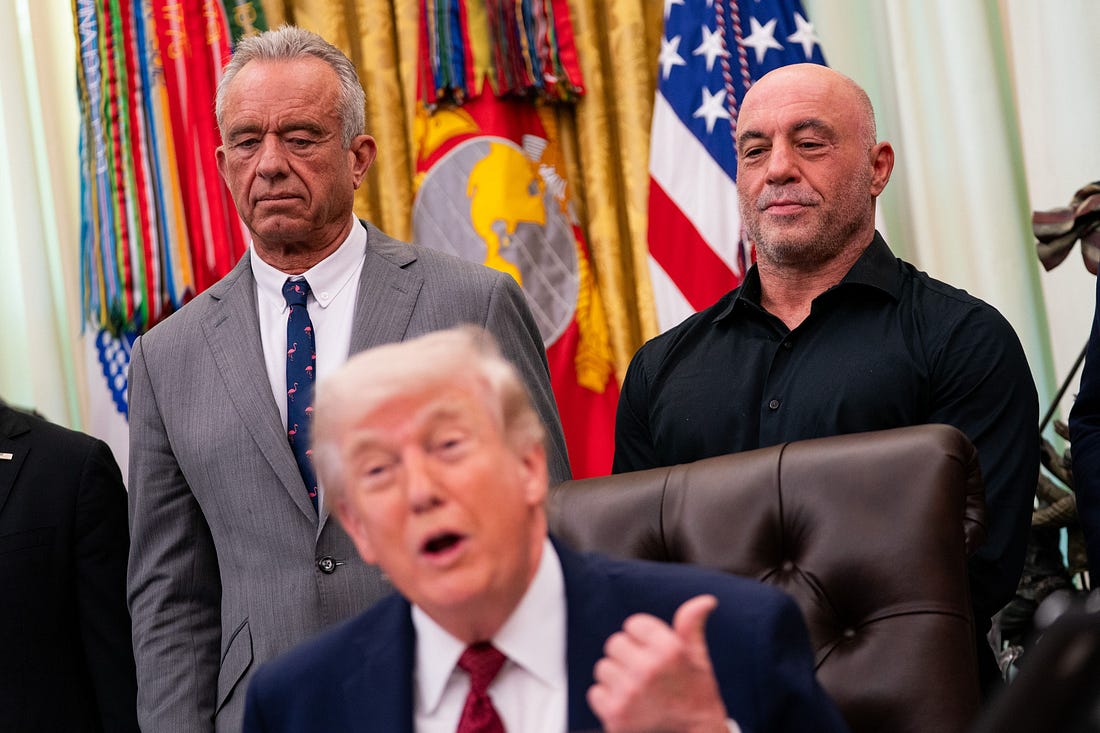 |
IF YOU DON’T LIKE ROBERT F. KENNEDY JR. setting national health policy, how do you feel about Joe Rogan? The question is a serious one that deserves a serious answer, given what transpired when Rogan showed up in the Oval Office a little over a week ago.
He was there to watch President Donald Trump sign an executive order promoting psychedelic drugs as a treatment for mental illness, a cause that Rogan has long championed. But it turned out the podcast host wasn’t just another invited guest. He was the one who had prompted Trump to act.
“I sent him that information,” Rogan said, revealing he’d texted the president about the ways psychedelics might help with conditions like depression and PTSD (post-traumatic stress disorder). “The text message came back, ‘Sounds great. Do you want FDA approval? Let’s do it.’ It was literally that quick.”
This does not appear to be an exaggeration.
Mehmet Oz, the celebrity doctor who oversees Medicare and Medicaid programs, told reporters that Rogan’s text set off a frenetic week of internal deliberations that culminated in the executive order. Kennedy played a role too, as Trump recounted in his own remarks. “I said, ‘Bobby, let’s just do it and get Oz involved and it’s going to get done so quickly,’” Trump recounted. “And you guys did a great job.”
The executive order calls on the Department of Health and Human Services to make more funds available for research into psychedelics, while telling the Drug Enforcement Agency to update its legal guidelines to allow legitimate academic and therapeutic uses to go forward. Those moves reflect a widespread recognition that psychedelics have real potential as a breakthrough therapy for some patients. And it’s hard to find anybody—even among frequent administration critics—who finds this sort of action beyond the bounds of normal presidential prerogatives.
“It’s well within the remit of any administration to decide that research in a given area is a priority for them, and to make it easier for researchers to do that work,” Peter Lurie, president of the Center for Science in the Public Interest, told me.¹
But the executive order also instructs the Food and Drug Administration to give psychedelic manufacturers so-called priority vouchers that expedite reviews. This provision is setting off alarm bells because it suggests the president is doing an end-run around the FDA’s normal scientific processes, quite possibly because he wants to quiet a politically influential podcaster who has been giving him grief over Iran. It also seems possible Trump might be looking to boost companies that stand to profit bigly from psychedelics—companies who count among their investors well-known Trump allies like Peter Thiel.
“The optics of the situation are quite concerning,” Rachel Sachs, a Washington University law professor and expert on drug regulation, told me.² “It appears that the president is directing FDA, at the very least, to issue these priority vouchers to these products—and based on his public statements, will be exerting some type of pressure on FDA to ultimately approve the products.”
It wouldn’t be the first instance of such meddling: Career FDA staff have told STAT News that they have come under pressure from administration officials seeking priority vouchers for pharmaceutical companies that agree to the prescription drug pricing deals Trump keeps hyping. And it’s not like it takes journalistic sleuthing to establish the connection to Rogan: Trump and several other administration officials came right out and said it exists.
None of this means that the FDA will ultimately bend to pressure from top Trump officials, or make ill-considered decisions when it comes to any particular treatments. But the threat itself is enough to damage the agency’s credibility, in ways that could ultimately hurt everybody—including both the companies that want to manufacture psychedelics and the people who might genuinely benefit from them.
This kind of reporting and in-depth analysis—so important to the future of our democracy—is made possible by the support of our Bulwark+ members. If you’re not already a member, consider joining today—and get your first two weeks free:
MODERN INTEREST IN THE THERAPEUTIC BENEFITS of psychedelics, like so many key episodes in medical history, traces back to an accident in the lab. In 1943, a Swiss chemist named Albert Hofmann was synthesizing a substance he hoped would lead to respiratory stimulants when he inadvertently absorbed a tiny amount. The substance was a version of a compound we know as LSD.³
The LSD altered his vision and perception, and made him feel like he was in a “mystical” state. He decided to try again a few days later, and experienced even more dramatic changes in perception and mental status. Hofmann famously rode his bicycle home while on what we would now call an acid trip, which is why historians (both professional and amateur) call the April 19 anniversary of that ride “bicycle day.”
Hofmann worked for a company called Sandoz Laboratories, where he and his colleagues quickly recognized the potential of such a powerful mind-altering drug. Sandoz distributed research samples to psychiatrists, kicking off a wave of promising studies in the 1950s that suggested potential to treat depression, personality disorders, and alcoholism.
Publicity around these developments attracted lots of attention, and not just among people with mental illness or those trying to treat it. Counterculture leaders in the ’60s hailed the drugs (still legal for purchase back then) as a way for everybody to alter their state of consciousness. Meanwhile, the CIA experimented with LSD as a way to wage psychological warfare.
Both those developments fed a backlash. Researchers stopped studying psychedelics, Sandoz stopped producing LSD, and the National Institutes of Health pulled funding. Eventually the federal government declared psychedelics to be a Schedule I controlled substance, making studies even more difficult to conduct.⁴
That was basically the end of research on psychedelics—until 2000, when scientists at Johns Hopkins University launched a new study on the effects of Psilocybin, the active ingredient in magic mushrooms that indigenous central Americans had long used in