| | In today’s edition: the backstory behind the Pulitzer Board’s recognition of a years-old series on J͏ ͏ ͏ ͏ ͏ ͏ |
| |  New York New York | Philadelphia |  Washington Washington |
 | Media |  |
| |
|
 - Pulitzer honors
- Weiss’ deputy speaks
- Mixed Signals
- Versant’s hits
- Dispatched
- American exceptionalism
|
|
 As the ad world descends on Midtown this week for upfront presentations, major media companies will make their annual pitch to marketers — and try to convince them that spending money on TV still makes sense. That’s become a harder sell each year, as tech giants like Meta and Google have continued to gobble up an increasing share of digital ad dollars — and as television screens themselves are increasingly places to watch streaming shows, rather than television. Unsatisfied with simply dominating the web, streamers, led by Netflix and Google’s YouTube, have also muscled into the upfronts with their own glitzy presentations. Outside of big-ticket events like the Super Bowl, broadcast media companies still haven’t figured out how to compete with the scale and precision offered by the tech giants. But, as Ben writes in this week’s newsletter, one interesting trend to watch is whether TV networks increasingly lean away from huge scale and into premium audiences, as digital publishers started doing years ago. Ben writes about how Versant plans to spotlight Morning Joe and Squawk Box at upfronts this week, in a bid to keep TV content relevant by appealing to the decision-maker class. Squawk Box host Becky Quick recalled to Semafor that Warren Buffett once told her he would pay “any amount of money” to watch the show. “He cares about the internet, he cares about his private plane, and he cares about CNBC,” she said. Also today: the backstory behind the Pulitzer Board’s recognition of a years-old series on Jeffrey Epstein, and a CBS News top editor goes on the record.
|
|
The Pulitzer Board’s Epstein reporting plaudits |
 Screenshot/YouTube/The Pulitzer Prizes Screenshot/YouTube/The Pulitzer PrizesEarlier this week, Semafor reported that a years-old fight among Pulitzer Prize judges over a major story about the late sex offender Epstein had spilled into view, a rare occurrence within a prestigious awards body that generally keeps its deliberations and decisions relatively private. On Monday, the Pulitzer Board awarded a “special citation” for Miami Herald investigative reporter Julie K. Brown’s 2018 series, Perversion of Justice, the story that raised questions about the federal government’s prosecution of Jeffrey Epstein and effectively reopened the investigation into him. The Miami Herald had submitted Brown’s work for a Pulitzer Prize when it was initially published, but one Pulitzer judge felt strongly that Brown’s stories, while important, didn’t contain enough brand-new information to earn an award. The “snub” was painful enough for the Herald that, years later, it was initially planned to be a plot point in the televised narrative version of the Epstein saga currently being developed by Sony Pictures Television and Adam McKay. The organization rarely grants citations for recent nominees who were snubbed, so the board’s move to honor Brown now is unusual, though people on the board that Semafor spoke with dismissed the notion that lobbying efforts by other journalists had swayed it. But given the Epstein story’s renewed importance in political discourse around the world, her citation is also one of several self-conscious efforts by the board to evolve with public opinion and changing media consumption habits. |
|
Weiss’ deputy on CBS’ independence |
 Brendan McDermid/Reuters Brendan McDermid/Reuters“Everybody here is owned by somebody,” the managing editor of CBS News, Charles Forelle, told me at the annual conference of the Society for Advancing Business Editing and Writing, a business journalism trade group, in Philadelphia on Friday. “The convention in American journalism is that the owners are independent of the news operation, and that’s the case at CBS,” he said. “And [owner David Ellison] said that, and he said quite clearly that that would be the case no matter what.” I was pressing Forelle, a former top Wall Street Journal editor who is Bari Weiss’ deputy at CBS News on the perception — encouraged by President Donald Trump, who has suggested it out loud — that the new regime at CBS was installed as a way to trade regulatory approval for more sympathetic coverage. Forelle acknowledged that idea is out there: “The president says a lot of things,” he said, but “I’m not going to try to pretend that I don’t know what you’re saying.” How does CBS get out from under that? “We do all the stuff that journalists do, and we hope that people who are the self-appointed criticizers and assessors of that perception see that.” He also offered a glimpse of the new leadership’s view of the network’s politics. “We don’t think that we want to move 10 degrees to the right and find the center. We think that there’s a wider aperture of audience out there than other people think,” he said. As examples, he cited coverage of nonprofit fraud in Minnesota and hospice fraud in California as stories CBS now covers more aggressively than it would have, undeterred by the notion that they’re right-wing themes off-limits to mainstream media. Forelle also described how the new CBS News is trying to keep and elevate talent. Journalists come to him and Weiss every day pitching new shows and podcasts, and their answer is: “Yes, yes, yes.” “We have a whole roster of pilots running now with existing talent inside CBS that had not been able to do that in the past.” Forelle said. “We are buyers of good ideas for stuff, and that, to my mind, is the strongest thing that we can do, and people are responding to that, even though it doesn’t make the media newsletters.” You can hear the full interview here, courtesy of JT Madore. — Ben Smith |
|
Angel Studios on ‘Mixed Signals’ |
 Angel Studios is crowdsourcing a “values-based” alternative to Hollywood. The brothers behind the faith-and-values-driven studio, known for its increasingly popular blockbusters, join Mixed Signals to explain how their 2 million-member Guild subverts the traditional greenlighting process. Max and Ben ask the Harmon brothers whether Angel Studios is a niche Christian media company or something with genuine mainstream scale. |
|
Versant’s pitch to advertisers |
 MS NOW; Brendan McDermid/Reuters; CNBC MS NOW; Brendan McDermid/Reuters; CNBCOne of the puzzles of contemporary fragmented media is how to find value in media companies that can’t match Google and Meta in sheer scale and reach. One answer is to look at the media outlets that appeal to specific, and sometimes quite powerful, audiences. CNBC’s new parent company, Versant, is trying to answer that question at this week’s upfronts, the annual advertising industry showcase. It will be represented there by the hosts of Squawk Box and Morning Joe, from Versant’s other network, MS NOW. Versant’s decision to pair Morning Joe and Squawk Box for advertisers suggests that its most valuable properties don’t have to be the ones with the largest audience — that remains MS NOW’s primetime shows — but can be those important to influential Americans. “We corner the market as far as influencers go on Washington and Wall Street,” Morning Joe co-host Joe Scarborough said in an interview. As audiences have moved to digital platforms — and often away from live feeds — morning television has, broadly, lost political and cultural relevance. The two Versant shows, however, continue to be watched by CEOs and political leaders, as any guest will find when they check their text messages as soon as they’re off the air. |
|
Dispatch exec departs amid uncertainty |
 Screenshot/The Dispatch; Thomas Peter/Reuters Screenshot/The Dispatch; Thomas Peter/ReutersThe Dispatch’s president is out — and the right-leaning outlet has been looking into selling itself, Semafor scooped this week. Mike Rothman left the company in recent days, people familiar said, in part due to his differences about the outlet’s direction with founders Jonah Goldberg and Steve Hayes. Over the last several months, The Dispatch had been discussing a potential sale to Axel Springer, the German media giant that has been on a buying spree — though its sudden purchase of The Telegraph earlier this year may have satiated some of its appetite. Still, one person familiar with the discussions said there remains some interest in a future deal. A spokesperson for Axel Springer declined to comment. Hayes said he and Goldberg “did not launch the company with the intention of one day being acquired … but we have been flattered by interest from potential partners over the years.” |
|
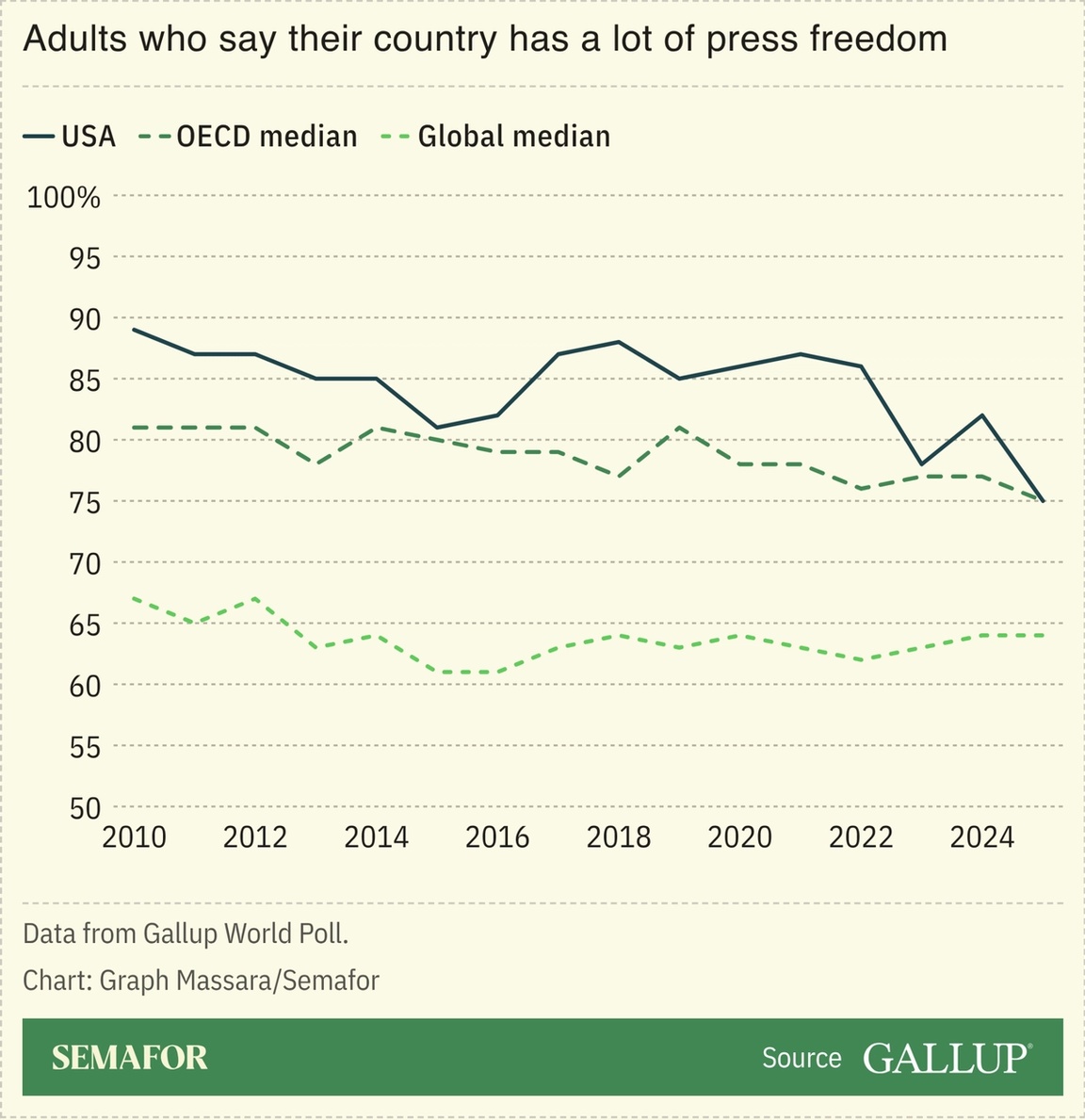 Americans broadly distrust the media and think freedom of the press here is on the decline. But in 2025, 75% of Americans still agreed that journalists in the US have a lot of freedom — down sharply from 86% in 2022, according to a Gallup analysis late last month of a survey comparing perceived media freedoms between countries. It’s a noticeable dip, though the 75% “yes, free” response ties the US with the median across OECD countries, and puts it more than 10 percentage points above the global median (64%). American pessimism about press freedom is also a relatively new phenomenon: Zoom out to a 15-year timeline, and the US’ drop in the rankings doesn’t even crack the top ten. (The worst decline was Hungary, which fell from 87% “free” in 2010, as Viktor Orbán came to power, to 45% “free” last year.) — Graph Massara |
|
Status: Several of Substack’s biggest names — The Bulwark, Zeteo, Emily Sundberg’s Feed Me, and others — have explored switching to one of its competitors, Oliver Darcy reports, as the newsletter platform’s once near-monopolistic grip on the market shows signs of slipping. Publish Press: Netflix, Disney+, and Google all rolled out new short-form vertical video features over the last week, as the microdrama platform ReelShort lures users with quick hits of content, Hannah Doyle and Syd Cohen write. Bloomberg: A bidding war has erupted for Ina Garten’s forthcoming podcast, as podcasting enters a “boomer bonanza,” Ashley Carman writes. WSJ: James Murdoch is in “advanced” talks to buy New York Magazine and Vox’s podcast division, Jessica Toonkel scoops. NYT: Very few DC media insiders think the White House Correspondents’ Association dinner do-over will be held this month, as more of them ask whether it should be held at all, Elisabeth Bumiller writes. Semafor Africa: The editor of South Africa’s Sunday Times was suspended after a corruption investigation, underscoring the perils of the “parallel income streams for journalists that have become a feature in the country’s cash-strapped media industry,” Semafor’s Tiisetso Motsoeneng writes. |
|
 - Orchestra, the holding company overseeing rebranded PR firm Berlin Rosen, is expanding its Washington presence with the addition of several veteran Democratic comms alums, Semafor has learned. Orchestra has hired Andrew Bates, a former senior deputy press secretary under former President Joe Bi
|
|
|


