
|
 |




Donald Trump’s quest to get a bunch of taxpayer money for his White House ballroom project isn’t going great, with plenty of Republicans in both the House and the Senate still sounding highly skeptical. “It was one thing when private dollars were doing it,” Sen. John Curtis of Utah told Politico yesterday. “If you’re asking me for a billion dollars, I have some really hard questions.” Rep. Brian Fitzpatrick (R-Pa.) was even more unequivocal: “Not happening here,” he said yesterday. Happy Wednesday.
 |
Take It From Him
by Will Saletan
Donald Trump always finds a scapegoat. When the economy does well under other presidents, he takes the credit. And when the economy suffers under him, he finds someone else to blame. In his first term, it was the “China virus.” In his second term, it’s the Fed.
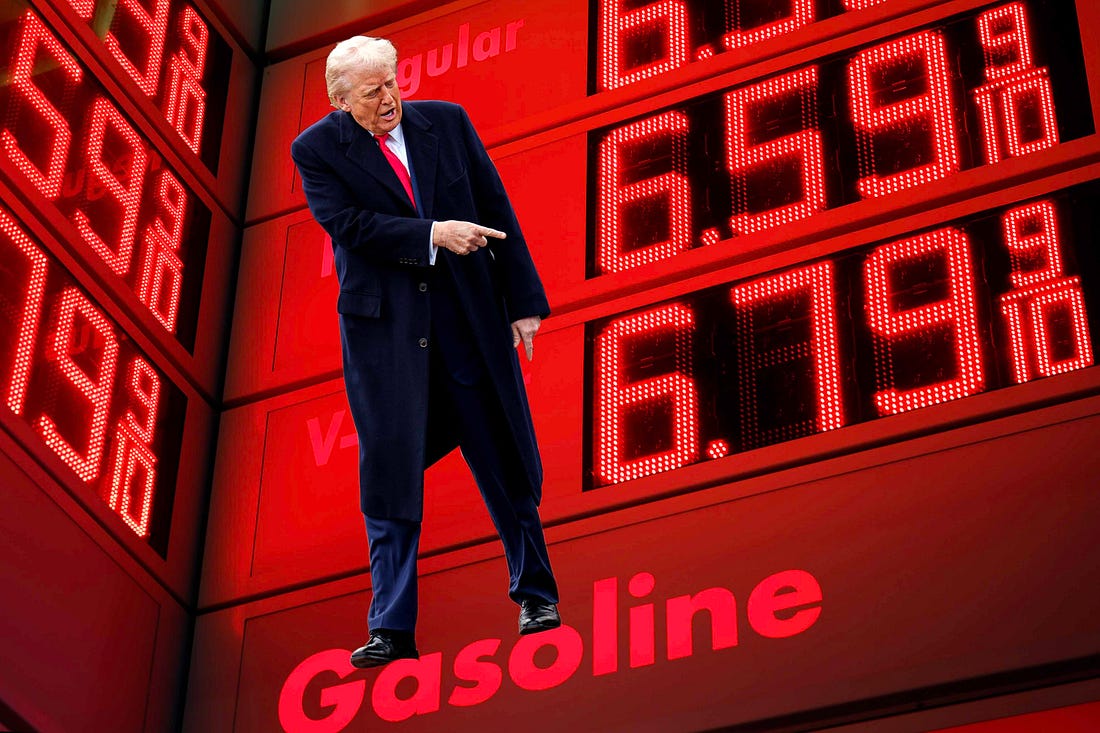
But now he’s in a jam. Official numbers released on Tuesday show that energy prices, grocery prices, core inflation, and the Consumer Price Index are all surging, thanks to Trump’s war in Iran. And this time, he can’t escape responsibility.
Why? Because he has repeatedly admitted, on camera, that he foresaw the war’s economic damage and started it anyway.
At least fifteen times in the past five weeks, Trump has recounted the story of how he told his economic team about the war. Here’s one version, delivered in Florida on May 1:
I called in Scott Bessent and all of my people, mostly my financial people. And I said, “Alright, folks, congratulations. We just hit the highest price in the history of the stock market.” . . . Oil prices were very low. They were $60 and $70 [per barrel]. They were buying [gas] for $2 and even less. . . . In Iowa, it was $1.85 a gallon.
I said, “Congratulations. Now I’m going to upset the apple cart for you, because we have to take a little journey down to a beautiful country known as Iran, and we have to make sure that they don’t have a nuclear weapon.” We stopped them with the B-2 bombers. If we didn’t do that, we would’ve had a nuclear weapon.
Every time Trump tells this story, the gist is the same: The war was his decision, and he knew it would upend the economy. Often, he quotes the pre-war price of gas, boasting that in some states it was under $2 per gallon. On average, it’s now about $4.50.
The first time Trump told this story, in an interview with Maria Bartiromo on April 12, he said oil and gas might be even more expensive by November. Bartiromo’s eyebrows went up in shock.
Three days later, Trump boasted that oil was only $92 a barrel, up from $65 before the war. “I’m very happy,” he said. On May 6, he bragged that it was only $100.
In February, before the war, the Dow stood above 50,000. In the war’s first month, it fell almost to 45,000. Since then, it has recovered, but not completely. And Trump says he expected much worse. “When I did this, I thought the market would go down 25 percent,” he told reporters on May 5. “I thought that was a great deal if it did. If it went down 25 percent, I was satisfied. . . . I also thought oil would go up to 200, 250, maybe 300.”
For context, the Dow fell slightly less than 25 percent in the first two days of the 1929 market crash. Trump thought an equivalent fall, percentage-wise, would be great.
And what are Americans getting for this?
Sometimes Trump says the cost was worth it to stop Iran from getting a nuclear weapon. But in his next sentence, he often adds—as he did in that May 1 speech—that we wiped out Iran’s nuclear program last year.
“Those beautiful B-2 bombers totally obliterated their three sites,” he gloated on April 12. But four days later, he said of the current war, “We had to take this journey to the Middle East in order to get rid of a nuclear weapon.”
Get rid of a nuclear weapon? Eight months after the B-2 strike? Either Trump can’t remember his own words, or he’s trying to sell you the same war twice.
In fact, he’s trying to sell it to you three times. The first time was last year, when he said the B-2s “obliterated” the nuclear sites. The second was on February 28, when he