
|
 |
Welcome to Popular Information, a newsletter dedicated to accountability journalism.


This week, Secretary of War Pete Hegseth and Acting Undersecretary Jules Hurst, the Pentagon’s Chief Financial Officer, answered questions about the cost of the Iran War while testifying before House and Senate Committees.
“Now we think it’s closer to 29 [billion],” Hurst said. “That’s because of updated repair and replacement of equipment costs and also just general operational costs.” There was no explanation of how this figure was calculated or documentation of any kind. The only thing Hurst provided was his brief verbal statement.
Two weeks ago, CBS News reported that the Pentagon’s internal estimate was “closer to $50 billion.” Writing for Popular Information, analyst Stephen Semler estimated the Iran War cost $72 billion in the first 60 days. Semler provided a detailed methodology of his calculations. Other independent estimates are even higher.
 |
|
Congressman Pete Aguilar (D-CA) asked Hegseth when a “formal accounting on the cost” would be available. Hegseth was non-committal, saying only he would share more information “when it’s relevant and required.”
It was an odd thing for Hegseth to say, since it is explicitly Congress’ job to approve and oversee federal spending. All departments are required to share information about how they spend allocated funds with Congress.
According to a report in the Washington Post, “Iranian airstrikes have damaged or destroyed at least 228 structures or pieces of equipment at U.S. military sites across the Middle East since the war began, hitting hangars, barracks, fuel depots, aircraft and key radar, communications and air defense equipment.” Under questioning from Congressman Ed Case (D-HI), Hurst acknowledged that none of the damage to military sites was included in his estimate.
“We have a lot of unknowns there,” Hurst said. “We don’t know what our future posture is going to be. We don’t know how to construct those bases.” Semler estimates the cost of military assets damaged or destroyed during the Iran War to be at least $11.9 billion. Hurst also said he would need to “double check” if arms transfers to other countries were included in his cost estimate. According to Semler, arms transfers to Israel, which is waging the war in concert with the U.S., cost about $2.9 billion in the first 60 days.
The biggest flaw with the Pentagon’s estimate is the way it calculates spending for munitions. (Hurst testified that spending on munitions accounted for $24 billion of its $29 billion estimate.) Semler explains:
The cost to fire one SM-2 interceptor is approximately $1.2 million. If 50 are withdrawn from the stockpile and fired, the Pentagon’s ledger would show $60 million in expenses from consuming those munitions… The Pentagon no longer buys SM-2s; the interceptor is being replaced by the more advanced and expensive SM-6. So each time an SM-2 is fired in the ongoing war, the Pentagon’s accounting system registers a cost closer to the SM-2’s $1.2 million unit cost from 2010 than the $6.3 million unit cost budgeted in 2027 for the SM-6 that will replace it. For US taxpayers, the cost of firing 50 SM-2s isn’t $60 million; it’s $315 million.
There are many more examples of expended munitions (or destroyed equipment) that are budgeted to be replaced by much more expensive variants.
Nevertheless, most major media outlets simply repeated the $29 billion estimate as if it was credible.
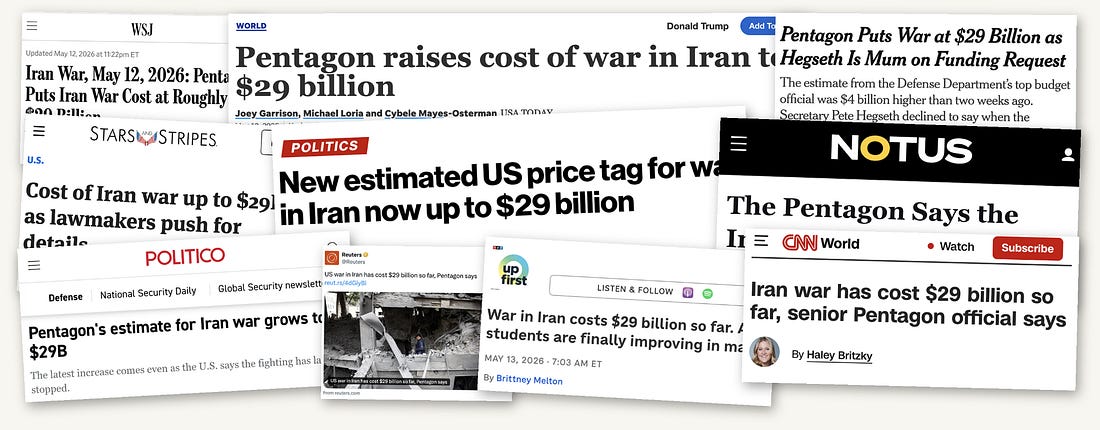 |
Popular Information reviewed articles or updates about the new estimate in the New York Times, USA Today, NPR, the Wall Street Journal, NOTUS, Stars and Stripes, New York Post, CNN, Politico, and Reuters. All of these publications put the $29 billion estimate in the headline.
The CNN article notes that a “source previously told CNN that a m