| | Oil prices inched up on Thursday as the market anxiously awaited any encouraging signals from the US͏ ͏ ͏ ͏ ͏ ͏ |
| |  | Energy |  |
| |
|
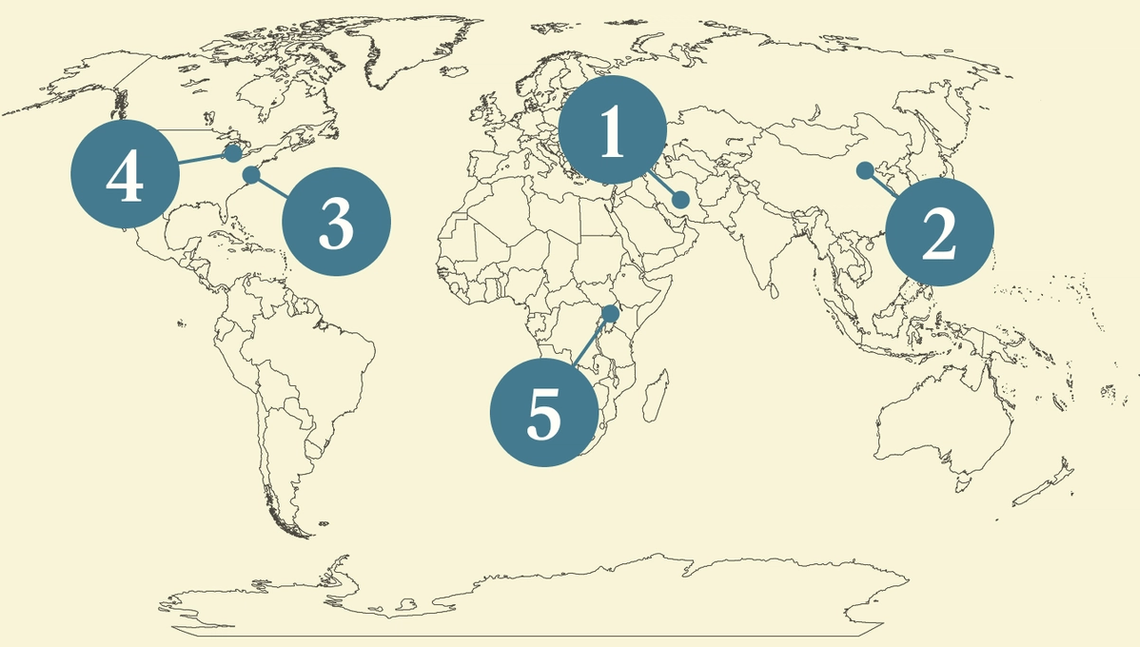 - Refineries knocked out
- China’s Iran calculus
- Clean factories peak
- Climate tech funding boost
- Record protestor crackdown
 Cubans protest US energy blockade, and Trump gives a second chance to a new FEMA chief. |
|
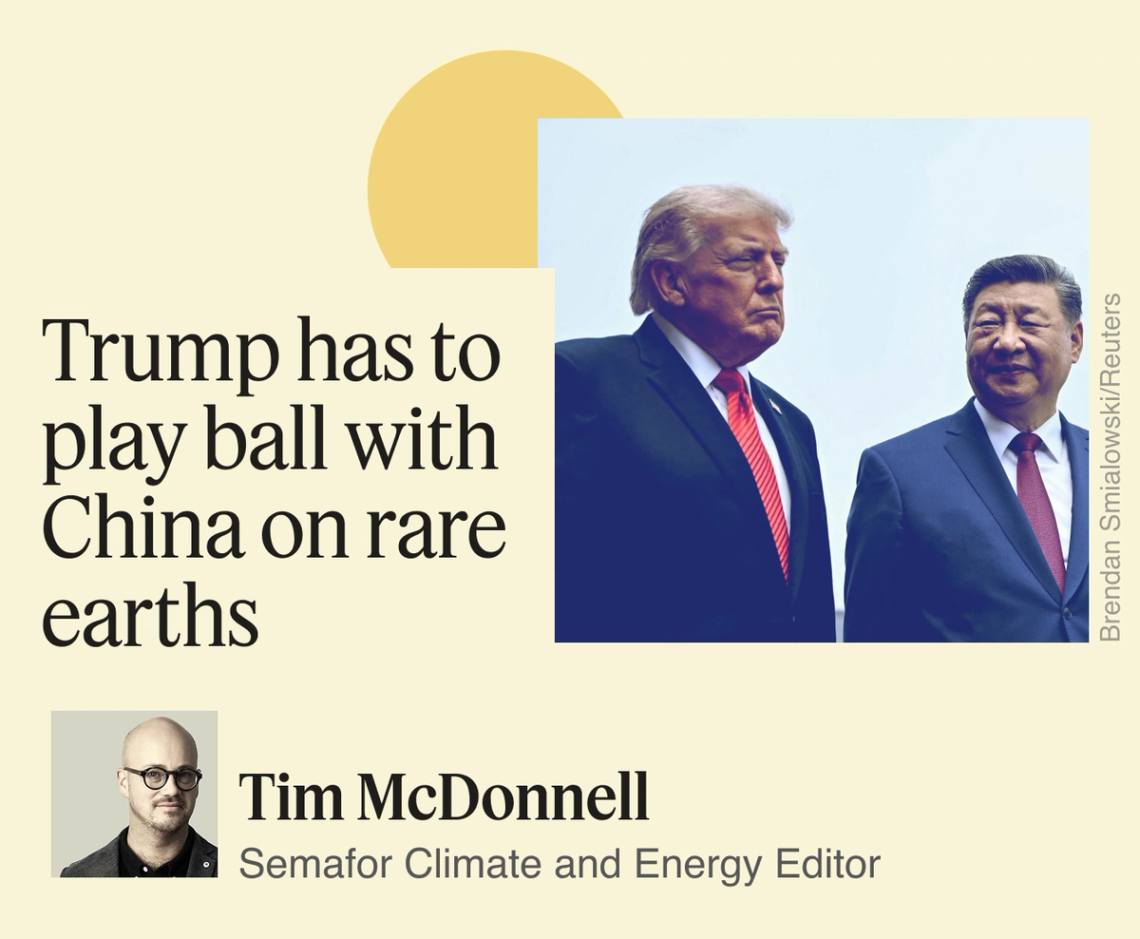 The summit this week between US President Donald Trump and Chinese leader Xi Jinping illustrates the waning power of US fossil fuel leverage. One of the key potential outcomes of the summit is a deal to extend a moratorium on Chinese export restrictions, which are now set to kick back in around the time of the midterm elections in November. Even with the exemption, Chinese export volumes for unpronounceable but irreplaceable things like yttrium and dysprosium are still way down, and prices are way up. The Trump administration is keenly aware of its rare earths Achilles heel, and has rolled out price floors, equity investments, federal stockpiling, and more — what Gracelin Baskaran of the Center for Strategic and International Studies recently called “the boldest domestic industrial policy in modern history” — to prop up new US mining companies and form new foreign trade deals that sidestep China. But given the lead times required to dig new mines, build new processing factories, and train a new generation of rare earths engineers, none of that will have a meaningful impact on the market until well after Trump leaves office. In the meantime, there’s nothing the US can do but continue to shop in Beijing. Compare that to Trump’s side of the negotiating ledger. Of course there are some things, such as the most advanced Nvidia AI chips, that China wants and only the US can proffer. But oil and gas, which are usually Trump’s trade cudgel of choice, won’t have much heft with Xi; China is well-supplied with reserves of both and has other options, including US adversaries like Russia, for getting more. The upshot is that this week, Trump needs a deal on rare earths more than Xi needs a deal on fossil fuels. And that dynamic won’t be changing anytime soon. The Trump administration “has recognized there’s a national security problem that has to be solved, and our normal processes aren’t solving it,” Barbara Humpton, CEO of USA Rare Earth, told me last month at Semafor World Economy. “But we’re not playing a game of competition against China — we’re simply playing the game of resilience.” |
|
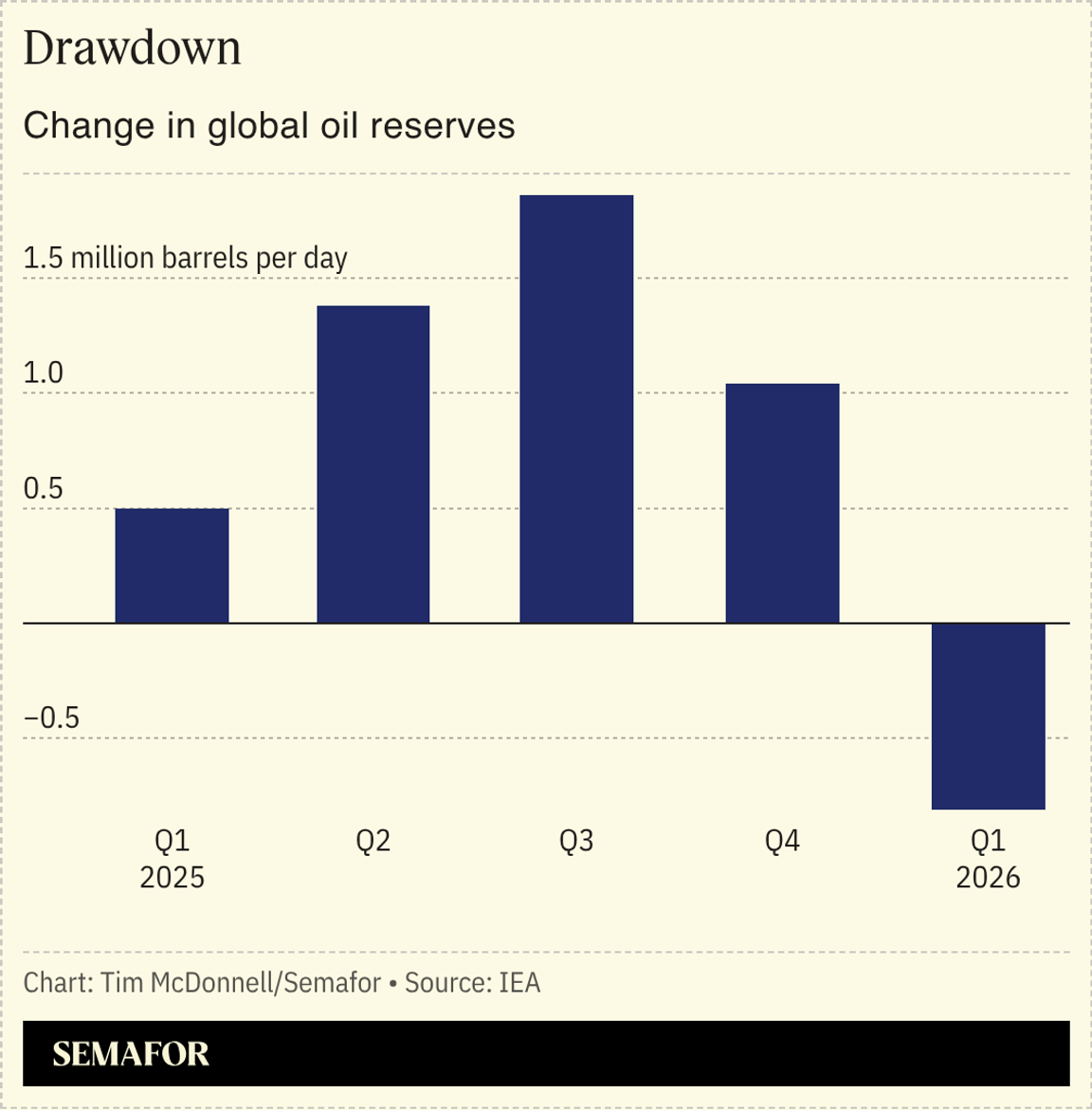 Oil prices inched up on Thursday as the market anxiously awaited any encouraging signals from the US-China summit in Beijing, while new data indicated an unprecedented drawdown of global oil reserves. Tehran cemented its grip on the Strait of Hormuz; a few more tankers managed to pass through in the last few days, albeit only by either negotiating in advance with Iran, or by shutting off their transponders and racing through. But some empty Iranian tankers are returning to port to act as floating storage vessels, a sign that the US oil export blockade could soon meaningfully curtail Iranian crude production. The rest of the world, meanwhile, is using up stored oil at a “record pace,” the International Energy Agency said; the US government reported that global reserve depletions for the full year could reach up to 2.6 million barrels per day on average, up from its pre-war estimate of 300,000. Much bigger price spikes are coming for gasoline, jet fuel, and other refined products: In addition to the shortfall of crude oil, attacks on refineries in the Middle East by Iran, and in Russia by Ukraine, have knocked out about 9% of global refining capacity. |
|
View: China’s strategic response to Iran war |
 Evan Vucci/Reuters Evan Vucci/ReutersA key part of the agenda during US President Donald Trump’s visit to China is the status of the Strait of Hormuz and how it might be reopened. For China, however, the strategic calculation may be very different to that of the US, Amena Bakr, head of Middle East Energy & OPEC+ research at global commodities data firm Kpler, writes in a column for Semafor. Beijing has looked on as Washington has become mired in a costly, open-ended confrontation with Iran. Around 40% of Beijing’s oil needs flowed through Hormuz before the war, but it has built up large stockpiles. It does not want to see a repeat of what happened in Venezuela, when the oil sector came under greater US control. Such an outcome “would represent another major strategic loss for Beijing that it is determined to avoid,” Bakr writes. However, she adds: “For China, time remains a strategic asset.” |
|
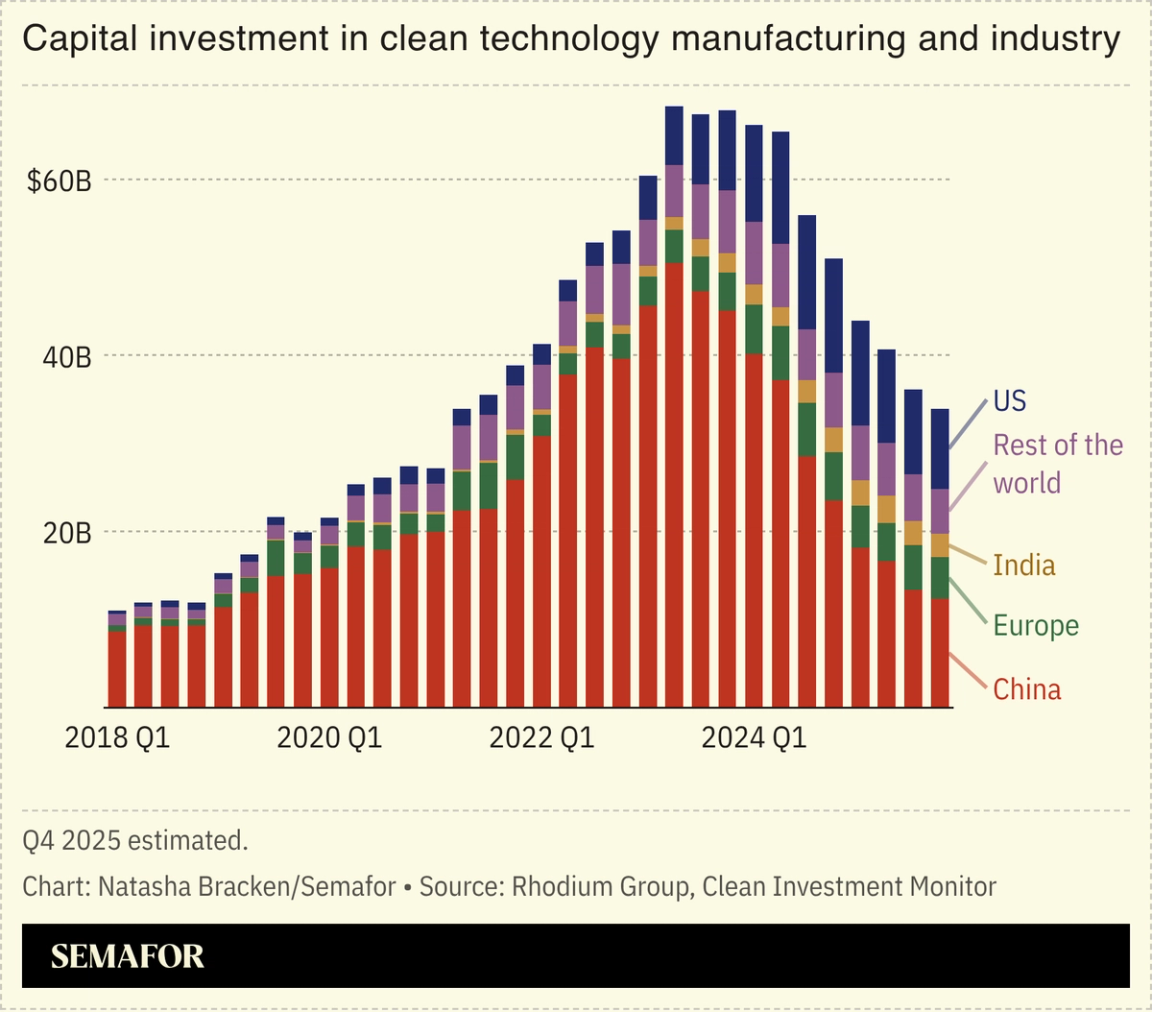 Global investments in clean technology manufacturing peaked in 2023 and have since dropped 42% to $155 billion in 2025, largely driven by huge declines in China and the US, a Rhodium Group report found. The figures can seem surprising given recent headlines of record demand for green energy as countries focus on weaning themselves off volatile fossil fuel markets. But the decline across the world’s two biggest markets has had a greater impact, though in different ways. In China, where investment has dropped nearly 70% from its 2023 peak, the fall is less alarming than it seems, the Brussels-based think tank Bruegel said, because it mostly reflects an oversupplied market from years of intense state support. That same logic doesn’t apply to the US, which also saw a decline but unlike Beijing, is experiencing it before significant planned investments have been realized and before a robust domestic market has taken hold. The administration’s rollback of the Inflation Reduction Act, clean energy tax incentives, and stricter rules on Chinese imports played a role in ultimately leading to this year’s weakest first quarter of clean tech manufacturing investment in nearly three years. Washington’s unpredictability has also pushed Beijing to pull back: Chinese companies in the green sector scrapped roughly $2.8 billion in planned US manufacturing projects last year, while more than half of proposed investments were canceled, paused, or delayed. |
|
Climate tech funding boost |
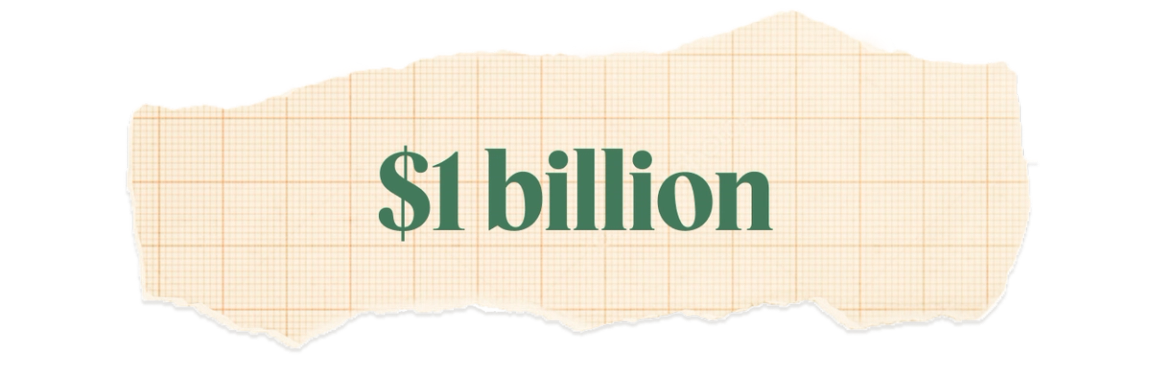 The size of a new climate tech funding round closed this week by the investment firm S2G. The new fund will focus on what the firm calls the “missing middle,” managing partner Aaron Rudberg told Semafor: Climate startups that are too big for early-stage venture funding but not yet big enough to attract private equity. And while the past few years have been a challenging time to raise capital for climate tech, the energy crisis stemming from the war in Iran has already changed that dynamic, he said: “The last few months really demonstrated a lot of structural vulnerabilities that were not previously as front-of-mind for the investment world. That’s been a great tailwind for a number of our businesses. The solutions we’re investing in move from just interesting, to really necessary.” |
|
Record protestor crackdown |
 Abubaker Lubowa/Reuters Abubaker Lubowa/ReutersA record number of people faced judicial harassment, intimidation, surveillance, and physical violence in 2025 for speaking out against businesses, a new report found — and most cases were tied to the energy sector. The Business and Human Rights Resource Centre documented nearly 800 incidents drawn from publicly available sources. Three-quarters targeted climate, land, or environmental defenders; and mining, fossil fuels, and agribusiness accounted for the highest number of cases. The single largest source of incidents was the East African Crude Oil Pipeline, a project stretching across Uganda and Tanzania led by TotalEnergies, which has drawn condemnation from local communities over forced evictions, lack of compensation, poor working conditions, and environmental degradation. In some cases, individuals were arrested and detained for taking part in peaceful protests, according to the report. Two mines tied to the clean energy transition, one in Indonesia and one in Panama, also ranked in the top five, suggesting renewables companies are “possibly repeating a lot of the same harms as fossil fuel companies,” Christen Dobson, one of the report’s lead authors, said, “because it’s still an extractivist model.” |
|
 Tom Wilson runs an insurance company in a low-trust America. That makes trust a core business issue for Allstate. “We sell trust,” he says. On this week’s episode of The CEO Signal, presented by PwC, Penny Pritzker and Andrew Edgecliffe-Johnson ask Wilson how that premise shapes the way he leads one of America’s biggest insurers. Wilson, who has led Allstate for nearly two decades, is disappointed that more CEOs are not speaking up on societal issues — but he is not calling for corporate commentary on everything. He explains the framework Allstate uses to decide when it has standing to engage, how the company connects corporate purpose to employees’ personal purpose, and why AI should force leaders to ask a harder question than how much cost they can cut: what kinds of good jobs can they create? |
|
 New Energy- The German energy company RWE announced an increase in adjusted earnings, boosted by a return to normal wind speeds across Europe.
- Geothermal energy developer Fervo Energy said it raised $1.89 billion through its enlarged US initial public offering, underscoring strong investor demand for the listing.
Fossil Fuels- Europe’s reliance on US natural gas is set to surge to a record high this year as the energy strain from the war in Iran has forced countries to turn to Washington.
- Russia revised down several oil and gas forecasts for the next three years, including on crude and gas output and exports, as the country begins to feel the effects of lower European imports and Ukrainian attacks on its energy infrastructure.
- Senegal is courting $7.5 billion in investment to develop a major gas field discovered around a decade ago that could help ease the country’s costly energy subsidies and replace imported fuels.
Finance- HSBC organized a meeting with top British banks, including Barclays, Lloyds, NatWest andSantander to discuss the mounting pressure they face from regulators and investors to disclose more information on climate risks.
Politics & Policy- EU energy ministers are discussing taxing major energy companies’ windfall profits from the Iran war this year.
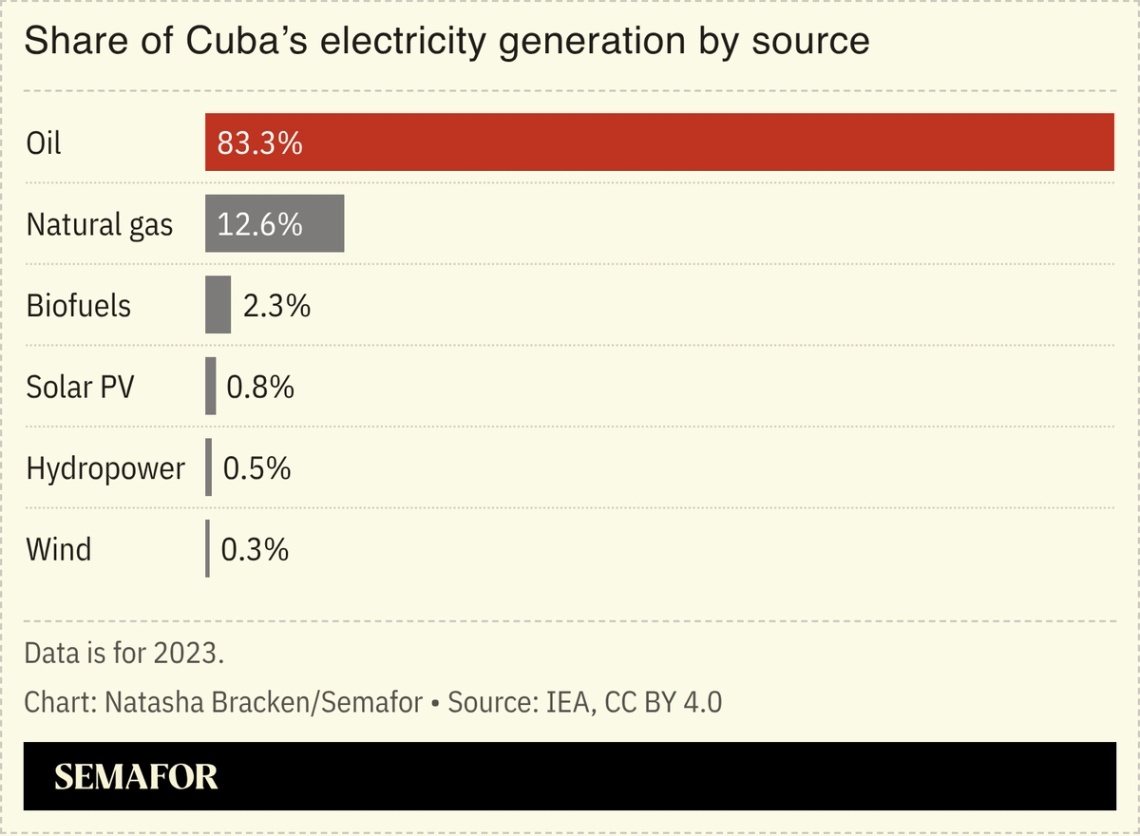
- Rare demonstrations erupted across Havana over repeated power blackouts, which have worsened since the US tightened its energy embargo on Cuba.
 |
|
|


