| | In this edition: Tinubu lambasts extractive minerals model, Kagame speaks out on US sanctions, and h͏ ͏ ͏ ͏ ͏ ͏ |
| |  | Africa |  |
| |
|
 - Tinubu wants more value
- Angola calls for investment
- Kagame shrugs off sanctions
- Transnet monopoly ends
- WhatsApp use in Nigeria
- Record protester crackdown
 Weekend Reads, and when Afrobeat meets anime. |
|
Tinubu criticizes extractive mining |
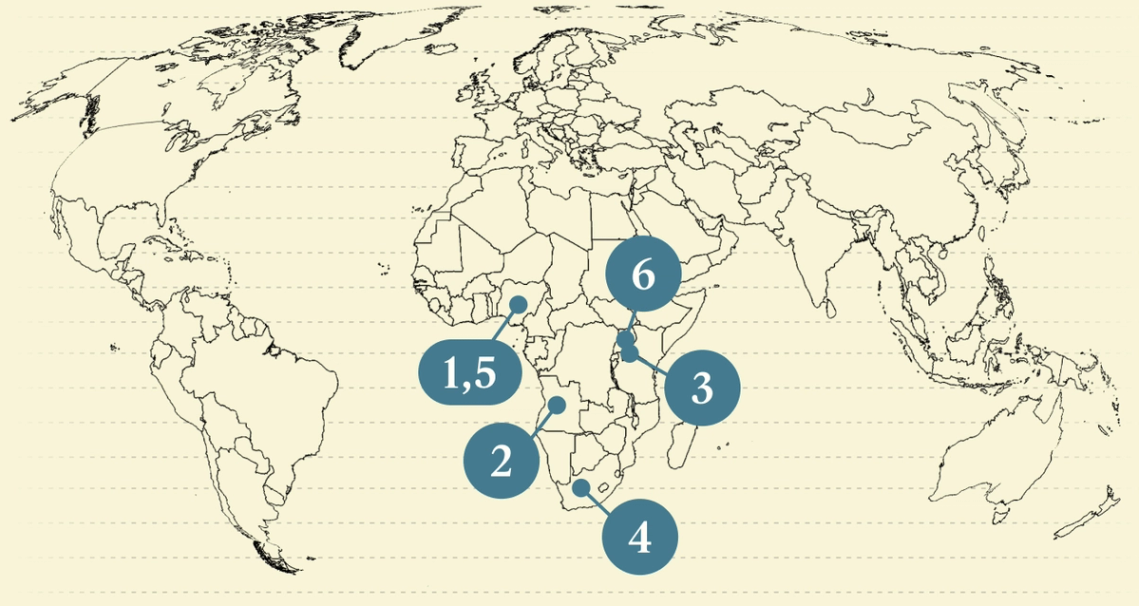
 Nigeria President Bola Tinubu and Gabon President Brice Oligui Nguema at the Africa CEO Forum in Kigali. Jean Bizimana/Reuters. Nigeria President Bola Tinubu and Gabon President Brice Oligui Nguema at the Africa CEO Forum in Kigali. Jean Bizimana/Reuters.African leaders intensified demands for foreign companies to process minerals locally rather than export raw materials, as surging critical metal demand and US-China competition increases their leverage. Nigeria’s President Bola Tinubu said his government would no longer tolerate the old extractive model: “No one can take any metal out of Nigeria without adding value,” he told the Africa CEO Forum in Kigali. Meanwhile, Gabon’s President Brice Oligui Nguema criticized opaque mining arrangements that leave his country, the world’s second-largest manganese producer, with limited visibility over what foreign companies earn from its resources. Abuja plans to set up at least two Chinese-built lithium processing plants, while Libreville has ordered operators to begin domestic processing by 2029 or risk losing concessions. The tougher rhetoric, part of a wider push across Africa to capture more value from refining and manufacturing, comes as oil and mineral producers gain leverage from commodity prices driven up by the Iran war: Oligui Nguema said he had instructed Gabon’s oil minister to raise output and capitalize on higher prices. — Yinka Adegoke |
|
Angola backs mining investment not quotas |
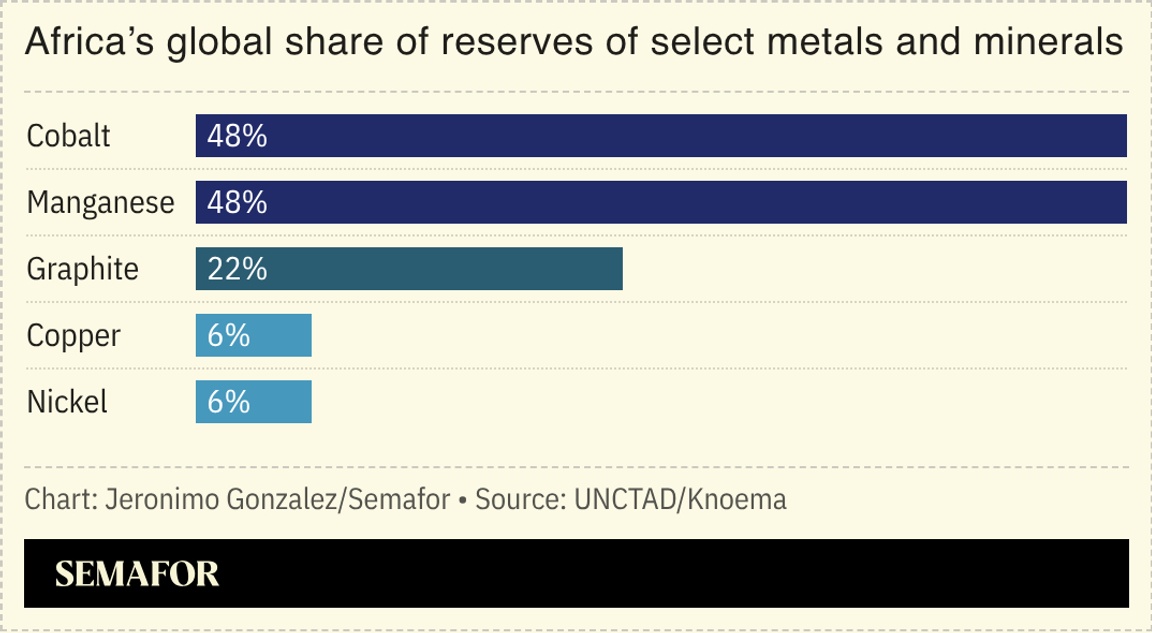 Angola does not plan to pursue punitive measures against mining companies such as export quotas or bans in order to bolster its domestic mining industry, a senior minerals minister said. Speaking to reporters in London, Diamantino Pedro Azevedo said Luanda would instead “prepare conditions to attract investment … so the private companies can come and set up factories.” The approach contrasts with that pursued by African countries such as DR Congo and Zimbabwe: They have implemented quotas on foreign sales of cobalt and an all-out ban on the export of lithium, respectively, to build up refining capacity and capture more of the value of their natural resources. Azevedo — the minister for mineral resources, petroleum, and gas — also said his country was pursuing a minority stake in De Beers that is sizable enough to win a seat at “the table, because we want to have [input on] the strategy.” Angola and Botswana have separately sought to acquire Anglo American’s shares in the diamond giant, though Botswana said in November it was taking “concrete steps” to acquire a majority stake. — Prashant Rao |
|
Kagame shrugs off US sanctions |
 Rwanda’s President Paul Kagame speaks during the Africa CEO Forum in Kigali. Jean Bizimana/Reuters. Rwanda’s President Paul Kagame speaks during the Africa CEO Forum in Kigali. Jean Bizimana/Reuters.Rwandan President Paul Kagame said US sanctions imposed on his military will not alter Kigali’s stance over eastern DR Congo, dismissing the restrictions as a cost of pursuing national interests. In March, Washington sanctioned Rwanda’s defense forces and several senior officials, accusing them of funding the M23 rebels who have taken over mineral-rich areas of eastern DR Congo. The US cited violations of a Washington-brokered ceasefire arrangement and said Rwanda was fueling instability. “I never capitulated in the worst situation,” Kagame told executives and policymakers at the Africa CEO Forum in Kigali. “In a way we are hurt but I think we would be hurt more by not doing what we are doing.” Rwanda has said its involvement in DR Congo is aimed at countering the FDLR, a militia founded by the perpetrators of the 1994 genocide of Tutsis by Hutus. Kinshasa and UN investigators accuse Kigali of providing direct military support to M23, a charge Rwanda denies. — Tiisetso Motsoeneng |
|
  Brendan Smialowski/Reuters. Banner credit: Andrew Caballero-Reynolds/AFP via Getty Images Brendan Smialowski/Reuters. Banner credit: Andrew Caballero-Reynolds/AFP via Getty ImagesOur coverage brings together reporting and analysis on how the summit will shape energy markets, business, policy, and the broader US-China relationship. With US and Chinese leaders meeting at this week’s summit, Semafor’s newsroom breaks down what’s at stake — from the durability of Trump’s China deals, to Washington’s rare earths Achilles’ heel, to Beijing’s wider geopolitical calculus. |
|
Transnet monopoly ends in South Africa |
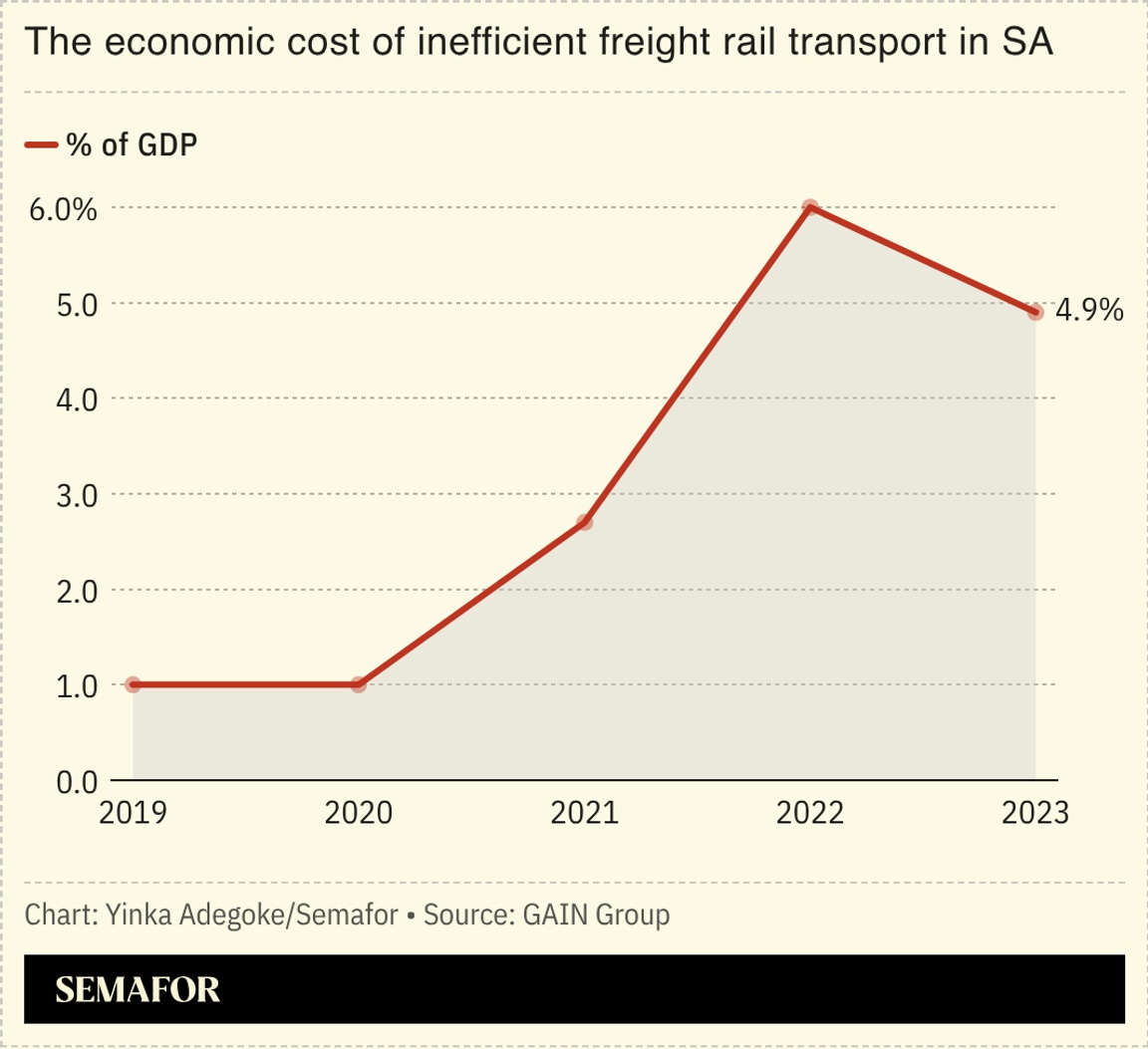 South Africa granted 11 private companies permission to operate trains on the national rail network for the first time in more than a century, a move aimed at boosting mineral exports and easing financial pressure on state-owned Transet after years of operational crisis. Transnet’s sprawling collection of railways, ports, and pipelines have made it a critical player in Africa’s biggest economy. But more than a decade of decay and corruption scandals have created an infrastructure chokepoint. South Africa hopes the new approach — which allows private companies to run the national network under a regulated slot system —- will reverse that decline. Transnet officials called it a “game changer,” allowing operators such as Geneva-based shipping firm MSC and Africa’s largest shipping company Grindrod to respond to growing global demand for the continent’s raw materials. — Tiisetso Motsoeneng |
|
How WhatsApp is being used by women |
 Lfredo Zuniga/AFP via Getty Images Lfredo Zuniga/AFP via Getty ImagesNearly 60% of self-employed women in Nigeria use WhatsApp to earn an income, the highest rate across four countries surveyed in a new study. Around 1 in 6 working-age women across India, Kenya, Nigeria, and Pakistan use WhatsApp to support their livelihoods, the research from consultancy group Caribou found. One explanation for Nigerian women’s higher adoption was that the country’s ecosystem of small-scale retail, services, and home-based production “aligns well with WhatsApp’s strengths as a communication-first tool,” the report found. But access barriers remain, including a lack of internet-enabled devices and data costs. A second divide — where higher-income women tap into growth opportunities on WhatsApp more effectively — could potentially be closed through AI, said Jonathan Donner, a co-author of the report. We need to “intentionally build AI systems to support women all across the income stack,” he said, “helping women become more visible” in domestic and international markets. — Preeti Jha |
|
East Africa pipeline in crosshairs |
 Abubaker Lubowa/Reuters. Abubaker Lubowa/Reuters.A record number of people were attacked for speaking out against businesses in 2025, a new report found, with the single largest source of incidents linked to the East African Crude Oil Pipeline. The TotalEnergies-led project, which stretches across Uganda and Tanzania, has drawn condemnation from local communities over forced evictions, lack of compensation, poor working conditions, and environmental degradation, the Business and Human Rights Centre found. In some cases, individuals were arrested and detained for taking part in peaceful protests, according to the report. BHRC researchers, who documented nearly 800 incidents drawn from publicly available sources, also found two mines linked to the clean energy transition — one in Indonesia and one in Panama — ranked in the top five. This suggested renewables companies are “possibly repeating a lot of the same harms as fossil fuel companies,” said Christen Dobson, one of the report’s lead authors, “because it’s still an extractivist model.” A version of this item first appeared in Semafor’s twice-weekly Energy briefing. Subscribe here. → |
|
|
 - Sudan’s civil war is increasingly destabilizing neighboring Chad, threatening to turn a regional crisis into a wider Sahel security emergency, argues a former White House Africa official. The conflict is placing growing pressure on President Mahamat Idriss Déby’s government through refugee flows, cross-border violence, and competing foreign interests, writes Cameron Hudson for World Politics Review. It also raises fears that a destabilized Chad would create a security vacuum that neither Western powers nor regional actors are prepared to fill.
- A feature by AFP explores how the British football team Arsenal became “Africa’s club.” In 2002, Arsenal became the first team to name nine Black players in a Premier League starting lineup, going on to rack up many victories. “(They) looked like me... that was why I chose Arsenal,” Kenyan influencer Nana Owiti, who has millions of followers across her Arsenal-obsessed social media feeds, tells the agency. The late Kenyan politician Raila Odinga was also known to be a passionate fan, while Rwanda sponsored the club in an eight-year deal ending this season.
- When Nigerian government funding dried up in the 1990s, unemployed actors and crew shot films at home.” The creative hustle of that defining era,” writes the LA Times, helped push Nollywood to become second only to India in the number of films it produces. While streaming services like Netflix leapt at the opportunity to fund Nigerian films when they entered the country in 2016, financing for original content has petered out since 2024. Growing the international market for Nollywood films is key to the next phase of growth, experts tell the paper.
- Traditional media in parts of Africa is increasingly being eschewed for news and current affairs influencers on social media. In Nigeria, 61% of people said that they paid attention to news creators, while in Kenya the figure was 58%, compared to 54% in the US and just 39% in the UK, according to the Reuters Institute’s latest Digital News Report. “When they watch us, it’s like they’re watching their cousin, their sister,” one Kenyan creator tells The Guardian when asked about her appeal to young people, “compared to traditional media where everything is so serious.”
- Human rights in Africa cannot be safeguarded without reforming the architecture of global finance, argues a UN expert. “Rights require money,” Attiya Waris, the UN independent expert on foreign debt and human rights, writes for Aeon magazine. Ensuring that people have freedom of movement or the right to access healthcare requires funds, she argues, yet colonial-era debt servicing, aid programs, and illicit money flows inadvertently work against the continent.
|
|
|


