
|


 |
Drone warfare has been a fascination of mine for a very long time. When I read Daphne du Maurier’s “The Birds” as a kid, I imagined what would happen if the attacking swarms were mechanical birds, controlled with AI. When I read about Japanese kamikazes in WW2, I reasoned that someday we’d have drones do the same. In 2013, I wrote a post about the advent of drone warfare that’s still probably the most prophetic thing I’ve ever written. It simply made sense that if we could create AI-controlled swarms of exploding artificial insects, then as long as they had enough battery power to sustain themselves over long flights, they’d be an unstoppable weapon.
Thirteen years later, my imagination has mostly become reality. Batteries have gotten good and cheap enough to sustain long drone flights, and AI has gotten good enough to guide drones to their targets (and, often, to select the targets in the first place). All we need now to fulfill my vision is for AI to start autonomously directing large numbers of drones in concert. That’s coming very soon.
The Ukraine War isn’t the first war in which drones are proving decisive — that would be the Second Nagorno-Karabakh War in 2020 — but it’s the war in which drones have truly come into their own. Ukraine’s intensive use of drones has allowed them to inflict casualty rates as high as 5 to 1 on the Russian army in recent months, while giving up little or no territory. Around 96% of those casualties are estimated to be caused by drones. In just the past year, Ukraine went from using just a few thousand FPV drones per day to using around 60,000.
You can read lots of stories about how drones represent a revolution in military affairs; the recent Carnegie Endowment piece is a good one, as is the slightly older one by the Army University Press. But to really viscerally understand how deeply things have changed, you have to watch videos from the war. Here is a montage of drone strikes in Ukraine, including a terrifying final sequence where a drone flies into a Russian barracks and destroys it. It’s difficult stuff to watch, but if you want to understand the changes that have come to modern warfare, you have to see it.
The age of the human infantryman is rapidly drawing to a close. Simply surviving an FPV drone attack has become an almost impossible task for soldiers on the battlefield. The drone cordon has not yet become so airtight that territory can be held without humans, but these humans’ job is to hide out in dugouts for months at a time alone or in tiny groups, terrified of emerging above ground lest they be instantly droned. And ground robots are developing very quickly, to the point where assaults can sometimes be conducted without humans on the front line at all.
Drones are also slowly replacing bombers and missiles as a modern military’s primary tool for conducting long-range strikes. Russia has been pounding Ukrainian cities with Iranian-made “Shahed” drones for years, but Ukraine is now fighting back. Ukrainian drones regularly destroy Russia’s oil infrastructure and military supply lines. And Moscow was just hit by over 1000 Ukrainian drones, causing widespread damage and chaos:
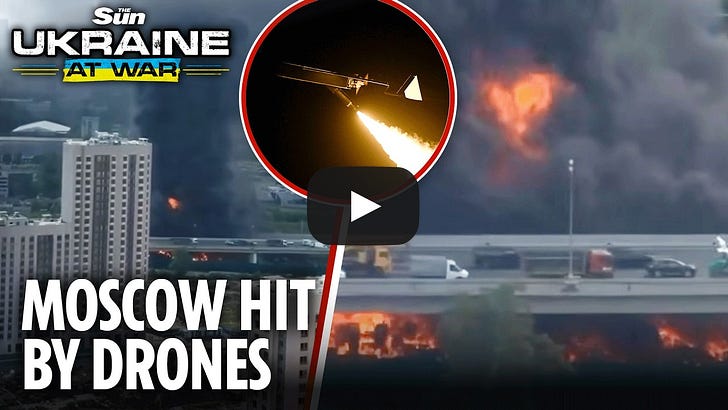
To understand the changes that drones are bringing to modern warfare, I went on the Latent Space podcast with Yaroslav Azhnyuk, founder and CEO of The Fourth Law, one of Ukraine’s most important drone startups. Here’s the video and the transcript:


And here’s a YouTube version, if you prefer:

My interview with Azhnyuk clarified exactly why drones are in the ascendant as the universal modern weapon of war. The reason is cost. Drones are simply so cheap to produce in huge numbers that they can overwhelm any more expensive system.
Here’s Azhnyuk:
The CEO of Rheinmetall, recently sort of ridiculed [the] Ukrainian drone industry, saying that…there is nothing interesting there, no real innovation…One of the best quotes I heard on this topic is from my friend Alexey Babenko, who’s the head of and founder of VIARI Drone, which is one of the largest manufacturers of FPV drones. They’re our partner. They’re using our autonomy. So he said that the drones we manufacture in one day will be more than enough to destroy all the tanks Rheinmetall manufactures in a year…Cost-wise, of course, a drone is like, $500 and a Rheinmetall tank is what, probably 5 million-ish or maybe more…
An artillery shell for 155 caliber…is about $4,000 per piece. So compare that to say, $400 per drone. That’s 10 times more expensive. Account for the amortization of the artillery gun and for how vulnerable it is and what is the sort of tactical capabilities it gives you as compared to a drone. You’ll figure out that an FPV drone is maybe three orders of magnitude, more versatile, more useful, more capable than artillery…Basically, I think a good way to think about an FPV drone is like an iPhone of warfare. [emphasis mine]