the deadliest drug
Drinking while pregnant more common than believed
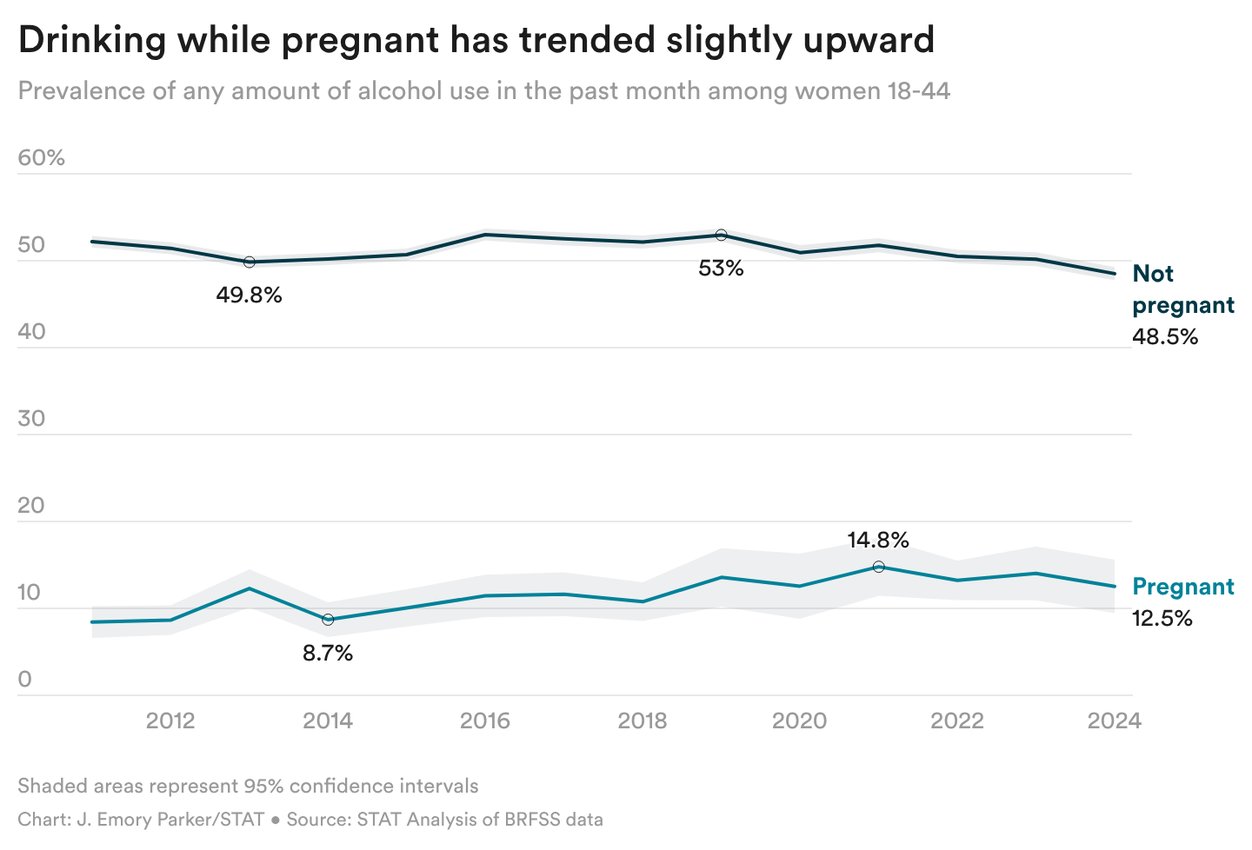
The first U.S. public health advisory on drinking during pregnancy was issued in 1977. Since then, rates of alcohol use among pregnant people have dropped steeply — for the most part. In the last decade, those rates have actually started climbing. By 2024, more than 1 in 8 pregnant adults reported drinking in the last month. In the latest installment of The Deadliest Drug, STAT’s Isabella Cueto lays out the findings of an original STAT analysis on drinking and pregnancy data from 2011 to 2024.
“How can something be so common and nobody’s talking about it? It blew my mind,” said Vincent Smith, who helps lead a neonatal intensive care unit in Boston.
While scientists and health experts understand the wide range of harms that can come from exposure to alcohol in the womb, it’s less clear how much alcohol it takes to cause those harms. It’s in that zone of opacity where things seem to get especially complicated. Read more from Cueto on data and attention gaps, the difficulty of getting a diagnosis for fetal alcohol spectrum disorders, and the cultural conversations around “light drinking.”
public health
More kids with autism are getting leucovorin
Since last spring, leucovorin prescriptions among children with autism have skyrocketed, according to a study published yesterday in JAMA Network Open. Federal health officials and President Trump first promoted the generic drug as a potential treatment for autism in September. Prescription rates were already increasing at that point in the wake of a CBS report on the drug, but the government’s spotlight brought even more attention to the drug.
While previous studies found that prescriptions for children generally increased, the new paper used large-scale Epic systems data to look at trends specifically among children with autism diagnoses. In 2023 and 2024, monthly leucovorin prescription rates among kids with autism held steady at 34 orders per 100,000 clinical encounters. That rose to 335 per 100,000 in August 2025, and all the way to 835 in November.
FDA officials have since walked back statements about the drug’s potential and acknowledged the limited evidence around both efficacy and safety. Still, prescription rates in early 2026 remained high.
first opinion
Haunted by a ‘ghost approval’
Heart transplant recipient Payton Herres has health insurance on paper. But in real life, she’s living in what she calls a “ghost approval.” This means that the medication she needs to make sure her body doesn’t reject the transplant is technically approved or covered, but she still has trouble getting it.
There’s always a reason for the difficulty: The drug needs prior authorization, or has to go through a specialty pharmacy, or, most common for her, it’s not FDA-approved for that exact use.
“That’s why I started using the term ‘ghost approval,’” Herres writes in a new First Opinion essay. “Because that’s what it feels like — something that exists enough to be referenced, but not enough to actually rely on.” Read more about her experience, which includes seeking help from places like Facebook and people like Mark Cuban.