
|
 |
Good afternoon, and welcome back to Press Pass. It’s officially shorts weather (or seersucker weather, if you’re on Capitol Hill). Dress for the temps and keep your mind cool too by staying up to date with a Bulwark+ membership. This week only, members of our free list can upgrade for half off. This is not a normal sort of deal for us, so give it a quick think and hit the button if you’re ready to provide key support for our independent journalism while also getting access to everything we produce:
Before we get started, I have a request for our Bulwark community. Have you contacted your senators or congressional representative about the January 6th slush fund and received an official response from their office in writing? If so, I’d love to take a look at it. You can email info@thebulwark.com or pass it along securely and privately through our confidential tip line. We will protect your anonymity.
Today’s edition offers a little bit of optimism, as a treat. Republicans—yes, you read that right: Republicans—in both the House and the Senate are publicly criticizing and even directly opposing the Trump administration’s attempt to create a large, taxpayer-funded payout system for January 6th rioters. While it’s easy to write off their statements as bluster, the backlash they have elicited from party leadership has stopped all forward progress for one of the GOP’s top legislative agenda items for this year.
In addition, over the weekend, a member of the Libertarian party proposed dress and grooming standards for their national convention. You can guess how mandating a dress code for a gathering of Libertarians worked out, but you don’t have to, because I will tell you. Lastly, if you care about how AI is reshaping our world and economy, consider reading the first encyclical from Pope Leo XIV. All that and more, below.
Why You Should Be Optimistic That Opposition to Trump’s Slush Fund Will Prevail
Lawmakers from both parties are pushing a ban on taxpayer money going to Jan. 6th payouts
|

| ||||||||||||


 |
Keep Ya Head Up
President Donald Trump’s “settlement”¹ with his own Department of Justice to establish a fund to disburse completely unaccountable payments to pardoned January 6th rioters and others who claim to have been unfairly investigated and prosecuted by the federal government has met significant opposition in Congress. Even Republican lawmakers have spoken out publicly against it. The situation has gotten bad enough that regular legislative business has gotten jammed up.
Intense intraparty disagreements over the slush fund derailed Republicans’ own plans to vote on a series of proposals for their upcoming reconciliation bill last week. During a conference lunch on Thursday in which acting Attorney General Todd Blanche sought to address lawmakers’ concerns, dozens of Republican senators spoke up—many more than usual—according to a source in the room. It seems as though their concerns were not addressed to their satisfaction: Lawmakers ultimately left town without finishing the week’s business.
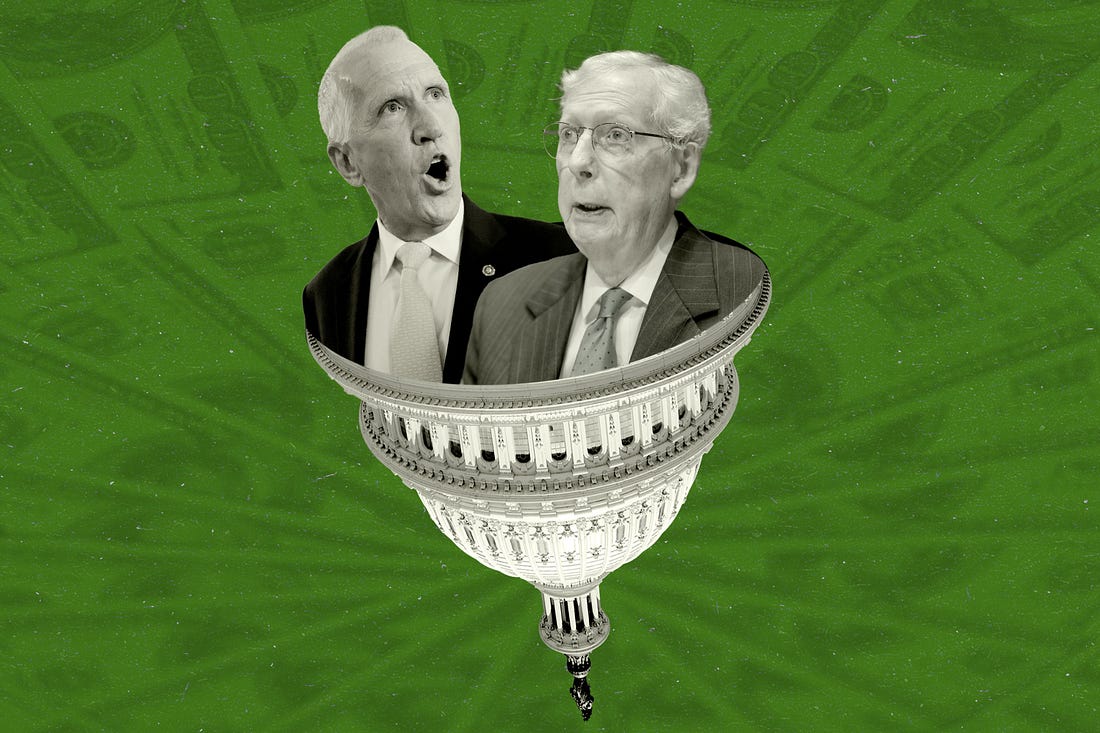
“These people don’t deserve restitution. Many of them deserve to be in prison,” Sen. Thom Tillis (R-N.C.) told reporters Thursday. “But this is just stupid on stilts.”
“They need to speak up,” Tillis said of his Republican colleagues who’ve opposed the settlement in private. “I mean, this is beyond the pale. This is not good for my colleagues. There’s not one positive thing that could be spun out of this between now and November. This is bad policy, it’s bad timing, and it’s bad politics.”
“So the nation’s top law enforcement official is asking for a slush fund to pay people who assault cops?” Sen. Mitch McConnell (R-Ky.) said in a statement.² “Utterly stupid, morally wrong—Take your pick.”
In the House, where Republican opposition to the fund is weaker and more diffuse, Reps. Brian Fitzpatrick (R-Pa.) and Tom Suozzi (D-N.Y.) introduced a bill that would ban the use of federal funds for Trump’s “anti-weaponization” fund.
Fitzpatrick and Suozzi co-chair the Problem Solvers Caucus, the long-dormant bipartisan collective whose stated goal is, well, solving problems. And the government shoveling huge piles of taxpayer money into the beds of more than a thousand pardoned convicts' Dodge Ram 2500s might be just the sort of problem they are well positioned to solve.
“It’s really up to the Republicans to join with the Democrats. Everybody knows this is wrong,” Suozzi told ABC’s Jonathan Karl on Sunday. “That’s the purpose of the checks and balances in government, so that [when] one branch of government does something stupid or wrong, the other branch holds them accountable.”
While many share broader concerns about corruption and the precedent that would be set by the creation of such a fund, the primary sticking point about it on Capitol Hill is whether money will go to any of the hundreds of individuals convicted of assaulting police officers.
In response to a question about concerns that violent rioters would be eligible to receive money from the fund, Blanche told CNN, “People that hurt police get money all the time.”
The Fitzpatrick–Suozzi bill would effectively kill the president’s plan to compensate the rioters and criminals he pardoned hours after being sworn in for his second term. Unlike a number of popular pieces of legislation that have been brought up through the discharge petition process in defiance of House Speaker Mike Johnson over the course of this Congress, though, the anti-anti-weaponization fund bill may struggle to reach the threshold of the 218 votes required to override chamber leadership and force a vote.
While many of the successful discharge petitions have been direct rebukes of Trump’s policies and stated positions—notably the Massie–Khanna bill mandating the release of the Epstein files and the recent package of additional military aid to Ukraine, which will come up for a vote soon—those bills have also touched on key areas of interparty frustration. Johnson’s habit of slow-walking any legislation that isn’t a favor to Trump has inflamed tempers among both moderate³ Republican and Democratic members.