| | In this edition: Kenya halts US Ebola center plan, South Africa’s central bank raises main interest ͏ ͏ ͏ ͏ ͏ ͏ |
| |  Nairobi Nairobi | Addis Ababa | Accra |
 | Africa |  |
| |
|
 - Ebola outbreak fears grow
- Kenya bars US Ebola center
- South Africa’s rate hike
- Visa costs investigated
- Ex-VP joins election race
- Weekend Reads
 Africa’s tallest building nears completion. |
|
Authorities race to fight Ebola |
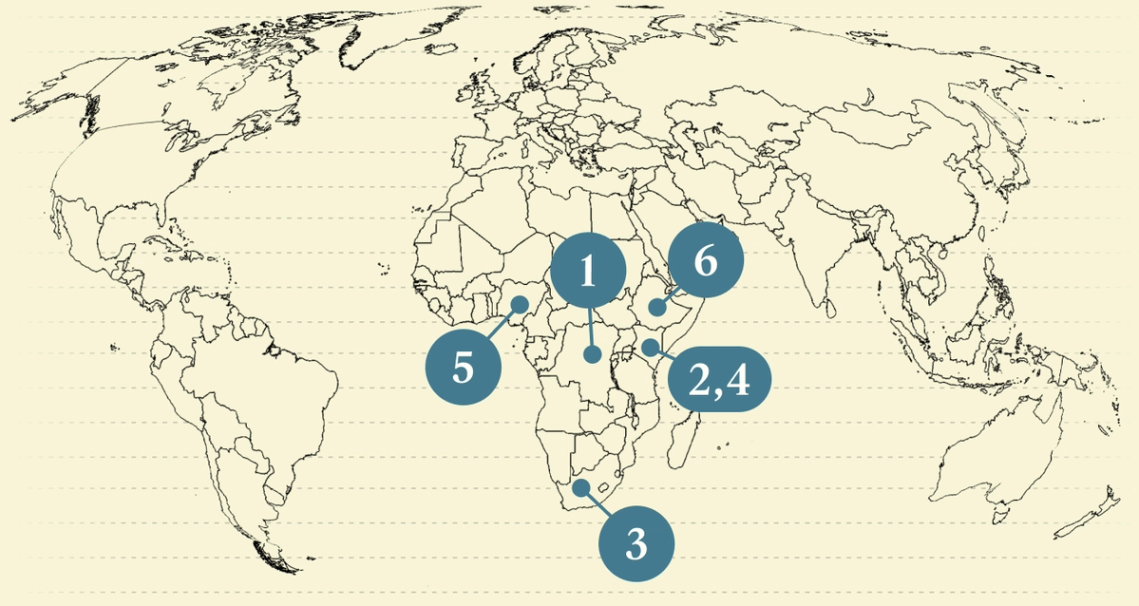
 The Biovac vaccine manufacturing facility in Cape Town. Misha Jordaan/Gallo Images via Getty Images. The Biovac vaccine manufacturing facility in Cape Town. Misha Jordaan/Gallo Images via Getty Images.African health authorities insisted the Ebola outbreak on the continent could be stopped and promised a vaccine would be ready by year-end, even as a top former US health official said the epidemic could be the worst ever. More than 200 deaths and nearly 1,000 cases have been recorded, though the World Health Organization said those were likely undercounts. Combatting the outbreak has been complicated: The virus strain is new, and the epicenter of the outbreak in DR Congo is the site of fighting between multiple groups. “This is on track to potentially be as bad as the [2014] West African Ebola outbreak if not worse,” a former US health security official told Semafor. Uganda closed its border with DR Congo on Wednesday and efforts are underway to mobilize funds to pay for health supplies. The director-general of the Africa Centres for Disease Control told a virtual press conference that almost $500 million had been pledged on Monday by the body’s partners to support the fight against the outbreak but that figure fell to around $290 million after a number of donors changed their minds. |
|
Kenyan court blocks US Ebola center |
| |  | Martin K.N Siele |
| |
 Health workers screening for Ebola in eastern DR Congo. Stringer/Anadolu via Getty Images. Health workers screening for Ebola in eastern DR Congo. Stringer/Anadolu via Getty Images.A US plan to establish an Ebola quarantine facility in Kenya for Americans exposed to the virus is facing mounting legal and political resistance. A Kenyan court temporarily barred the agreement this week after rights groups and medical unions challenged the proposal, arguing it posed public health and constitutional risks. The Trump administration had backed the Kenya facility as part of a strategy to prevent infected Americans from being flown back to the US, while pledging $13.5 million toward Kenya’s Ebola preparedness efforts. Opposition to the plan has united lawyers, doctors’ associations, and civil society groups, who argue the agreement was negotiated with little public scrutiny. Critics say the proposal could expose Kenyan health workers and local communities to unnecessary risks by turning the country into a holding ground for foreign patients during a regional health emergency. |
|
South Africa hikes key rate |
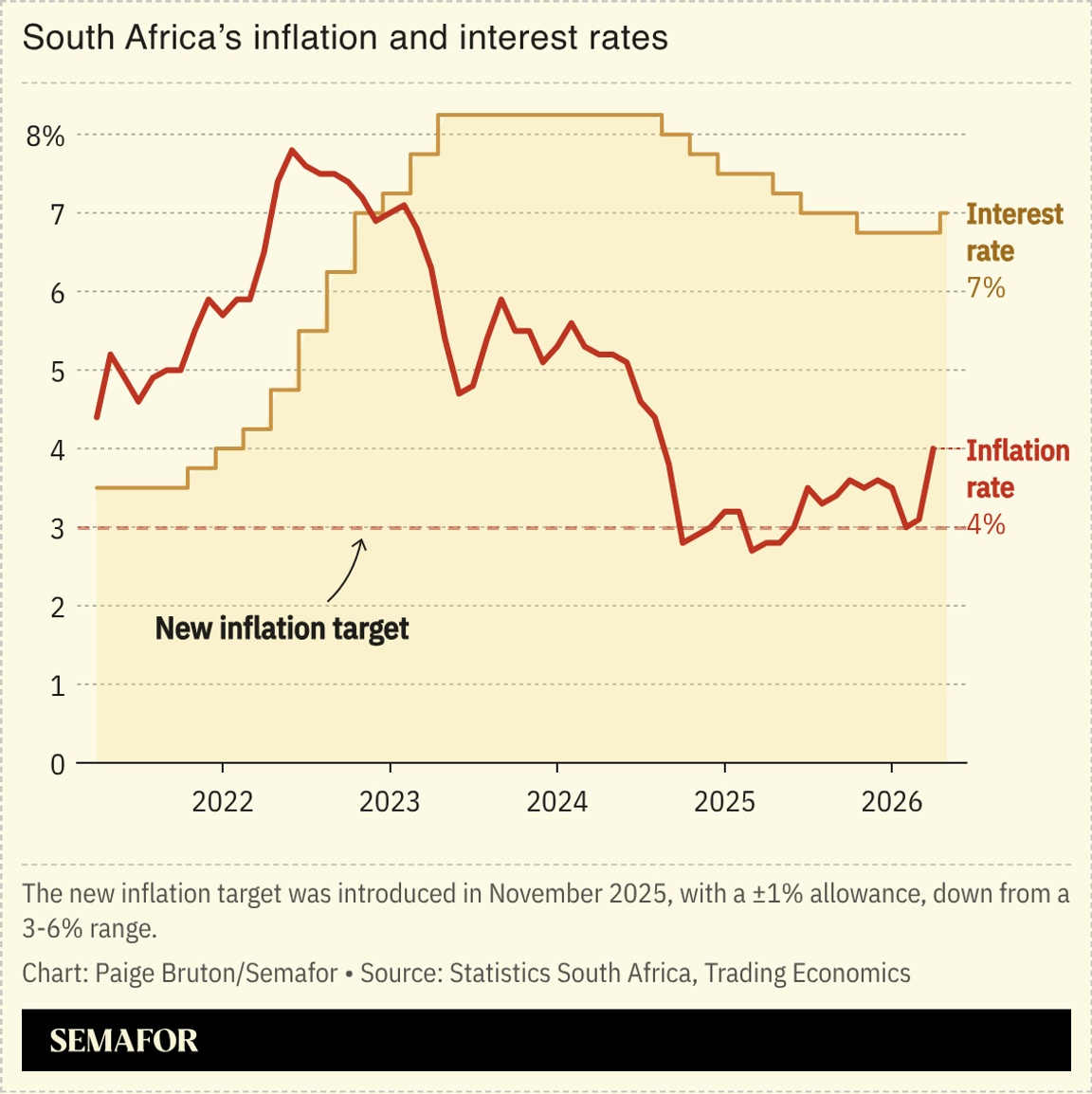 South Africa’s central bank raised its benchmark interest rate for the first time in three years, in effect blunting a $1 billion fuel relief package designed to soften the blow of surging oil prices. The move positions South Africa at the vanguard of a small group of emerging markets hiking rates to cushion the impact of the Iran war upending global supply chains. Policymakers voted 4-2 to lift the repo rate by 25 basis points to 7%, with Governor Lesetja Kganyago telling reporters in Pretoria that the bank was prioritizing its newly codified 3% inflation target over a fragile domestic recovery. Ghana, Kenya, and Nigeria — like South Africa — had been easing monetary policy before the conflict broke out, but chose to hold their lending rates steady in recent weeks. The South African central bank’s widely expected decision potentially sets up friction with politicians who want to show voters set to go to the polls in November’s local elections that they are easing the cost of living — a goal they thought they achieved last month when they rolled out a $1 billion tax cut at fuel pumps. — Tiisetso Motsoeneng |
|
Africans boost visa agency profits |
| |  | Alexander Onukwue |
| |
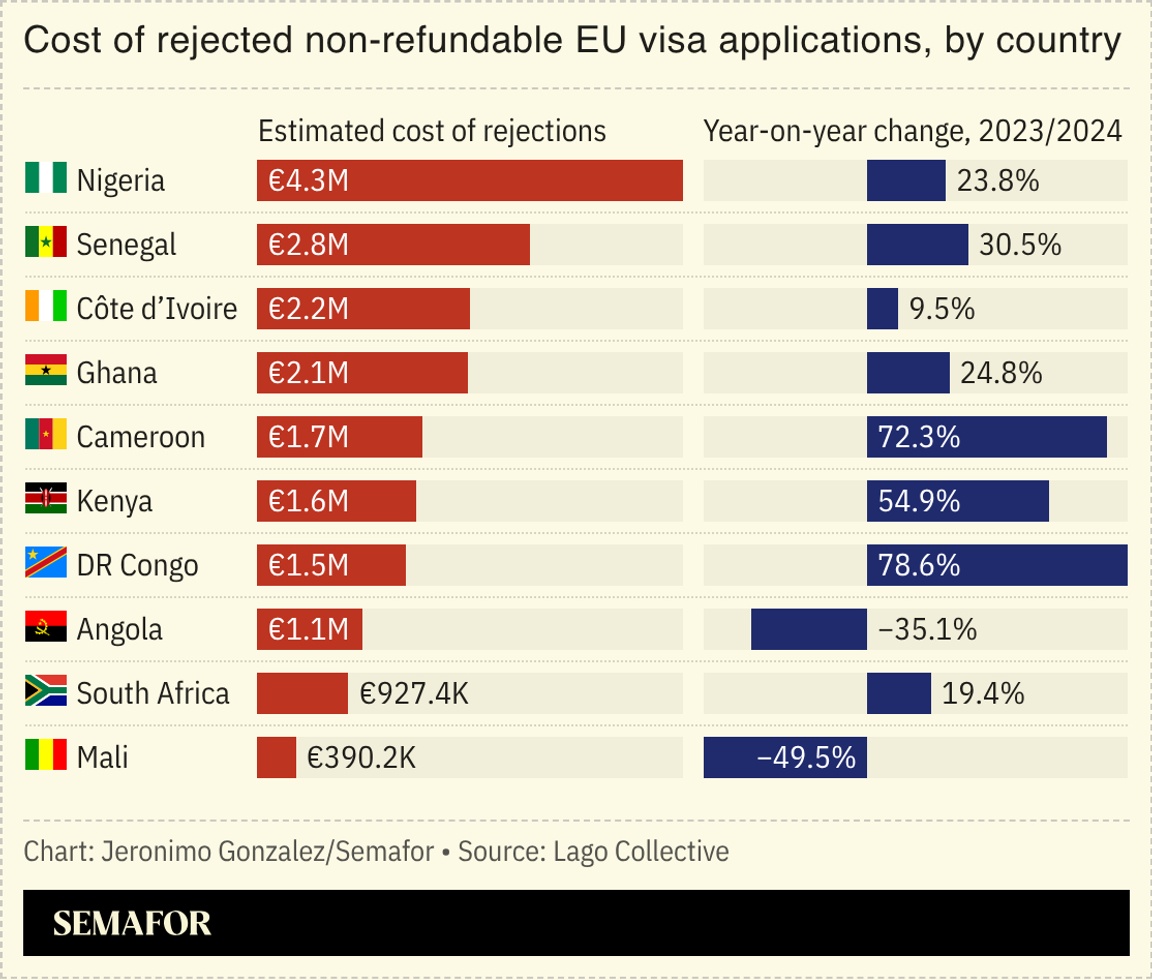 VFS Global, a multibillion-dollar outsourcing agency used by European countries to process visa applications in Africa, has amassed millions of dollars in profits from services that are often sold without proper disclosure to applicants, a new investigation alleges. The company, majority-owned by US asset manager Blackstone, is the top processor of visa applications for EU countries and the UK. Agency staff in Ethiopia, Kenya, and Nigeria who gave information to nonprofit investigations group Lighthouse Reports, said they were trained by VFS Global to include charges for ancillary services such as SMS updates, courier return services, and access to premium lounges. But they often ended up doing so without applicants’ consent, the investigation found. Lighthouse Reports found charges for these services increasingly make up VFS Global’s revenues: Its operating profit rose fourfold between 2017 and 2024 to $200 million on account of the sale of these services, despite visa applications only growing by 15% in that period. VFS Global said suggestions tying its financial growth to improper conduct were “false” and that visa applicants were “clearly informed” of “optional” value-added services. |
|
Atiku wins Nigeria election nomination |
 Nigerian Vice President Atiku Abubakar. Pius Utomi Ekpei/AFP via Getty Images. Nigerian Vice President Atiku Abubakar. Pius Utomi Ekpei/AFP via Getty Images.Former Nigerian Vice President Atiku Abubakar won his party’s nomination to challenge President Bola Tinubu in January’s elections in which the latter is seeking a second term on the back of a three-year economic revamp. Abubakar, who is commonly referred to as Atiku, scored 29% of the vote in 2023 to finish second and has sought the Nigerian presidency on six previous occasions. He will represent the African Democratic Congress, a party that he and other leading opposition figures adopted over the past year to present a unified candidate against Tinubu. That mission has floundered in recent weeks with the departure of politicians who were key to the coalition agreement. Among them is Peter Obi, who like Atiku was a candidate in the last election. Obi joined the newly formed Nigeria Democratic Congress and is expected to be named its candidate following primaries on May 29, ensuring a repeat of the 2023 race with the same top candidates, a scenario that could split the opposition vote in Tinubu’s favor. — Alexander Onukwue |
|
 - Nigeria’s inflation crisis is perhaps best understood through the rising cost of a pot of jollof rice — a staple that has become a shorthand for the country’s cost-of-living squeeze. Cheta Nwanze of SBM Intelligence argues in an essay that President Bola Tinubu’s fuel subsidy removal and currency liberalization policies may have been economically necessary, but were introduced into an economy still crippled by weak agricultural productivity, insecurity, and broken supply chains. The result, he writes, is that ordinary Nigerians are bearing the brunt of reforms through rapidly escalating everyday costs and a constant recalculation of what survival requires.
- The East African approach to elite long-distance running often seems worlds apart from what pertains in Western countries: Training centers in the West are data-driven and based around highly personalized sessions, while in Ethiopia, training is usually much more intuitive and collective; athletes almost always train as a group, and timings and distance in sessions are often not fixed, Aeon magazine writes. However, both approaches focus on an ideal that may seem counterintuitive: restraint. “Both methods are themselves ‘checks’ on an individual’s maladaptive tendencies to push too hard or not hard enough — one is social, and one is technological,” Aeon argues.
- As Ethiopians prepare to vote next week, Prime Minister Abiy Ahmed appears headed for another dominant victory — but questions about the country’s democratic future are growing louder. One recent analysis by The Conversation argues that debates over term limits miss the deeper problem: Ethiopia’s institutions remain too weak to constrain executive power. The Economist warns that Abiy’s increasingly centralized, almost “imperial” vision risks deepening ethnic tensions and instability, even as he promises economic renewal and national unity. With conflict still simmering in parts of the country, the election looks less like a democratic reset than a test of how far Ethiopia’s political system can bend without breaking.
- A growing number of East Africans are being trafficked to Myanmar, where they are forced to work — not in customer service or as cleaners as they were promised by supposed job-seekers agencies — but as slaves running online scams. Estimates suggest there may be as many as 100,000 people trapped in war-torn Myanmar, working in scam compounds running romance or cryptocurrency get-rich-quick schemes. For this documentary film, Africa Uncenscored and Ukweli Africa spent eight months investigating the human trafficking pipeline from East Africa to Myanmar, revealing the extreme violence, deception and governance failures that has allowed scamming gangs in southeast Asia to infiltrate Africa.
|
|
 Business & Macro
|
|
|


