| | In this edition, Anthropic lends yet another eye-watering valuation, and the share of tech ads on Ne͏ ͏ ͏ ͏ ͏ ͏ |
| |  | Technology |  |
| |
|
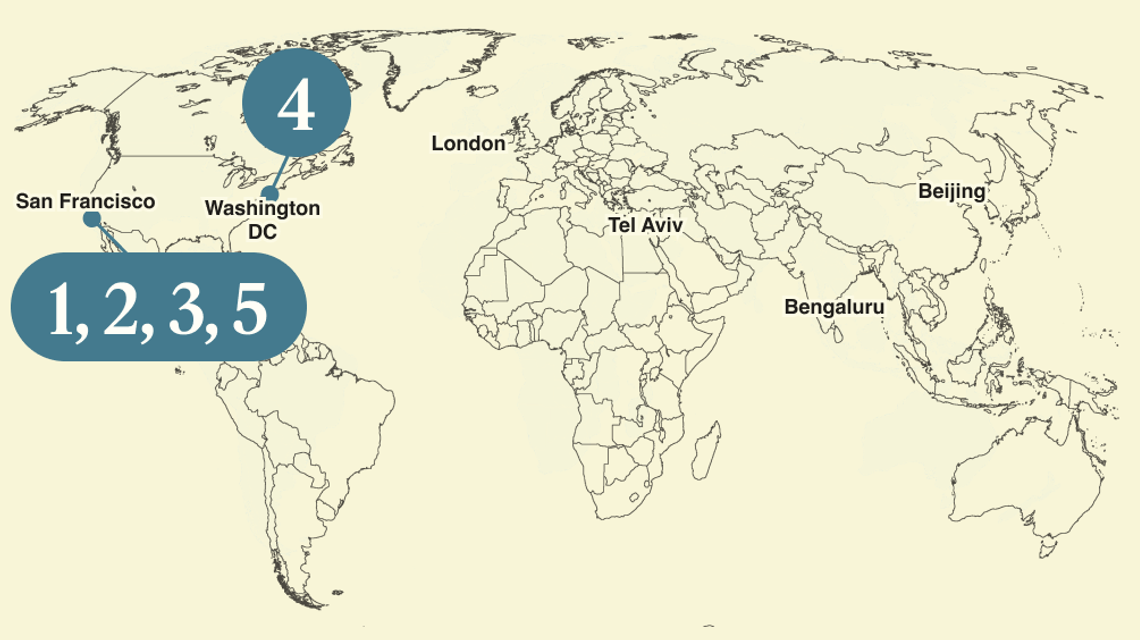 - Anthropic’s big raise
- A plan for Mythos
- Meta’s copycat approach
- AI subway ads
- AI for good
 Why Mustafa Suleyman says it’s a bad idea to only use open-source AI models, and a startup offers to clean your house for free to train their robots. |
|
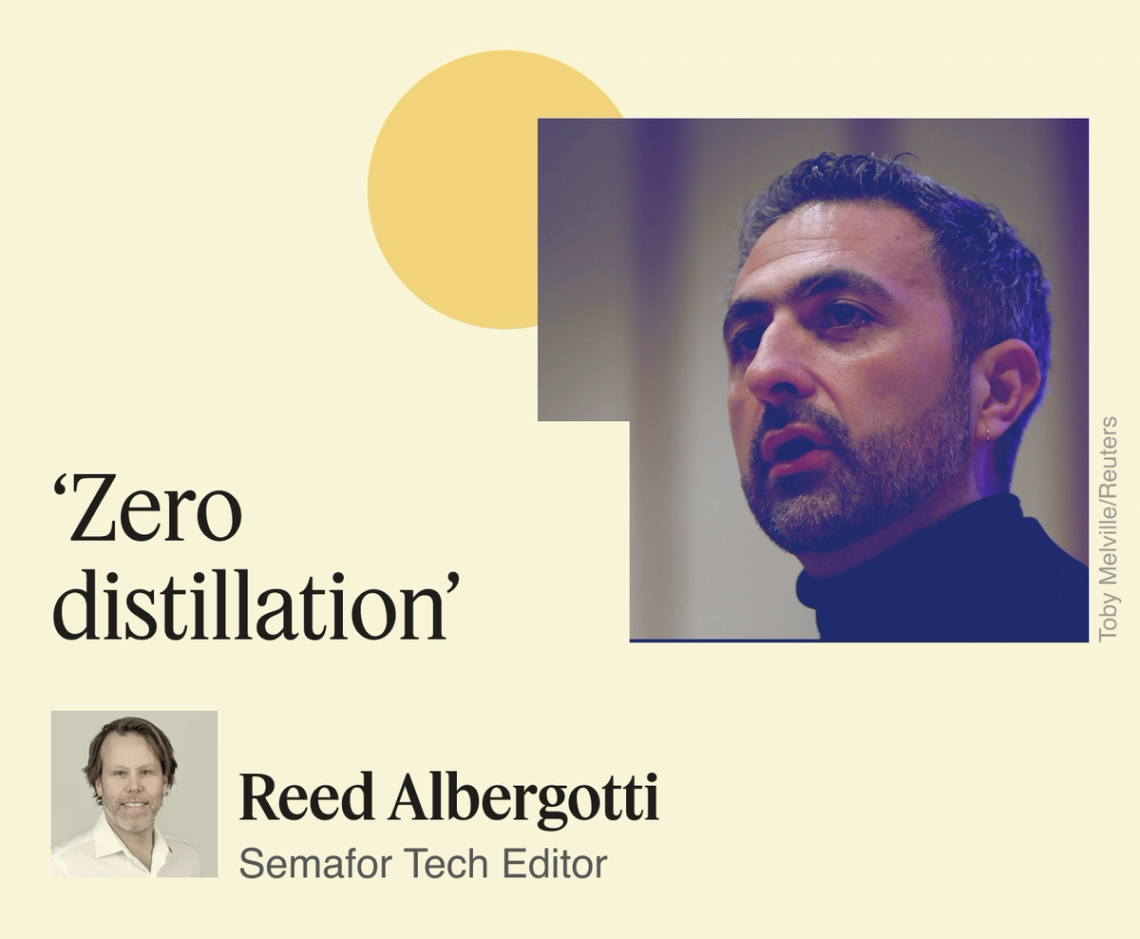 Amazon’s decision to scrap its AI leaderboard after tokenmaxxing rapidly drove up costs is the most recent case of sticker shock hitting companies trying to implement AI. Those rising costs have led to a growing chorus of people hawking Chinese open-sourced models like DeepSeek. But in a recent interview, Microsoft AI chief Mustafa Suleyman told me why that’s a bad idea. Companies that rely on distillation — the process of using datasets generated by larger AI models from frontier labs like Anthropic and OpenAI — is a shortcut that often leads to a dead end, Suleyman said. “You’ve basically stuffed your model full of somebody else’s knowledge,” he said. As Microsoft builds toward independence with its own AI models, it is doing so with “zero distillation.” Because big frontier labs don’t make public the massive data sets they use when they train the world’s biggest AI models, it’s impossible to know exactly what those companies prioritized when they created them. So while distillation can be effective at making small models for specific tasks, eventually models built on a foundation of distilled data will fall behind when applied to a wide range of general-purpose tasks. Cheap, distilled Chinese AI models haven’t taken over, as many predicted. Demand for the most advanced AI models has been surging far more than demand for open-source versions. The limits of distillation could be one of the reasons. And if Suleyman is right, there’s an even bigger gap between the big, frontier AI labs and the open-source models than people think. It’s prohibitively expensive for most companies to train such massive AI models from scratch. And that could have a big impact on the cost companies must pay to implement AI. Free, open-source AI models aren’t a real alternative to the cutting-edge ones on the frontier, at least not for the most useful work tasks. We’re past the experimentation phase of AI and it is now becoming a crucial tool for many companies. Costs, even for frontier models, are coming down incredibly fast, but not as fast as companies and users would like. It could be that there aren’t any shortcuts for getting there. And a heads up: I’ll be in San Francisco for Semafor Tech: First Principles on June 10, talking with Charina Chou, Chief Operating Officer, Google Quantum AI; Aaron Levie, Co-Founder & CEO, Box; Jeetu Patel, President & Chief Product Officer, Cisco; and more to explore the breakthroughs pushing technology into a new phase of economic and geopolitical consequence. See the full lineup of speakers and request an invite here. |
|
What’s behind Anthropic’s $65B raise? |
 Courtesy of Anthropic Courtesy of AnthropicAnother week, another eye-watering valuation for an AI company. The economics are so unprecedented that Anthropic — which raised another $65 billion at a $965 valuation — seems to be teetering on the brink of either growing too fast, or too slowly. Iqonic Capital’s Matt Jacobson, who’s led multiple Anthropic funding rounds, has an all-encompassing saying to explain how this works: “Capitalism will find a way,” he told me this week after the funding announcement. “At the beginning of this year, when the company made a few announcements, we looked at growth well ahead of our expectations. We wondered how they’d get the compute to keep up with demand,” Jacobson said. That problem was solved, at least temporarily, with a blockbuster deal to rent compute from xAI at a cost of $1.25 billion per month. Now, as Anthropic and other AI companies head toward public-market listings, there are other supply-chain strains: chips, memory, energy, cooling, and turbines to rattle off a few. “We’ll see where capitalism finds solutions and what bottlenecks remain,” Jacobson said. — Reed Albergotti |
|
Cisco’s CEO isn’t worried about Mythos |
 Semafor/YouTube Semafor/YouTubeCisco CEO Chuck Robbins isn’t worried about Anthropic’s Mythos model — at least not in the long term. Cisco missed the shift to the cloud in the 2010s, but under Robbins, it’s become a key player in AI, providing “the plumbing” to connect chipmakers and LLMs. Robbins has also made security a pillar of the business — and he thinks Anthropic’s Mythos model, which has roiled the tech world with its ability to find and exploit software vulnerabilities, will transform cybersecurity even if it might be a messy transition to get there. “It’s going to help find vulnerabilities more quickly” and figure out how to close them, he told Semafor’s CEO Signal show. “In the interim … It’s going to expose a lot. We’ve got to be very thoughtful about how we manage the middle.” Preparation for that transition begins internally. Robbins launched what he describes as “AI universities” to provide training for employees and an AI boot camp for Cisco’s board of directors. “No one is impacted more by your own personal development than you. So you should own it,” he said. |
|
Meta’s copycat strategy in the AI era |
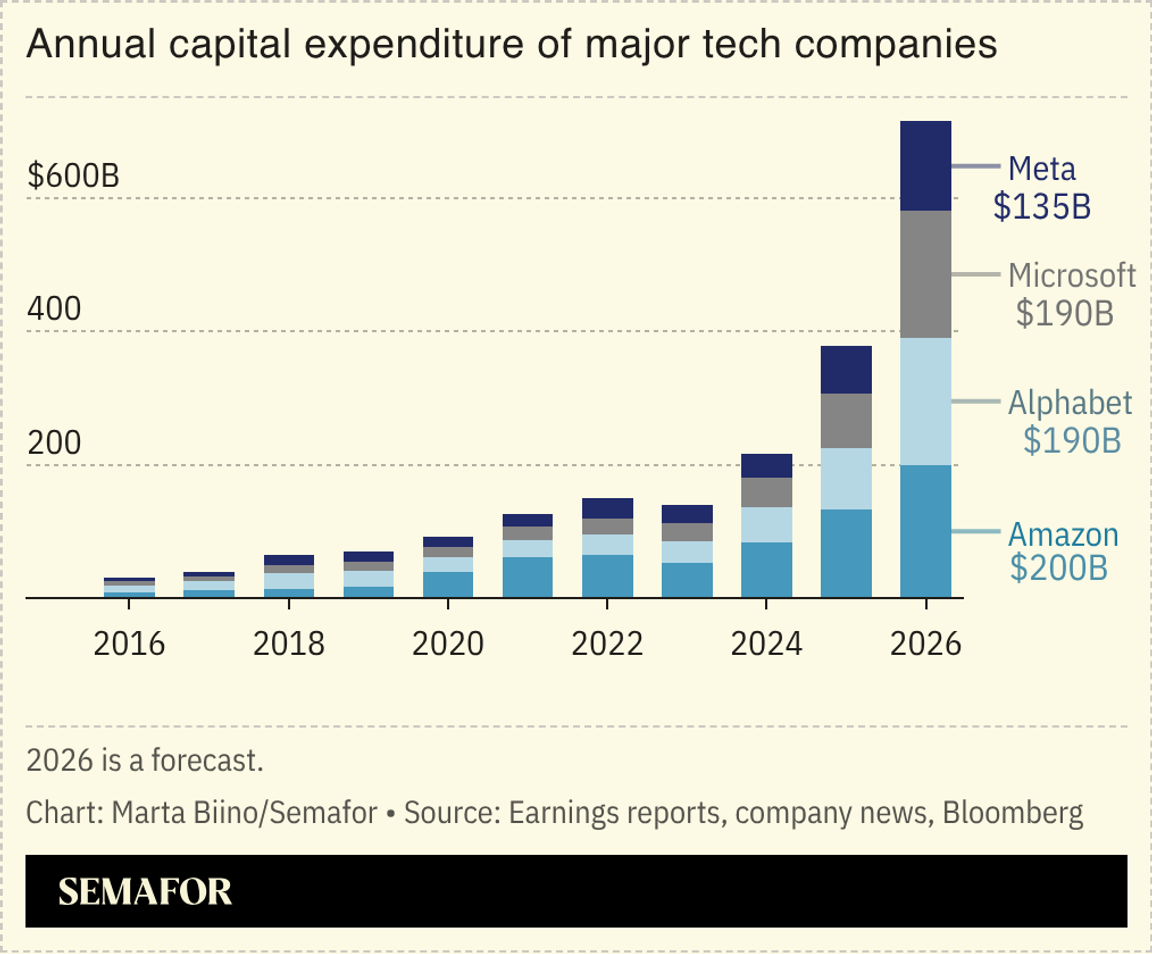 Meta built its social media business by copying its competitors. Its AI push is no different. CEO Mark Zuckerberg on Wednesday said the company could start renting out its own data centers if it has extra compute, following Elon Musk’s move to rent xAI’s data center space to Anthropic. Meta’s also building an enterprise AI business complete with forward-deployed engineers, according to The Information. Overspending so much on AI that you need a new business line to cover the tab doesn’t bode well for Meta’s AI strategy, which was already flailing. The company was able to cannibalize Snapchat, X, BeReal, and TikTok, because it had a head start in social media and a huge share of loyal customers. But it doesn’t have the same leg up in AI, and it doesn’t have the kind of institutional knowledge or deep relationships when it comes to running an enterprise business. Copying its way to the top is going to be much harder this time around. — Rachyl Jones |
|
About all those AI ads on the subway… |
 An ad for AI company Mistral in an NYC station. Shannon Stapleton/Reuters. An ad for AI company Mistral in an NYC station. Shannon Stapleton/Reuters.The share of ads on New York City subways and buses from tech companies jumped 50% in the first quarter of 2026 from a year ago, as AI startups try to win over the world’s finance capital. AI has already upended the digital advertising sector. Now, more tech companies are turning to traditional static ads to generate buzz, MTA ad contractor Outfront Media told Semafor. Ironically, as more people turn to chatbots and agents for internet searches, it’s gotten more difficult for AI brands to get in front of consumers through the channels the tech industry has long relied on. That “will place a bigger premium on reaching real humans,” Outfront’s East Region VP of Marketing Victoria Mottesheard said. Tech companies now make up 15% of all ads across New York transit. But the city is still trailing San Francisco, where tech represented about 40% of first-quarter advertising across all media. — J.D. Capelouto |
|
 Meta’s AR glasses. Yves Herman/Reuters. Meta’s AR glasses. Yves Herman/Reuters.With all the negative AI sentiment bubbling up among the consumer class, it’s worth taking a moment to note where it’s actually improving people’s lives. For more than a decade, California-based Aira has been connecting visually impaired people with trained assistants who, through the phone camera, help with daily tasks like reading a menu or finding an item at the grocery store. AI has now enabled Aira, which has worked with Google DeepMind, to develop models that can do that work. It’s also now available hands-free through Meta’s smart glasses. Aira has no plans to offload any of the few hundred human agents it employs, as there are still tasks — like determining how many stairs are left in a staircase — that are too difficult for AI to assist with, CEO Troy Otillio told Semafor. But it helps solve the company’s ongoing difficulty finding qualified individuals to work as agents. And since AI agents are cheaper than humans, it plans to lower its prices. “AI helps our visual interpreters be better at their job,” said Everette Bacon, who works as chief of blindness initiatives at Aira. “When a [user] calls in and has a difficult question maybe they’re not familiar with, they can quickly pivot to AI and get answers much faster than they ever could before.” — Rachyl Jones |
|
 Fox News host Bret Baier has spent years interviewing presidents, moderating debates, and operating at the center of American political media. On this week’s episode of Mixed Signals, he joins Max and Ben to discuss how he navigates tough questions while maintaining access to President Donald Trump, what he actually learned from the Fox News Dominion discovery process, and why he doesn’t vote. Plus, his new book, his 2028 predictions, and whether CBS News has any shot at replicating what he’s built. |
|
 Courtesy of Shift Courtesy of ShiftAn AI startup is offering free home cleaning in New York City — as long as customers let the company record their dirty apartments to train its robots. Shift made a splashy launch Thursday, and has since gotten demand for “thousands and thousands of bookings,” US General Manager Harry Kilberg told Semafor. Shift is an offshoot of Germany-based Microagi, which already oversees data collection work in several countries — the data is anonymized and sold to AI labs. It also uses some of the data for its internal research lab. Kilberg said Shift is trying to “democratize the AI economy” by, say, allowing someone to clean their neighbor’s apartment for free — and still get paid, by Shift, for the recording. The company plans to launch in more cities and offer more services beyond cleaning. Why start in NYC? It’s “the beating heart of the world’s economy” — but also, “it’s pretty dirty to begin with and we’re hoping the free cleaning can help.” — J.D. Capelouto |
|
|


