| | In today’s edition: turnover and turmoil at New York Public Radio, the latest on Paramount-WBD, and ͏ ͏ ͏ ͏ ͏ ͏ |
| |  New York New York |  Washington Washington | Los Angeles |
 | Media |  |
| |
|
 - Bilton’s new era
- WarnerMount update
- NYPR’s revamp
- Mixed Signals
- America250
- Something fun
|
|
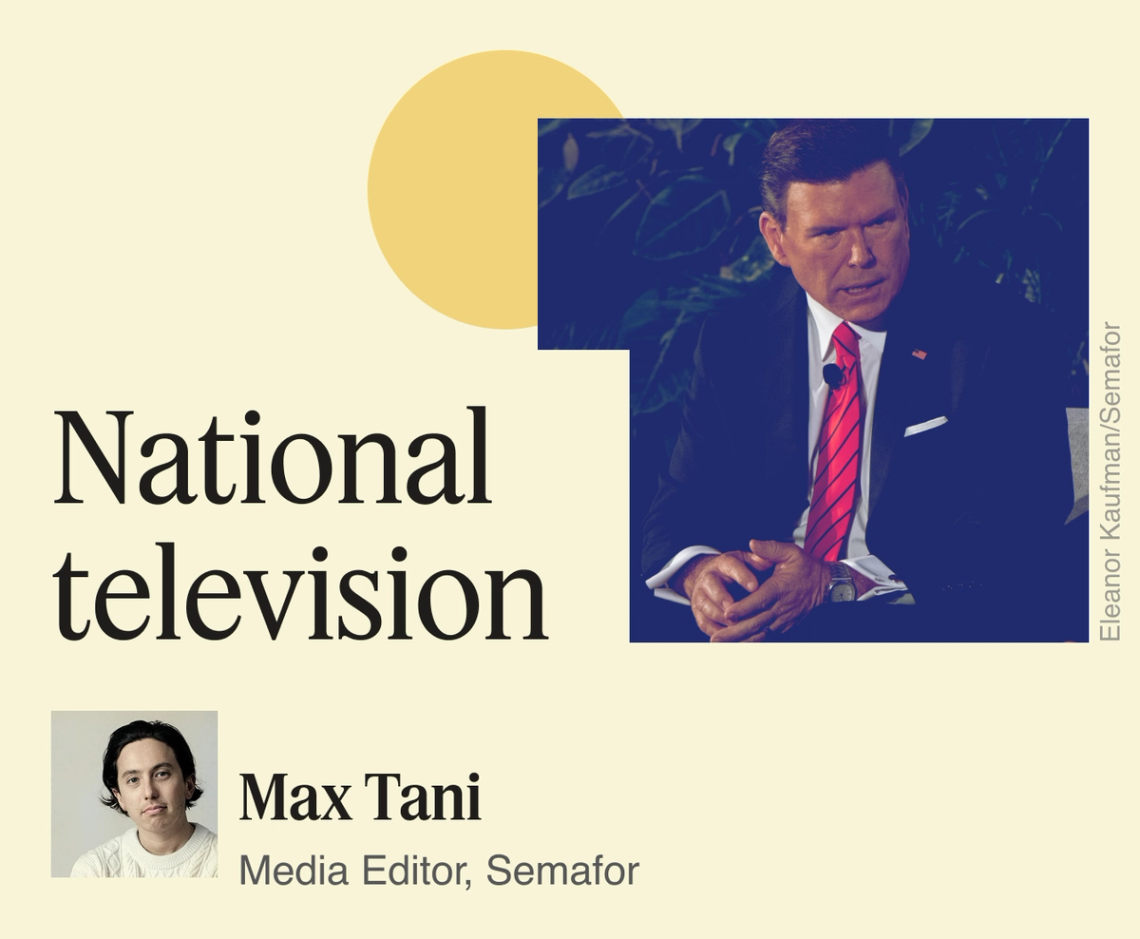 Subscribers to this newsletter (and its many rivals) may have noticed an increase in the sheer volume of media reporting. There are more stories to tell and more new names to know, as the hierarchical structures of media have toppled. And nowhere is that truer right now than in linear television. Viewership is declining — dramatically in many parts of cable, and steadily in broadcast news. Paramount is betting that at CBS News, television broadcasting experience is basically unnecessary for many of the top jobs, as the company places greater value on multiplatform content. Speaking with me after the network dismissed a good segment of 60 Minutes leadership, new 60 Minutes chief Nick Bilton had a warning for legacy media: “If you look historically to what happens to these institutions, why they fail — it’s because they don’t innovate and they don’t disrupt themselves.” Yes, but: For now, a few television programs have remained stubbornly relevant. Speaking with us on Mixed Signals last week, Fox News anchor Bret Baier, whose Special Report program has actually seen growing ratings, talked about the incoming he still gets from the country’s leaders. He speaks with President Donald Trump up to a few times a week — when his show has irked the president somehow, or when he wants a read on Trump’s thinking about an issue. When Sen. Mitch McConnell was still the top Senate Republican, he used to block out an hour of his day to watch Baier’s show. And Baier’s fans aren’t all Republicans; he told us he occasionally texts with California Gov. Gavin Newsom, who the Fox News anchor said is a flawed but “formidable” 2028 contender. There’s a reason CBS’ Bari Weiss tried to hire Baier, and why — for all the discussion of the end of television — the networks are still duking it out for top talent and the eyeballs of aging Americans, many of whom happen to be America’s leaders. Also today: turnover and turmoil at New York Public Radio, the latest on Paramount-WBD, and which streamer Americans turn to for fun. |
|
Bilton’s ‘completely new’ ‘60 Minutes’ |
 Shannon Stapleton/Reuters Shannon Stapleton/ReutersIs Bilton at all daunted by the notion of entering TV news for the first time as the leader of one of its most storied shows? “It’s not the slightest bit intimidating,” he told me last week. Bilton, a former star New York Times reporter and successful documentary producer, said Weiss had approached him in recent months about taking over the show, and he couldn’t get the idea out of his head. In their conversations about the role, the two agreed that the program needed to expand its scope to cover new types of stories and have a larger digital presence. That could include branching out beyond the program’s traditional one-hour Sunday timeslot and publishing content online more frequently, Bilton told me: “To me, that’s the most incredible exciting opportunity — to expand it beyond just one hour a week.” Bilton said that he knows enough about the format of the show to do it justice, and compared it to the kinds of films he’s made for HBO and Netflix. But the selection of an outsider with no TV news experience signals that Paramount CEO David Ellison and Weiss’ overhaul of CBS News will be radical and total, and that the newly minted mogul is willing to bear years of audience decline in the service of a new vision of who 60 Minutes is for. |
|
Paramount appears to sway DOJ staff on WBD deal |
 Mike Blake/Reuters Mike Blake/ReutersUS antitrust regulators appear ready to approve Paramount’s purchase of Warner Bros. Discovery, Semafor’s Liz Hoffman and Rohan Goswami scooped last week, after Department of Justice attorneys grilled Ellison at a two-hour meeting. At issue: Hollywood’s fears that Paramount will make fewer films overall, or that it will funnel the films it does make directly onto its streaming services in lieu of a traditional theatrical release. DOJ staff attorneys seemed swayed by Ellison’s arguments — the CEO has said the merged Paramount-Warner Bros. will release 30 movies a year — but talks remain ongoing, and the department’s analysis could change, Liz and Rohan report. California Attorney General Rob Bonta has also promised to investigate the merger. |
|
New York Public Radio boss’ reorganization |
 Katie Jones/Variety/Penske Media via Getty Images Katie Jones/Variety/Penske Media via Getty ImagesIn her first four months on the job, Christy Tanner, the new CEO of New York Public Radio, has swiftly eliminated some of the organization’s top staffers with little explanation. She pushed out Jennifer Schell Podoll, the executive in charge of overseeing fundraising efforts; longtime VP of comms Jennifer Houlihan Roussel; and NYPR’s liaison to the board of trustees. None of those departures have been announced publicly. It’s not uncommon for a new CEO to bring in new leadership, and Tanner told The New York Times in February that part of her mission early on would be to shore up the public media organization’s finances. But the volume of departures has surprised other senior leaders, two of whom told Semafor that they were concerned Tanner didn’t have a plan to replace the people she fired, and were worried that the terminations would negatively affect the organization’s internal morale and ability to raise money and recruit new talent. These questions were raised at an all-staff meeting earlier this year, three people who attended the meeting told Semafor. In an interview on Friday with Semafor, Tanner said she could not comment on personnel decisions, but said that she has been committed to growing the organization. She told Semafor that NYPR plans to announce several new hires next month to editorial positions focused on expanding live events and streaming. “In any evolution, there are necessary changes to help fuel growth and expansion, and I do not take those changes lightly,” she said. |
|
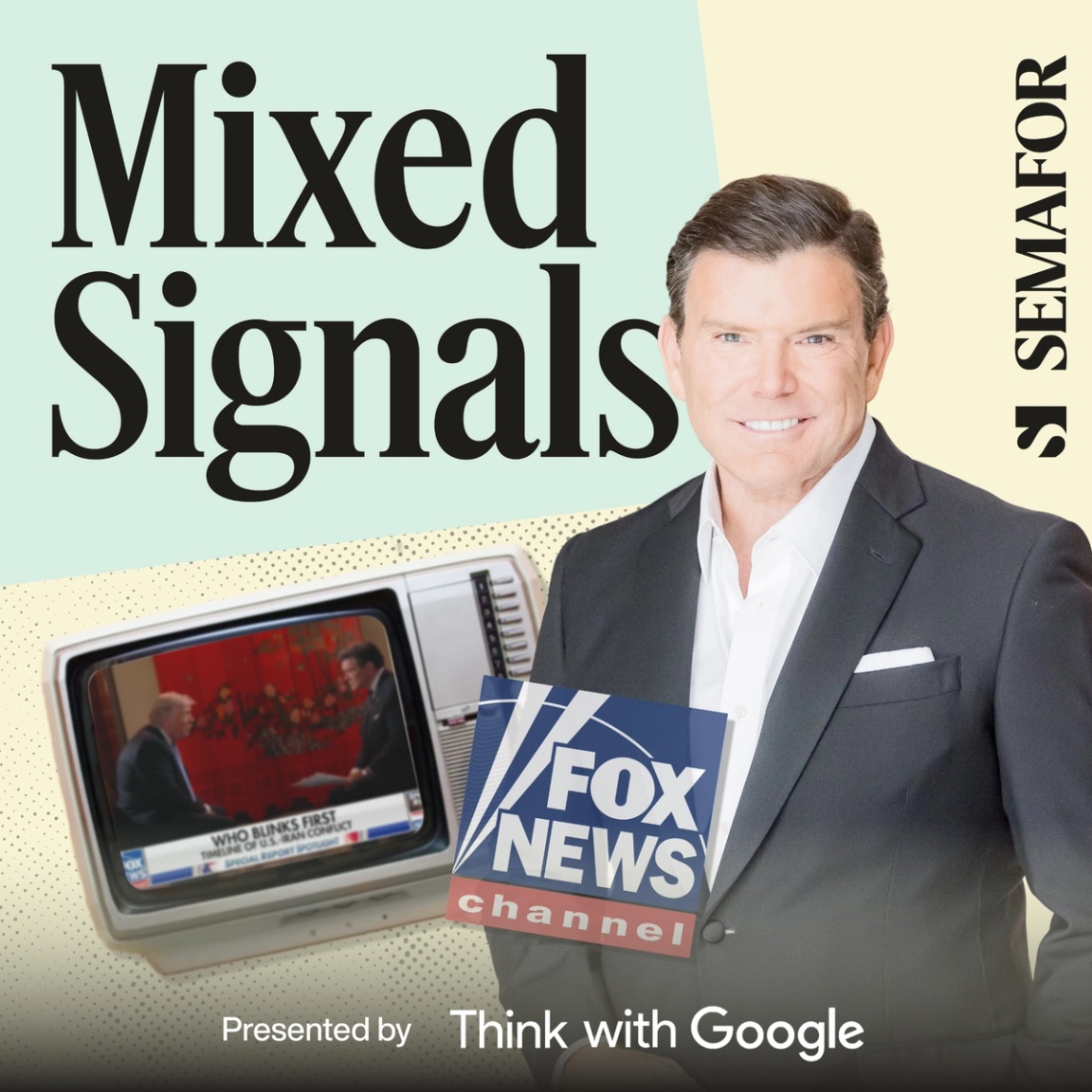 Baier has spent years interviewing presidents, moderating debates, and operating at the center of American political media. On this week’s episode of Mixed Signals, he discusses how he navigates tough questions while maintaining access to Trump, what he actually learned from the Fox News-Dominion discovery process, and why he doesn’t vote. Plus, his new book, his 2028 predictions, and whether CBS News has any shot at replicating what he’s built. |
|
View: America’s negative-sum birthday |
| |  | Ben Smith |
| |
 Tyrone Siu/Reuters Tyrone Siu/ReutersI recently ran into Democratic strategist Doug Thornell, who was worried about America’s 250th anniversary this July 4. “Trump wants to make it a partisan two-to-three months where he can beat Democrats over the head for not being patriotic,” he mused, calling on Democrats to “go on offense.” No! A cherished American moment turning into a bitter partisan food fight? Couldn’t happen. The semiquincentennial is, in 2026 fashion, being run by two rival organizations. One is the wholesome, congressionally mandated America250, while the more glam White House-controlled Freedom 250, tuned to Trump’s taste for spectacle, is co-branding the June 14 Ultimate Fighting Championship event on the South Lawn. Corporations, traditionally thrilled to support nonpartisan patriotism, now have a pair of options: Sponsor a group that puts on events like a time capsule and Times Square ball-drop, which will make broadcast television; or get your logo right in front of Trump at the White House cage match. The first flickers of how badly this all might go came last week, when musicians you hadn’t heard of for years began pulling out of a Freedom 250 concert series on the National Mall during the Great American State Fair. “I had no clue it was considered a ‘Trump-backed’ event,” YoungMC complained. Trump has volunteered to replace the performers himself. And the choice of a UFC event is emblematic: It’s almost impossible to find a divisive American sport (a recurring theme of our media coverage), but the polling firm YouGov finds that UFC Fight Night is popular with 26% of Americans and disliked by 25%. Is this good or bad for Trump’s politics? Who knows. But Trump and his aides are happy to seize the opportunity to paint Democrats as unpatriotic. |
|
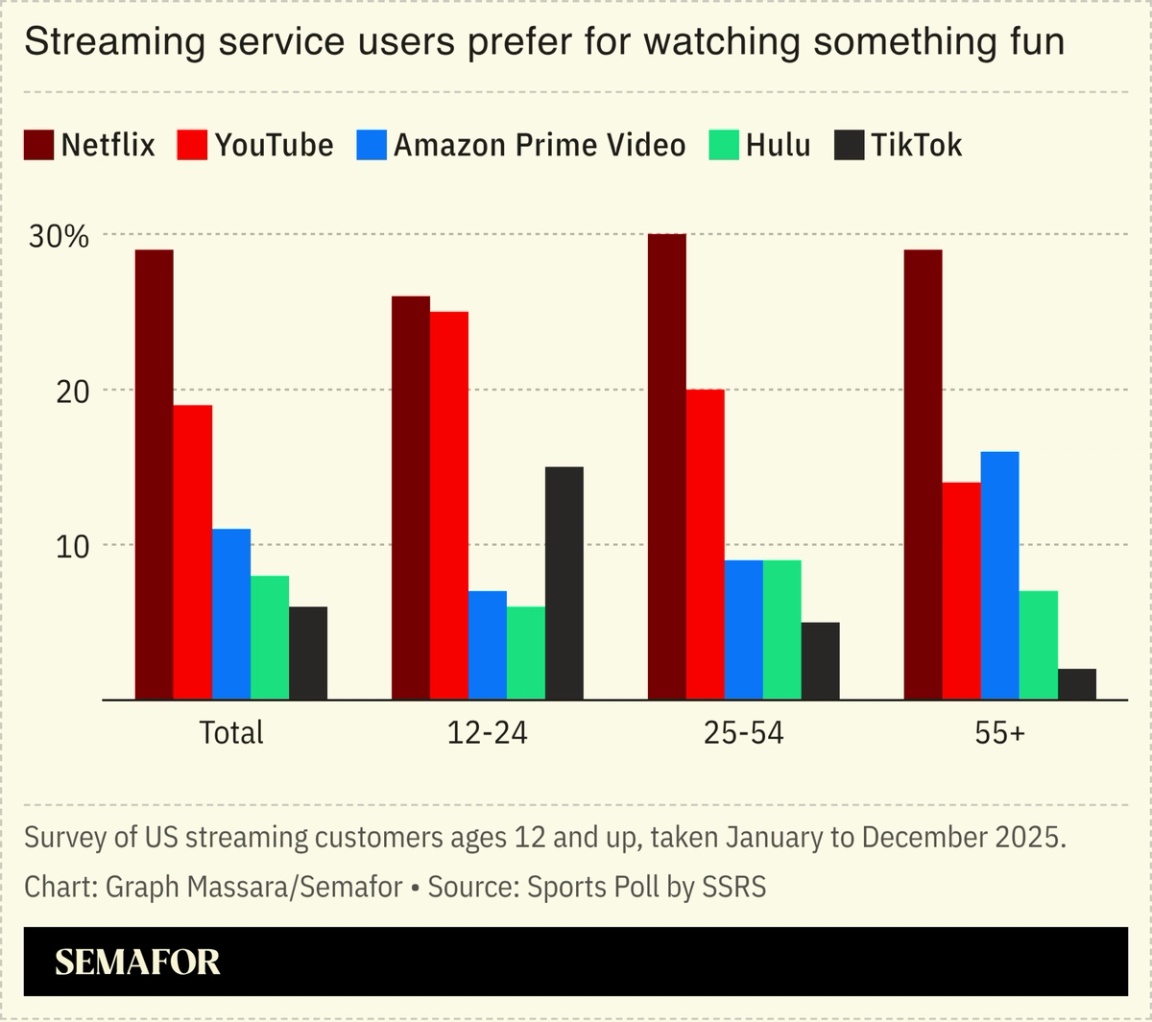 What streaming app is your go-to when you want something fun? That’s what the research firm SSRS asked a sample of American media consumers, per a blog post out this month. Netflix is dominant, with a plurality of about 30% across all age groups. That’s perhaps unsurprising, given its first-mover advantage in film and TV streaming, even if YouTube continues to nip at its heels. But Netflix is nearly tied with YouTube in popularity among the poll’s youngest age cohort (ages 12-24), with TikTok a distant third. The platform that kicked off the now-omnipresent vertical video arms race remains less popular overall with older users, though the people that do use TikTok increasingly go there to catch up on the news — a bit less fun than the viral dance videos of yesteryear. — Graph Massara |
|
 Like data and pop culture? Stat Significant is a free weekly newsletter featuring data-centric essays about movies, music, TV, and more. When do we stop finding new music? Which TV shows got their finale right, and which didn’t? Which movies popularized (or tarnished) baby names? Subscribe for free to find out. |
|
|


