| | In today’s edition: Gulf sovereign wealth funds are on a dealmaking spree despite the war, while the͏ ͏ ͏ ͏ ͏ ͏ |
| |  Riyadh Riyadh |  Islamabad Islamabad | Abu Dhabi |
 | Gulf |  |
| |
|
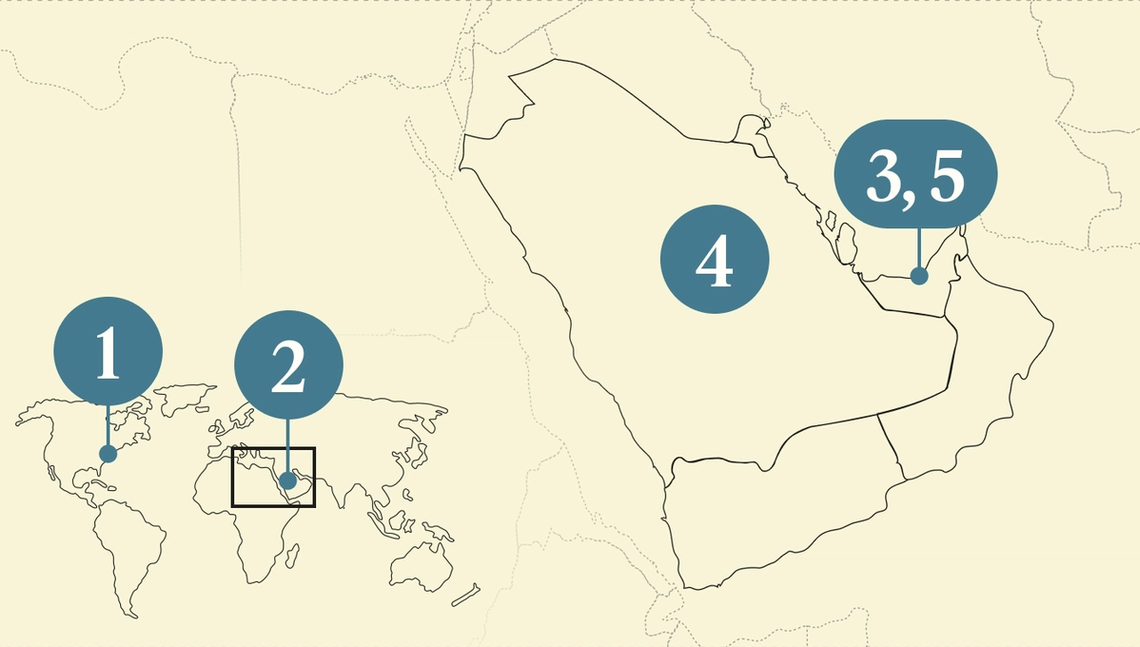 - US, Iran trade more blows
- Sovereigns’ dealmaking surge
- Abu Dhabi backs Anthropic
- Alwaleed’s SpaceX windfall
- UAE plans Arabic revival
 Fox’s World Cup hat trick, courtesy of Qatar. |
|
Ships trickle through Hormuz |
 An anti-US billboard in Tehran. Majid Asgaripour/West Asia News Agency via Reuters. An anti-US billboard in Tehran. Majid Asgaripour/West Asia News Agency via Reuters.Washington and Tehran again traded blows, driving oil higher and raising questions over the viability of peace talks that had seemed near the finish line. The US hit Iranian radar and drone installations, while Tehran targeted an American military base in Kuwait — though US President Donald Trump insisted “it will all work out well in the end.” Pressure on energy markets is mounting: Ships are sailing “dark” through the Strait of Hormuz, which remains largely closed, while Barclays warned that risks to its oil-price forecast were “skewed higher.” Overall, one leading foreign policy expert argued, “the central question is no longer how the conflict ends, but whether the instability it has created is becoming permanent.” US forces have helped coordinate passage of roughly 70 ships through the strait over the past three weeks, according to The New York Times — far less than the 100 or so that would sail through on a daily basis prewar. The trickle has allowed for a third of the large crude tankers stranded in the strait to slip through. But with negotiations stalling between Washington and Tehran, a Qatari official offered a more flexible arrangement, suggesting that a “mine-clearing or some usage of the fees for a temporary time, this is something that is negotiable.” |
|
Gulf funds step up dealmaking |
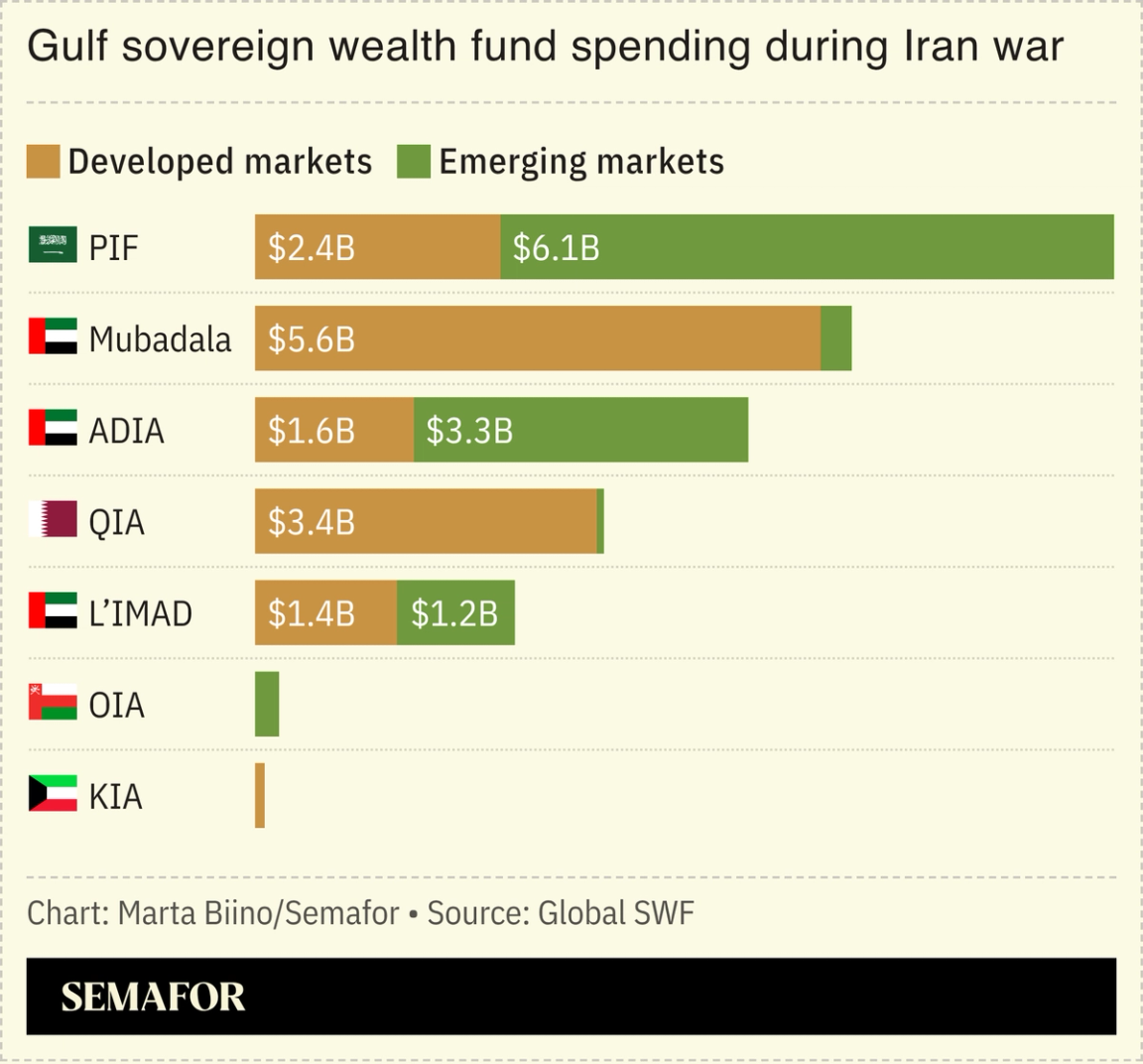 Gulf sovereign wealth funds have ramped up dealmaking in the past three months, despite the region being embroiled in the Iran war and oil revenues being hit by the closure of the Strait of Hormuz. The five biggest spenders in the Gulf — the UAE’s Abu Dhabi Investment Authority, L’IMAD, and Mubadala; Saudi Arabia’s Public Investment Fund; and Qatar Investment Authority — collectively spent almost $26 billion during March, April, and May, a higher deployment rate than over the previous five years, according to Global SWF. Gulf capital flowed into US deals during the period, although PIF’s $6 billion investment in Chinese game developer Moonton Technology meant that emerging market investments outpaced developed market deals. That also helped to make the Saudi fund the most active in the Gulf, even as it pulled back on some of its more ambitious bets, including the decision to stop funding LIV Golf, throwing the future of the upstart golf tournament into doubt. QIA was the only fund that slowed down its pace of investing, according to Global SWF. — Matthew Martin |
|
UAE ups pre-IPO stake in Anthropic |
 Courtesy of Emirates News Agency-WAM Courtesy of Emirates News Agency-WAMAbu Dhabi’s MGX backed Anthropic’s $65 billion fundraise, further strengthening its position in the Claude developer. MGX, launched in 2024 by Abu Dhabi AI conglomerate G42 and sovereign wealth fund Mubadala, and chaired by UAE National Security Adviser Sheikh Tahnoon bin Zayed, owns stakes in three frontier model frontrunners: Anthropic, OpenAI, and xAI. All three are expected to go public this year (xAI as part of its parent company SpaceX), making the UAE the Gulf state with the greatest private-market exposure to the AI race. Qatar’s QIA has invested in both Anthropic and xAI, while Saudi Arabia’s PIF-backed HUMAIN is also a recent backer of xAI. Anthropic initially ruled out taking the region’s money on national security and moral grounds, only to backtrack. The latest funding round gives it a $965 billion valuation, above that of its rivals. Anthropic has blown past growth expectations while spending at least $1.25 billion a month on compute in “a very delicate dance” between growing too fast and going bankrupt, as one investor told Semafor’s Reed Albergotti. — Kelsey Warner |
|
Alwaleed discloses SpaceX stake |
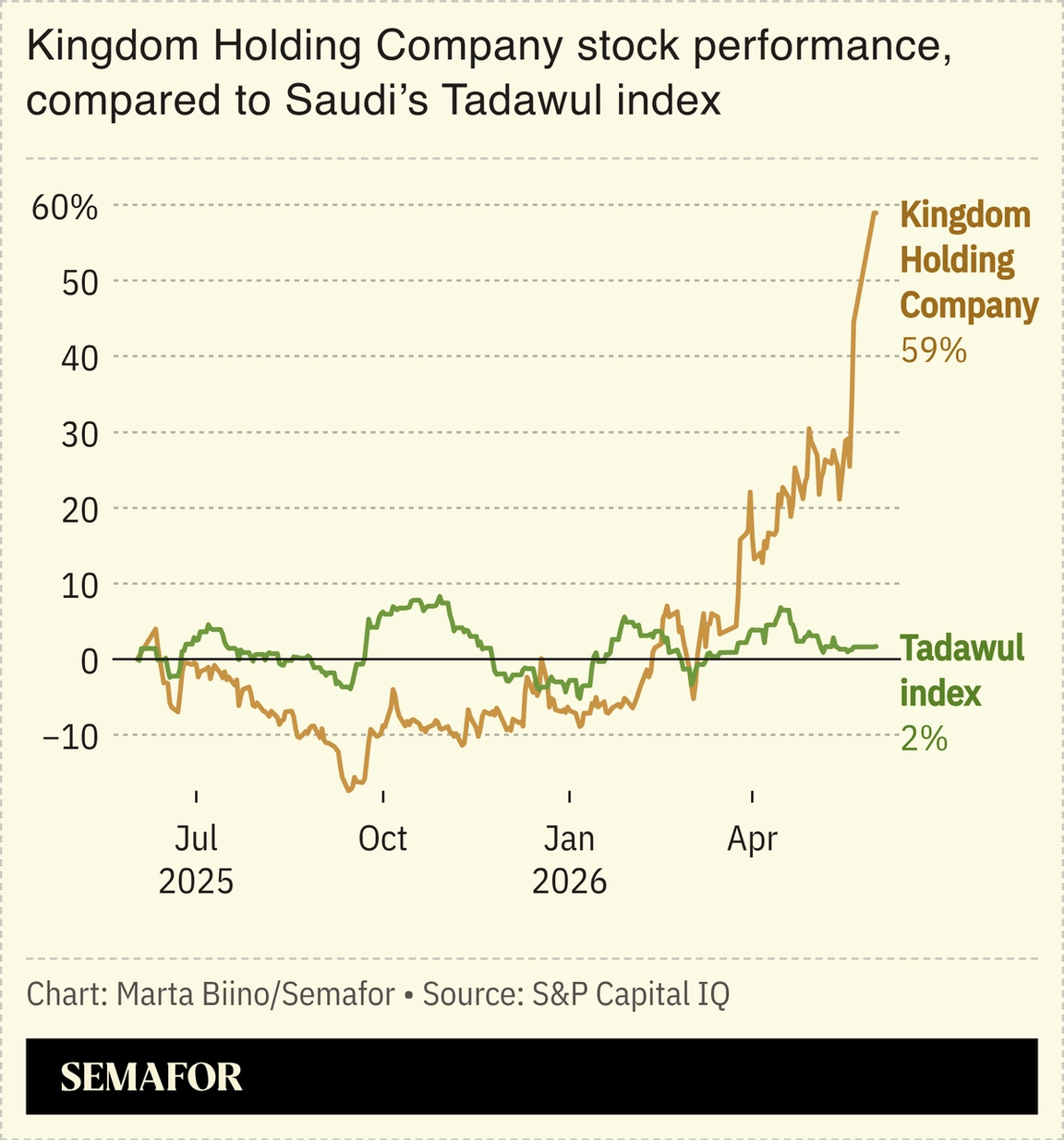 Investors have driven up the share price of Saudi billionaire Prince Alwaleed bin Talal’s Kingdom Holding to a 10-year high, after it said its 0.63% stake in SpaceX could be worth $10.5 billion in an IPO, according to Asharq Business. SpaceX is seeking a valuation of at least $1.75 trillion in what would be the largest-ever stock market listing. The company has several Gulf backers, of which Alwaleed is among the most prominent. His investment traces back to a $300 million Twitter stake that ultimately converted into SpaceX shares as Musk reorganized his empire. PIF’s HUMAIN poured $3 billion into xAI in February before it merged with SpaceX; Abu Dhabi’s MGX, Oman Investment Authority, and Qatar Investment Authority have also participated in xAI funding rounds. |
|
UAE reclaims its mother tongue |
 JohnnyGreig/Getty JohnnyGreig/GettyThe UAE is drafting its first Arabic language law, which will require hotels and other customer-facing businesses to have Arabic speakers on staff, with incentives for organizations that comply and penalties for those that don’t. The new rules will also mandate translations at public conferences, and raise standards for how the language is taught in schools. It is a significant move for a country where Emiratis make up less than 12% of the population. The cosmopolitan nature of UAE society means Arabic has ceded ground in daily life, to the point where even some Arab children don’t speak it fluently. The language push comes amid signs of a shift in some other Gulf countries, where younger locals are no longer looking so much to the West for validation and are increasingly comfortable asserting their identity in their own language. — Manal Albarakati |
|
 Banks- Lenders in Saudi Arabia and the UAE have mostly held their earnings guidance for 2026 despite the economic impact of the Iran war and slowing loan growth for Saudi lenders, according to research by UBS. — AGBI
Crime- Dubai Police arrested four people accused of attempting to defraud an oud merchant, in a 12-million-dirham ($3.3 million) scam involving a fake princess and an opulent dinner in a rented villa. Four co-conspirators in the theft of the woody-smelling resin of the agarwood tree fled before they could be detained. — The National
Sovereign wealth- Abu Dhabi sovereign wealth funds have sold billions of dollars worth of shares in listed companies, cashing in on soaring US stock markets. Mubadala and Abu Dhabi Investment Authority have sold down stakes in firms including GlobalFoundries and Innio. — Bloomberg
Sports- When Paris Saint-Germain met Arsenal in Europe’s Champions League soccer final on Saturday, Qatar and the UAE were both in the stadium: the former owns PSG, the latter has Dubai’s flagship airline name on Arsenal’s shirt. Gulf presence is no surprise to any elite soccer fan, with regional backers bolstering rosters from New York to Newcastle. — New Lines Magazine
|
|
 Hannah Mckay/Reuters Hannah Mckay/ReutersThis may be the final twist from the 2022 men’s soccer World Cup in Qatar — and, as with most things related to FIFA, it involves lots of money. In 2014, soccer’s world governing body faced a dispute with broadcaster Fox Corp. which argued that moving the tournament from summer to winter — to cope with the Gulf’s weather — diminished the value of the rights it had bought. Rather than risk lawsuits, FIFA extended Fox’s contract through to this year’s tournament at roughly the same rate, meaning Fox will be paying about $425 million to televise games which should be worth as much as $1.5 billion, according to The New York Times. As a result, the world’s biggest sporting tournament, which kicks off this month, will deliver a windfall to Fox. It may also mark the end of FIFA’s largesse that stemmed from efforts to contain the controversies around the award of the tournament to Qatar. |
|
|


