| | Donald Trump signs an executive order seeking early access to AI models, companies adopt diverging v͏ ͏ ͏ ͏ ͏ ͏ |
| |  | Flagship |  |
| |
|
The World Today |  - Trump’s newish AI order
- AI boom propels stocks
- US job openings rise
- Considering a Hormuz toll
- Europe-China trade spat
- A ‘bulldozer’ spy chief
- WeChat plans AI agent
- A whey protein shortage
- A ‘prize’ for allergy research
- YouTube to the big screen
 An album evoking “ghosts of British folk and Pacific Northwest indie rock.” |
|
Trump signs AI order after delay |
 Trump with AI leaders in 2025. Carlos Barria/Reuters Trump with AI leaders in 2025. Carlos Barria/ReutersUS President Donald Trump on Tuesday signed an executive order asking AI companies to give the government early access to their models, after he postponed similar guidance last month. The measure has a lighter federal touch compared to the prior version of the order: The timeline for voluntary review was reduced from 90 days to 30 days, marking “the AI industry’s latest victory in its push to avert heavier federal oversight,” Politico wrote. The White House wants to improve the country’s cyber defenses as new AI models prove more adept at exposing software vulnerabilities. Anthropic said Tuesday that 150 additional entities in 15 countries will get access to its powerful, not-yet-released, Mythos model to shore up their systems. |
|
US stocks increasingly rest on AI pillar |
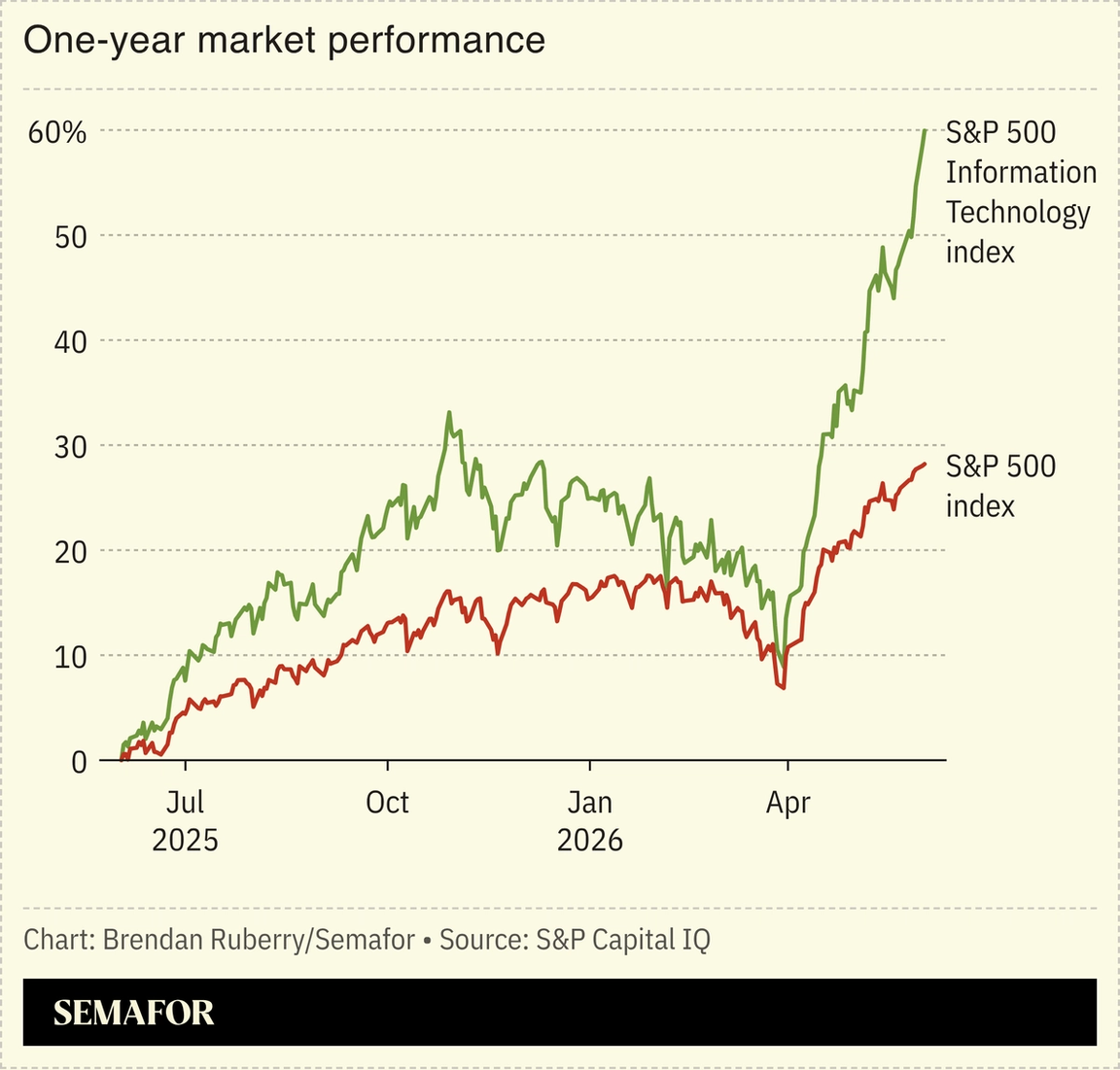 Tech companies boosted US stocks to fresh highs on Tuesday, even as warnings bubbled up over the AI boom’s outsized grip on markets. Despite geopolitical turbulence — a rocky energy market in particular — there is “more greed than there is fear,” Goldman Sachs’ CEO said Tuesday. But outside AI, stocks are far weaker than headline indexes suggest, and investors are underestimating the risk that carries, a market strategist argued, since “the profit cycle and the market narrative are all leaning on the same narrow pillar.” Companies have yet to show real returns on their AI investments, Goldman’s head of equity research said on a podcast. “That doesn’t mean it’s never going to happen. It just means the stakes are higher.” |
|
US job openings pick back up |
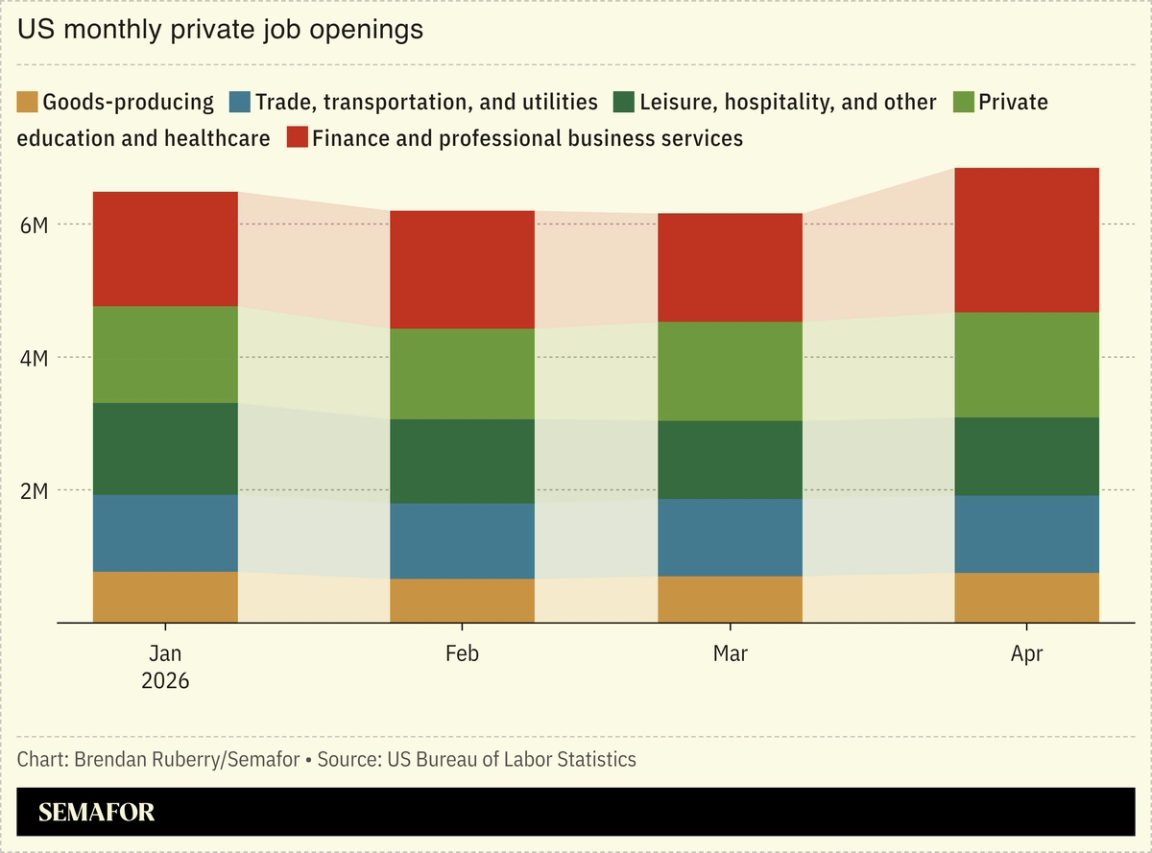 US job openings in April rose to their highest level in nearly two years as layoffs fell, the latest sign of stability in the labor market. Professional and business services roles accounted for almost all of the increase, following a bleak 2025 for white-collar jobs. While hiring rates are still low, “at least companies appear to be hunting for talent again,” one economist said. The growth further dents the case for an interest rate cut, as US monetary policymakers discuss possibly raising the cost of borrowing. As college graduates blame AI for bleak job prospects, the data is welcome news for them, a Bloomberg columnist argued, noting “young, hungry, low-cost” AI-native workers are well-placed to help companies navigate the AI era. |
|
Diverging approaches to Hormuz toll |
 Amirhosein Khorgooi/ISNA/WANA via Reuters Amirhosein Khorgooi/ISNA/WANA via ReutersCountries and companies are taking divergent approaches to prepare for the possibility of Iran imposing long-term fees on ships passing through the Strait of Hormuz. A Greek shipping tycoon on Tuesday said he would be willing to pay a toll — it would be “much better than to have the straits closed.” Qatar also appeared to be flexible, with a top official saying the Gulf nation would be open to negotiating on fees. Chevron’s CEO, though, said he won’t consider paying tolls. The US secretary of state said Tuesday that an open, toll-free Hormuz was a precondition for any peace talks with Iran. That some parties are open to paying, though, shows how severe the disruptions have become. |
|
UK, China deepen ties amid trade tensions |
 Dominic Lipinski/Reuters Dominic Lipinski/ReutersThe UK and China’s top diplomats on Tuesday agreed to deepen cooperation, as Europe’s trade tensions with Beijing loom large. The UK foreign minister signaled willingness “to manage differences with China constructively,” Bloomberg wrote, amid lingering friction: The UK recently blocked a Chinese turbine maker from building a facility, and last month it moved to nationalize the China-owned British Steel. The EU, meanwhile, is inching closer to a trade war with China. The European Commission vowed a tougher approach to curb the flood of cheap Chinese imports, prompting Beijing to threaten countermeasures. It would be unwise to ignore China’s trade barbs, an analyst argued, noting Beijing is confident it can adapt to pressure from Europe just like it did with Washington’s tariffs. |
|
Trump taps housing regulator as intel chief |
 Kevin Lamarque/Reuters Kevin Lamarque/ReutersUS President Donald Trump on Tuesday tapped his top housing regulator to oversee the country’s spy agencies, elevating a political supporter who has no experience in intelligence. Trump allies see Bill Pulte’s “attack-dog mentality as critical in waging an internal war to ramp up the declassification of sensitive information,” Semafor’s Washington team reported; one source called him a “bulldozer.” Democrats criticized the appointment, arguing Pulte — who called for the firing of former Federal Reserve Chair Jerome Powell — will use his role as acting director of national intelligence to seek retribution against Trump’s political enemies. The decision comes as infighting picks up among US spy agencies, reducing collaboration between offices, Reuters reported. The CIA has reportedly stopped pitching in on some intel assessments. |
|
Chinese super-app could get an AI agent |
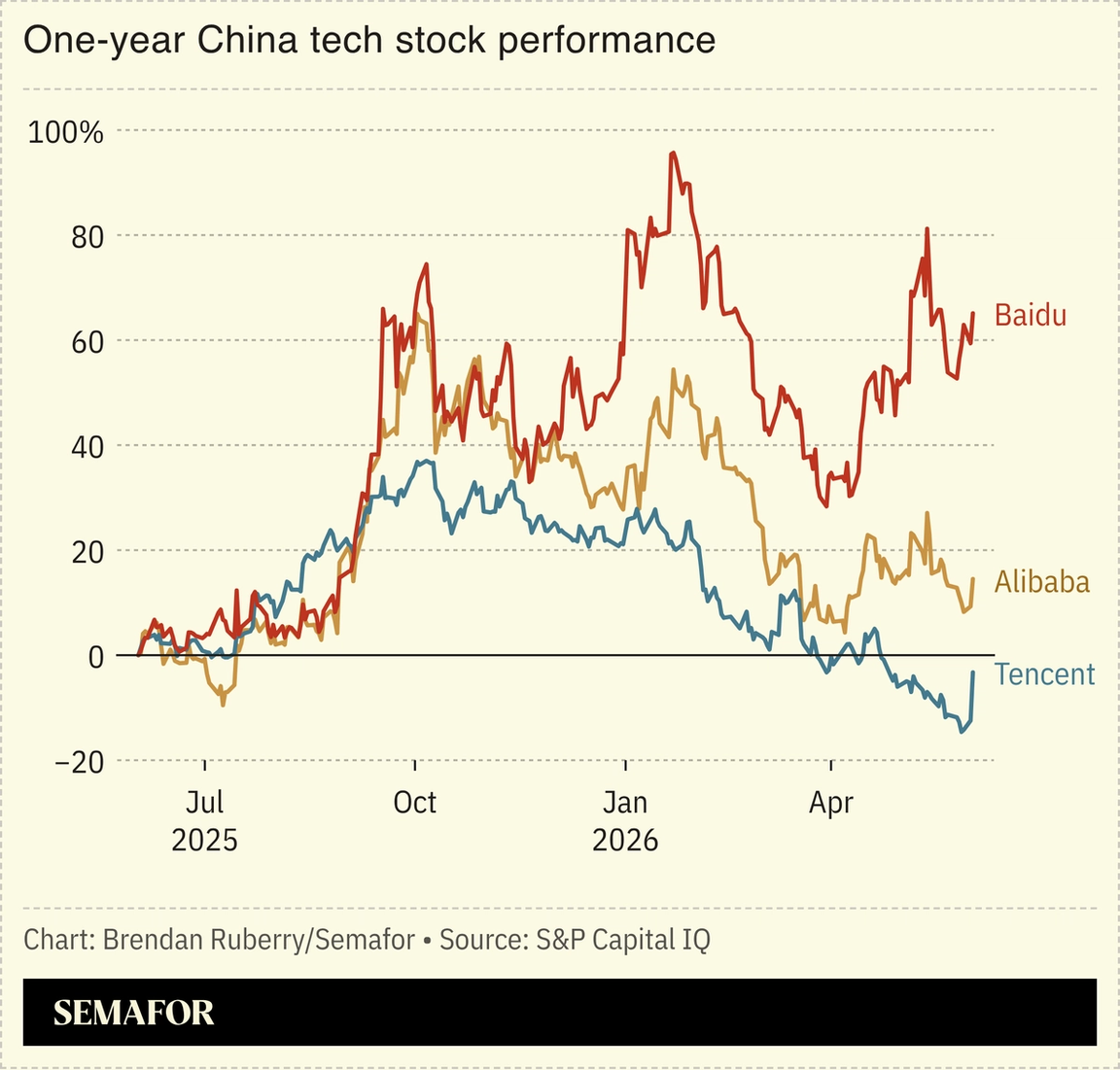 Chinese tech giant Tencent is reportedly getting closer to launching an AI agent for WeChat, its “everything app” widely used across China for messaging, social media, and payments. A public launch could happen as soon as this month, the Financial Times reported, ramping up competition among Chinese tech players racing to roll out AI features for customers. AI-powered commerce, in which an agent can shop and make payments on a user’s behalf, could represent the next big bet for online platforms — though it’s unclear how much customers will trust AI with their finances. Governance and hallucinations also remain challenges: A recent survey of large companies across 10 countries found three-quarters have already rolled back or shut down a customer-facing AI agent. |
|
 Anthony Pompliano thinks you’re smarter than your financial adviser. The Bitcoin evangelist has reinvented himself as the champion of a new kind of investor: digitally native, high-net-worth, and deeply skeptical of Wall Street expertise. On this week’s Compound Interest, presented by Amazon Business, he joins Liz and Rohan to talk about his AI-powered CFO product, why he thinks independent investors outperform the pros, what’s left in crypto worth caring about, and the uncomfortable politics of the Trump family’s meme coin. |
|
Whey protein industry faces shortages |
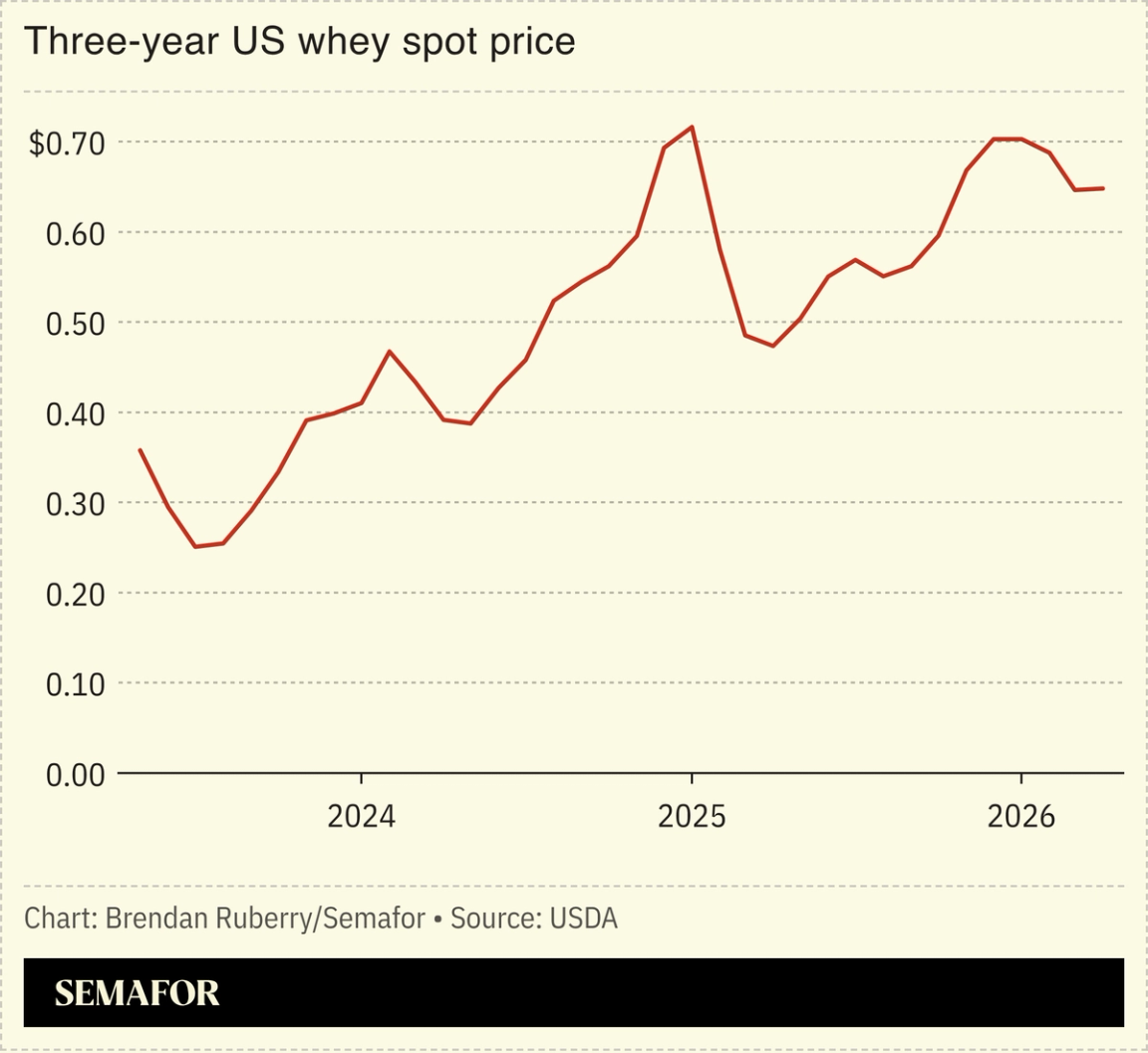 Producers are adding whey protein to so many foodstuffs that the industry is facing shortages and soaring prices. High-protein diets have become a mainstream wellness fad: A survey found that “good source of protein” became consumers’ primary criterion of healthy food last year, overtaking “fresh” and “low sugar.” Protein-enhanced chips, chocolate bars, lattes, and more are commonplace. But several suppliers are out of stock, Bloomberg reported, and one UK-based company said the price of whey protein increased 30% over three months. Some food manufacturers are switching to milk or pea proteins or pausing production altogether, while others are buying up what stock they can find to outlast the shortage. |
|
A new ‘prize’ for food allergy research |
The parents of a British child who died of an allergic reaction have set up a £10 million “prize” to encourage research into food allergies. Prizes have a long history in science: The British government’s 1714 “Longitude Prize” offering £20,000 to determine a ship’s longitude at sea was awarded to clockmaker John Harrison. But prizes can have off-target effects. If only the first team to succeed gets paid, it incentivizes speed over quality. Other research incentivization schemes include “advanced market commitments” that reward both; the model’s inventor won the economics Nobel in 2019. Natasha’s Prize is not a true prize but allocates funding to promising research avenues amid a sharp rise in allergic conditions in recent decades. |
|
|


