
|
 |



Today, Donald Trump appointed Tulsi Gabbard’s replacement as Director of National Intelligence (DNI) in a social media post.
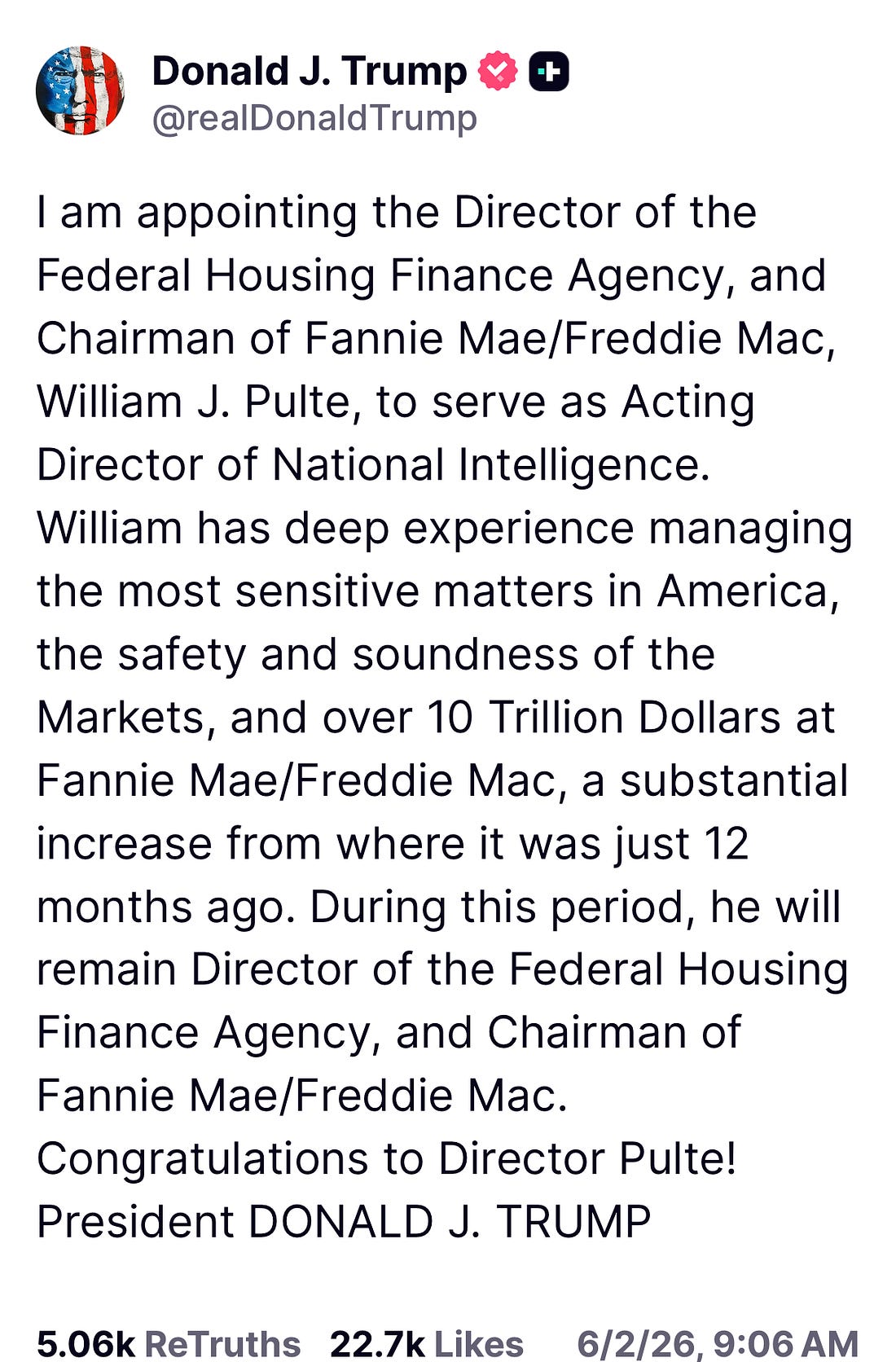 |
The DNI is “the head of the U.S. Intelligence Community, overseeing and directing the implementation of the National Intelligence Program and acting as the principal advisor to the President, the National Security Council, and the Homeland Security Council for intelligence matters related to national security,” according to the office’s website. DNI is a presidentially appointed, Senate-confirmed position, but Bill Pulte is being appointed as the acting DNI, so he won’t face that process.
Currently, Bill Pulte is the head of the Federal Housing Finance Agency (FHFA) as well as being the chairman of Fannie and Freddie. That’s a big job already, even before the add-on responsibilities of the DNI, which is a full-time, round-the-clock job. Pulte’s official FHFA bio indicates he “had a longstanding career in homebuilding, housing products, and community development. In 2011, Pulte founded Pulte Capital Partners LLC, an investment firm that focuses on building and housing products. He also served on the board of Pulte Homes, a Fortune 500 company and one of the largest homebuilders in the country. Beyond business, Pulte is recognized for his philanthropy.” There’s nothing that suggests he knows anything about national intelligence, let alone that he’s qualified for the position.
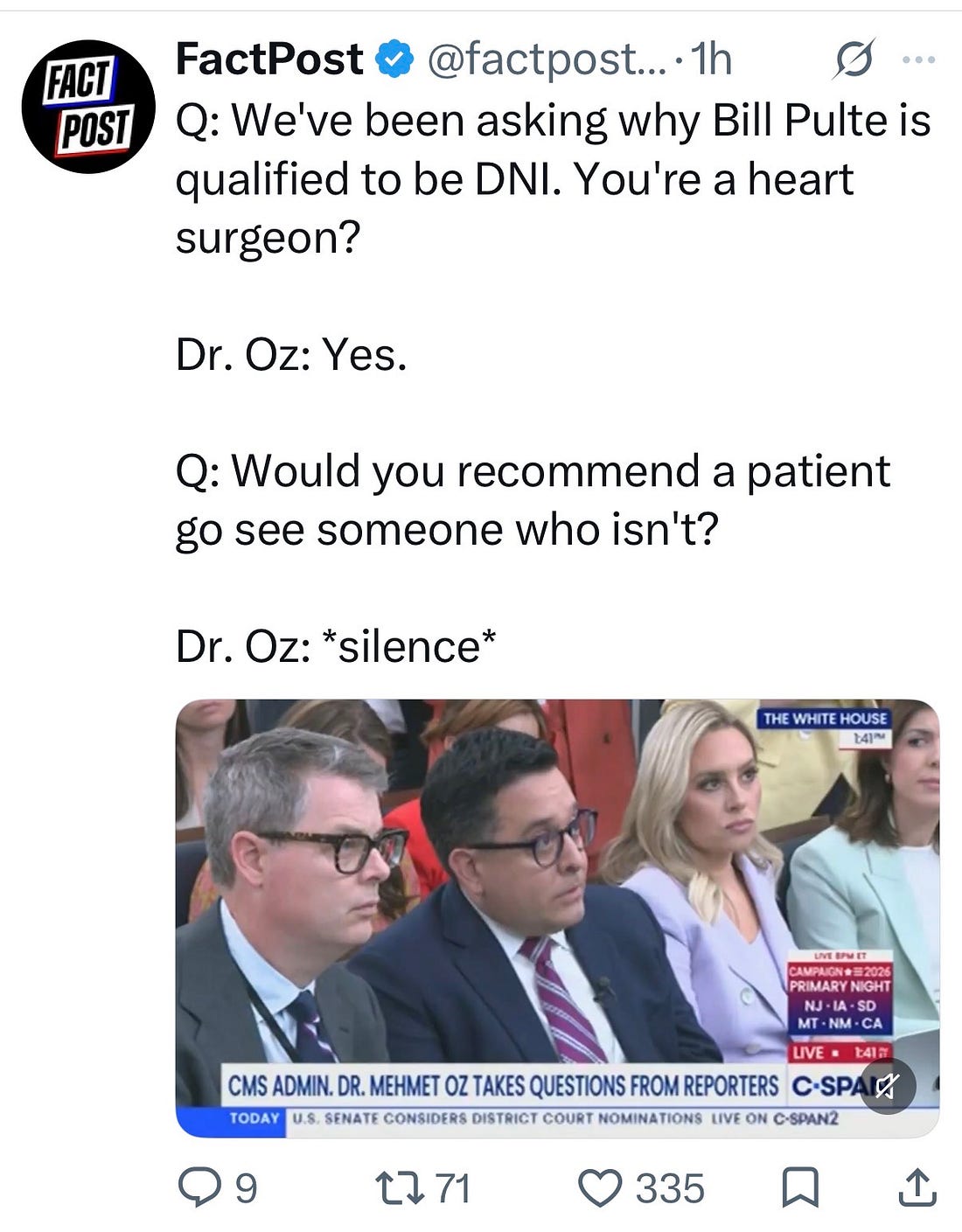
The law that creates the DNI position specifies that the nominee “shall have extensive national security expertise.” Pulte lacks any expertise, let alone extensive experience, which one might think a president would want at a time of international tension and outright war. But he is loyal to Trump, which, apparently, is the only criterion that matters here. Trump is back to using “acting” officials to skirt requirements for confirmation and qualification.
 |
What did Pulte do to demonstrate his loyalty? There are allegations that at FHFA, he used the access that came with his position to target Trump political opponents, like New York AG Letitia James and Fed Governor Lisa Cook, with unsubstantiated mortgage fraud allegations. He’s under investigation for doing that.
NBC reported that Pulte sent criminal referrals on both women to DOJ. Green was fired by Trump based on the allegations, which have never been proven and are internally inconsistent. She was never charged, but James was. The indictment against James was subsequently dismissed because Lindsey Halligan, the U.S. Attorney for the Eastern District of Virginia who obtained it, was improperly appointed. But James’ lawyers maintained she did nothing wrong, offering a credible explanation for how her mortgage was structured.
Trump had demonstrated animosity toward James for years over her legal challenges to his businesses and charitable organization. As to Cook, the first Black woman to serve in the role of Fed Governor, Trump fired her and tried to use her lawsuit as a vehicle to establish control over the Fed. That’s a position that the Supreme Court seemed poised to reject at oral argument, however. Pulte has not expressed regret for his role.
What might Pulte be able to do with access to the intelligence community’s stash of information? Like the warrantless surveillance of foreign targets outside of the U.S. that FISA (currently up for renewal) authorizes, which can sweep up Americans’ communications if they have email or telephonic communications with foreign targets. It’s quite a position for someone with no relevant experience, just a proven track record of supporting the execution of Trump’s revenge agenda, to be in.
As we look ahead to the midterms, it’s also possible that Pulte, whose role will include advising the president on potential foreign interference in the elections, could aid with an agenda designed to ensure favorable outcomes— seizing ballots or election equipment, or even offering a rationale for canceling elections with claims of foreign interference. This is all speculative, but not inconsistent with some of the schemes that were floated in the wake of the 2020 election. That makes it concerning when the DNI position and the access it brings with it go to someone with no apparent qualifications and a willingness to aid an illegitimate agenda, even more so because of the end run around Senate confirmation.
Senator Mark Warner of Virginia said the appointment “speaks volumes about what this president expects from the nation's top intelligence official.” He went on to warn that “Americans have every reason to worry about what happens when the official charged with overseeing everything from counterterrorism to foreign election threats is chosen for his willingness to advance the president's political agenda rather than [for] his experience. That is how intelligence becomes politicized, how inconvenient facts disappear, how agencies charged with protecting our democracy instead become tools to manipulate it, and how Americans are left more vulnerable to a terrorist attack.”
Here’s the silver lining: Trump’s hold on his party continues to slip. He lost ground in Congress, where some Republicans decided not to run again, including Marjorie Taylor Greene, while others broke with him over the Epstein Files. In the Senate, his decision to support Texas AG Ken Paxton and abandon the incumbent, John Cornyn, led to Cornyn’s primary loss and some loss of support for Trump. He joins Louisiana’s Bill Cassidy, who lost after Trump endorsed his opponent, and North Carolina Senator Thom Tillis, who decided against running again. That’s bad news for Trump with such thin majorities in both bodies. He may find that he lacks the support to pull off any election shenanigans this go round, with a less tolerant Senate when it comes to any improprieties.
All of that, as there is news that Trump’s favorability numbers are abysmal. Nate Silver wrote yesterday that Trump’s net approval rating is -16.1, worse than both Joe Biden and Trump’s first term self: “About 48 percent of Americans strongly disapprove of Trump’s job performance. Just 21.7 percent strongly approve of the job he’s doing, while another 17.2 percent only somewhat approve.” We are making progress.
Pieces like this one take time: connecting the legal dots and translating what actually matters into plain English. If this kind of analysis is valuable to you, consider becoming a paid subscriber. It helps keep Civil Discourse going and keeps this work accessible to everyone who needs it. If you haven’t already, you can join for $6 a month, or $50 a year if you want to save a bit.
We’re in this together,
Joyce