| | In today’s edition: Why oil prices aren’t higher, Iran strikes Kuwait’s airport, and an agricultural͏ ͏ ͏ ͏ ͏ ͏ |
| |  | Gulf |  |
| |
|
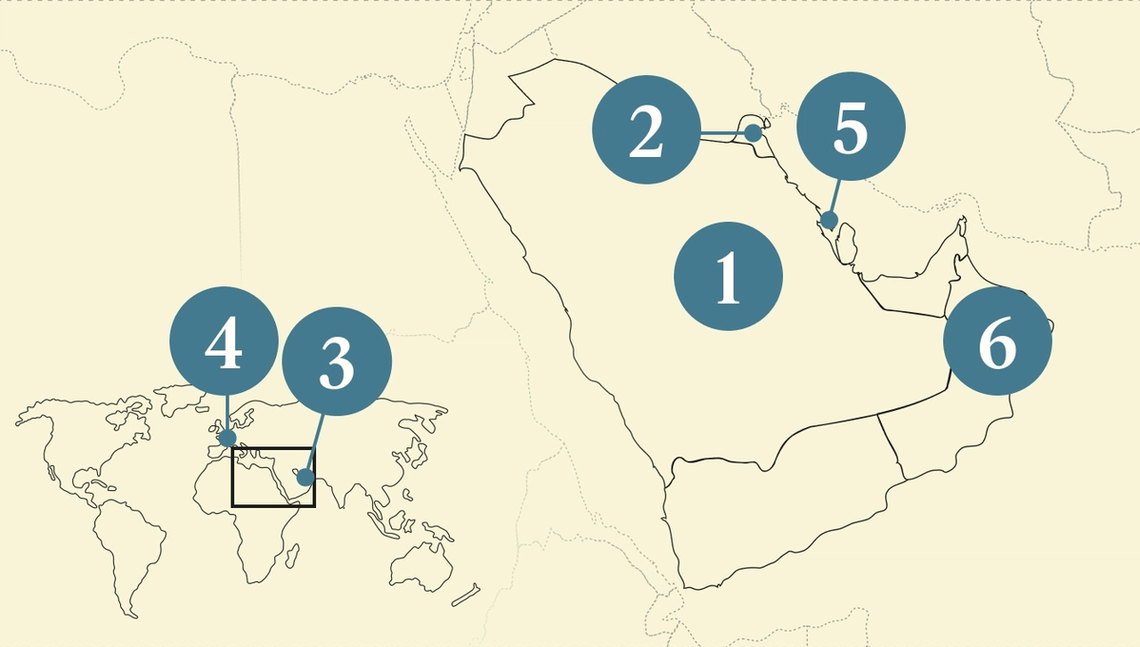 - Why oil prices are low
- Iran strikes Kuwait airport
- 20,000 seafarers trapped
- MGX boosts French AI deal
- Bahrain bets on Europe
- Oman’s food security push
 Elite workouts in the snow, in Dubai. |
|
Buffers keep oil prices from surging |
| |  | Tim McDonnell |
| |
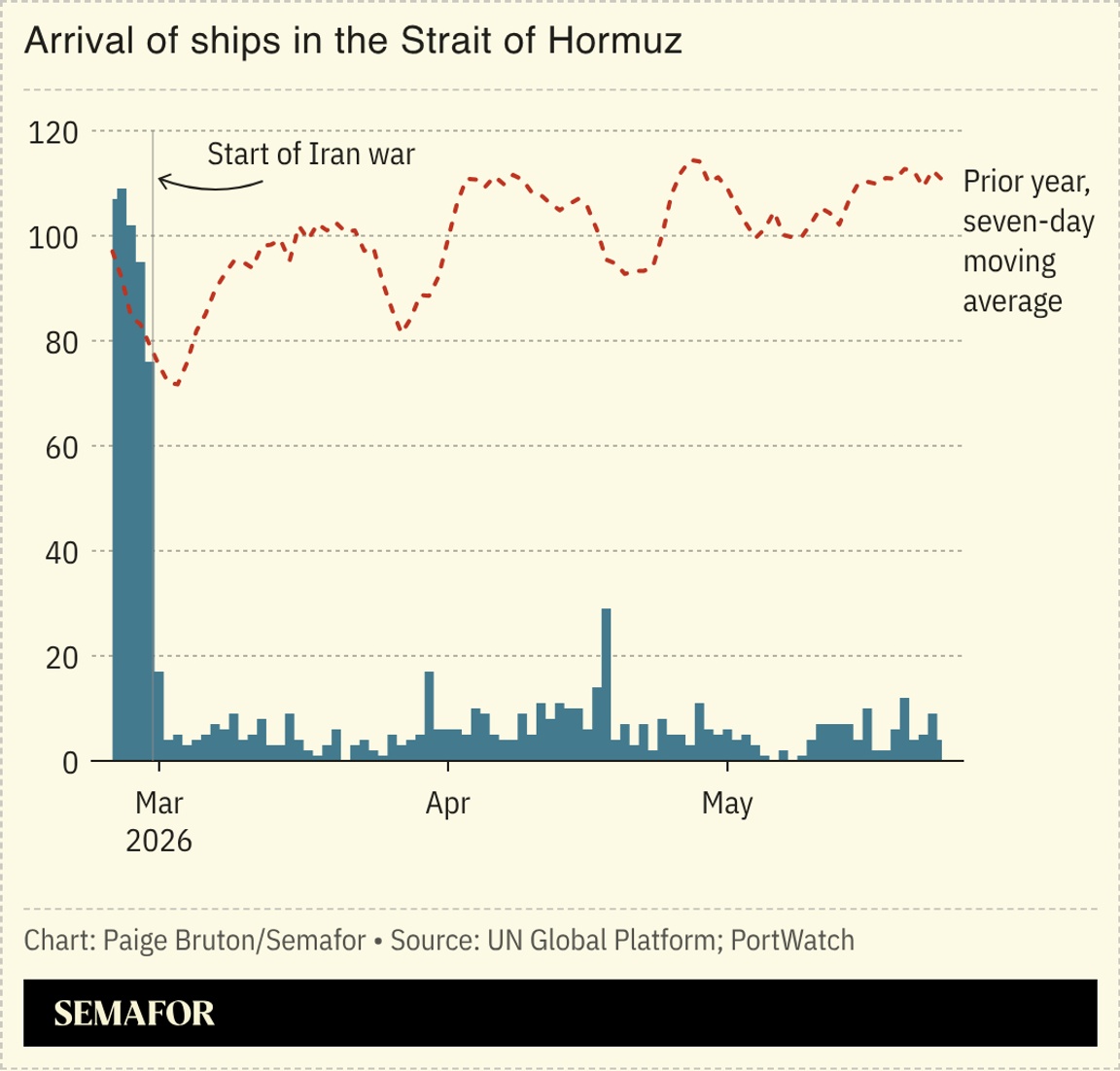 The Strait of Hormuz has been effectively shut for more than three months, tankers have been stuck at anchor, and peace talks between Iran and the US are in limbo. So why aren’t oil prices higher? Brent crude is hovering around $100 per barrel, 30% above prewar levels. This feels remarkably mild. A few factors have helped to keep prices in check. The UAE and Saudi Arabia were able to push crude through pipelines that bypass the strait. (The UAE is planning more links to circumvent Hormuz). China, which had been on a stockpiling spree, slashed its buying. The US and others tapped strategic reserves, US exports hit a record high, temporary waivers on some sanctioned Iranian and Russian crude unlocked more frozen barrels, and a handful of tankers have managed to slip through the strait. On top of all that is demand destruction: People use less energy when it’s expensive. The explicit willingness of at least some ship operators and energy exporters to consider paying Iran a toll may be convincing traders that flows can recover even without a broader resolution to the conflict. This week, a Greek shipping tycoon said he would pay to move vessels through Hormuz, while a senior Qatari official said Doha would consider a temporary fee. The bigger question is how long these buffers can last. According to the Brookings Institution, the supply disruption in May was 3.3 million barrels per day compared to prewar levels. That is set to double to 6.4 million by July, pushing oil prices to $150, according to Brookings — a forecast repeated Friday by a senior ExxonMobil executive. |
|
Kuwait shuts airport after Iranian hit |
 Aftermath of Iranian strikes at Kuwait International Airport. Social media via Reuters. Aftermath of Iranian strikes at Kuwait International Airport. Social media via Reuters.Kuwait briefly closed its international airport on Wednesday, after Iranian drones and missiles killed one person and injured more than 60 others, and caused “significant damage” to the facilities at Terminal 1. The building had only reopened on Monday after work to repair the damage from earlier Iranian hits. Kuwait Airways was later allowed to operate from another terminal. Kuwait has borne the brunt of recent Iranian attacks. The latest wave came amid a tit-for-tat exchange between the two belligerents, which saw the US hit an Iranian oil tanker near the Strait of Hormuz, and a communications tower on the Iranian island of Qeshm, while Iran fired at a container ship and the headquarters of the US Fifth Fleet in Bahrain. The US said other missiles fired at Kuwait fell short or broke apart in flight. |
|
Still unsafe to save seafarers, UN says |
 An estimated 20,000 seafarers are still stranded in the Gulf, according to the UN’s shipping agency. The shaky ceasefire and the lack of security guarantees means it is still too risky to move the sailors, Arsenio Dominguez, secretary-general of the International Maritime Organization, told Reuters. The IMO has been trying to establish a safe maritime corridor to allow vessels to exit, holding discussions in Oman with regional actors in recent weeks, he said. Some ships are turning off their transponders and moving along the Omani coast with US military assistance, in an effort to avoid Iranian mines and other threats, Bloomberg reported. However, mines are a risk even there. Other shipping companies are moving vessels into position in the hope of a US-Iran deal to reopen the strait. |
|
Abu Dhabi doubles down on French AI |
 Emmanuel Macron, president of France, and Khaldoon Al Mubarak, MGX vice chairman, at a signing for Campus AI. Courtesy of Emirates News Agency-WAM. Emmanuel Macron, president of France, and Khaldoon Al Mubarak, MGX vice chairman, at a signing for Campus AI. Courtesy of Emirates News Agency-WAM.Abu Dhabi’s MGX is doubling its investment in data centers in France, as the country emerges as the UAE’s top technology partner in the EU. The joint venture of MGX, state-owned investment bank Bpifrance, chipmaker Nvidia, and France’s AI champion Mistral announced their Campus AI expansion on the sidelines of a Paris investment summit, with plans to build 3 gigawatts of compute capacity nationwide, bringing the total investment to €7.5 billion ($8.7 billion). The ambitions are twofold: The planned data centers will rely on water-free cooling — a rarity in an otherwise water-intensive industry — and be powered by France’s nuclear-heavy electricity grid. That will make them a lower-carbon alternative to data centers elsewhere. The project will also help anchor tenant Mistral try to close the gap with US frontrunners like Anthropic and OpenAI. Separately, G42’s infrastructure subsidiary Core42 said it plans to more than triple its computing capacity to 60 megawatts in Buffalo, New York, in a further sign of Abu Dhabi’s growing ambitions to be an AI player abroad, as much, if not more, than at home. — Kelsey Warner |
|
Bahrain bets on French luxury deals |
 Hamad I Mohammed/Reuters Hamad I Mohammed/ReutersBahrain’s sovereign wealth fund Mumtalakat is partnering with France’s TRAIL to back an investment fund focused on arts, music, luxury, and sports deals. As part of the arrangement, the French fund will open an office in Bahrain and use it as a hub for fundraising and the expansion of its portfolio companies in the Gulf. TRAIL is an investor in Swiss luxury watchmaker Breitling, while its SLAM fund has invested in mixed martial arts through AresMMA, and motorcycle racing team Tech3. The deal was announced in Paris, where Aluminium Bahrain also said it would go ahead with a $2.2 billion purchase of Aluminium Dunkerque. The deals are further proof of Gulf countries’ willingness to deploy capital abroad even as they seek to bolster their domestic economies. Mumtalakat, with assets of around $18 billion, is one of the smallest Gulf sovereign wealth funds. |
|
Oman pours money into food security |
 Ibraheem Abu Mustafa/Reuters Ibraheem Abu Mustafa/ReutersOman has started work on a $4.2 billion agriculture development in the Batinah region which could provide food for 25,000 people — part of wider efforts to reduce the country’s dependence on imports, according to officials quoted by AGBI. Food security is a perennial issue for Gulf countries, where the harsh climate and limited water resources make growing crops difficult and expensive. Oman is aiming to produce 80% of the food it consumes by 2040. In pursuit of that, the government has set up a string of cloud seeding stations, mostly in Batinah and other areas in the north of the country, which it claims have contributed to a 14% increase in rainfall. The agriculture ministry has also invested more than 800 million rials ($2 billion) in around 400 food security projects in recent years, helping to expand arable land by 50,000 square kilometers; it will commit a further 200 million rials this year. — Dominic Dudley |
|
 On June 18 in Abu Dhabi, Semafor will convene The Gulf’s Golden Age Interrupted to examine how the region can sustain its economic momentum amid renewed conflict and geopolitical uncertainty. The Gulf has emerged as a global crossroads for energy, capital, technology, and talent, generating growth during decades of regional instability. As new tensions reshape markets and test economic resilience, Semafor editors will host on-the-record conversations with leaders in finance and technology at the Abu Dhabi debut of Semafor Gulf Live, exploring how the region can navigate this moment and reinforce its position as a critical global hub for capital, innovation, and energy. June 18 | Abu Dhabi | Request Invite |
|
 Food and Beverage- Berenjak, the London-born Iranian restaurant that opened a branch in Riyadh at the height of the war, has pressed on with a new Abu Dhabi location, its third in the UAE after Dubai and Sharjah. — Caterer
Human Resources- Staff at Sotheby’s UK property arm — owned by CEO George Azar, who also backs the Saudi and UAE franchises — accused management of sexual misconduct and hostility. Azar has reportedly boasted that his firm doesn’t have a human resources department to discuss complaints. — Bloomberg
Logistics- Abu Dhabi’s BlueFive Capital led a $250 million fundraise for autonomous delivery company CargoX, and announced Tomaso Rodriguez as the new chief executive. Rodriguez was previously CEO of delivery company Talabat, and led it through its $2 billion IPO in 2024.
Technology- Abu Dhabi Commercial Bank will allow customers to move between dirhams and cryptocurrency with zero fees on deposits or conversion penalties through a tie-up with Binance, the world’s largest crypto exchange by volume, which has made the UAE capital its de facto headquarters.
|
|
Ski Dubai is holding a HYROX-style competition at its indoor slope in the Mall of the Emirates. The first-of-its-kind event will include running through the snow, wall balls, and lots of burpees.  Courtesy of Ski Dubai Courtesy of Ski Dubai |
|
|


