| | In this edition: Tuesday’s messy primary results, Platner asks for the Biden treatment, and a bearis͏ ͏ ͏ ͏ ͏ ͏ |
| |  WESTON, FL WESTON, FL |  TRAVELERS REST, SC TRAVELERS REST, SC | SULLIVAN, ME |
 | Americana |  |
| |
|
 - Ballot boxed
- Blackout
- Anti-AIPAC 2.0
- Evette’s winning ads
- Dems’ tough poll
|
|
 “Every family has its own mythology,” Jill Biden wrote in her first memoir. Her second, released this week, digs through the East Wing’s rubble to rescue that mythology from the debacle of 2024. The former First Lady has some things in common right now with a Maine oyster farmer and political neophyte who’s running for Senate. Both Jill Biden and Graham Platner have highly scrutinized marriages (and families) that have made them political celebrities. And both argue that the public interest in their past missteps is a waste of time. “Amy and I have a very loving and very happy marriage,” Platner told reporters on Sunday after reports of sexual texts to other women walloped his campaign with new questions. “Establishment media outlets,” he said, were obsessed with personal “gossip” about him. It’s enough to make Democrats bristle at the sound of their names. The party resents being asked about Biden or Platner, resents that the political press can’t point its cameras somewhere else. That resentment is only a problem when a candidate loses or drops out. But the Biden-Platner defiance in the face of personal baggage points to a clear difference between the two parties when it comes to what disqualifies a candidate. Political operatives’ view of survivable scandal was transformed completely by President Donald Trump, then transformed again. Republicans can be convinced that negative stories about their candidates are media put-ons, and Democrats are a little envious that their voters haven’t adopted the same attitude of ignore, fight, move on, maybe sue. Read on for more about politicians demanding forgiveness. → |
|
|
Tuesday’s messy primary results |
 Manuel Orbegozo and Carlos Barria/Reuters Manuel Orbegozo and Carlos Barria/ReutersSix states’ primaries this week featured a loss for the president and mixed results for the left as California began its slow journey to a final vote count. In Iowa, Rep. Randy Feenstra became the first Trump-endorsed candidate this year to lose his race, conceding defeat to MAHA-endorsed activist Zach Lahn after a limp campaign that worried DC Republicans. Democrat Rob Sand had no competition for his gubernatorial nomination, and state Rep. Josh Turek crushed progressive favorite state Sen. Zach Wahls to win the nomination for Senate. It was the result establishment Democrats had hoped for, betting that the Paralympian from a Trump-won district would be more attractive to swing voters. Republican efforts to boost weaker Democrats in swing seats didn’t pay off. In north New Jersey, Air National Guard veteran Rebecca Bennett will challenge Rep. Tom Kean, R-N.J., who has yet to explain an illness that’s kept him off the Hill for months. But in a more liberal district, covering Trenton and Princeton, left-wing surgeon Adam Hamawy triumphed over a divided field with 28% of the vote. Progressives were also on track to nominate smokejumper Sam Forstag in Montana’s competitive 1st District, but there were too many outstanding California ballots to declare the top two finishers in most races. One exception: the 48th District, where support from the Congressional Progressive Caucus couldn’t rescue Ammar Campa-Najjar from his failure at seeking a House seat. In a statement after his loss to Democrat Marni von Wilpert, he said he was finished with electoral politics. |
|
Black Caucus confronts oblivion |
 Kylie Cooper/Reuters Kylie Cooper/ReutersHouse Minority Leader Hakeem Jeffries rarely declines to endorse an incumbent Democrat, but he made an exception this week: Florida Rep. Debbie Wasserman Schultz, a white incumbent who had left her gerrymandered seat to run in a majority-minority district, was not necessarily his candidate. “Everybody has a right to run where they see fit,” Jeffries told reporters. “They’ve got to go make their case to the people.” The Supreme Court’s evisceration of the Voting Rights Act in its Louisiana v. Callais decision could push out as many as a third of the Congressional Black Caucus’ 60 members by 2028. At least a half-dozen Black Democrats are expecting to get pushed out this year after Republicans eliminated safe seats in Florida, Missouri, Alabama, and Louisiana. That’s already sparked fights between Democratic incumbents and challengers — notably in South Florida, where Black candidates pushed into a safe seat by a new Republican map are furious about Wasserman Schultz’s decision to run against them. “It’s unnecessary division in a time where we’re fighting against Jim Crow Republicans for literally carving up our seats and stealing representation,” said Elijah Manley, a Democrat who announced for the district last year, and was seen as an early favorite when incumbent Rep. Sheila Cherfilus-McCormick resigned amid an ethics scandal. Read the full story from me and Semafor’s Nicholas Wu. → |
|
|
AIPAC’s Democratic toxicity enters a new phase |
 Daniel Becerril/Reuters Daniel Becerril/ReutersAdam Hamawy’s victory in New Jersey’s primaries this week delivered a safe Democratic seat to a progressive Justice Democrat, a critic of Israel’s war in Gaza who campaigned with Hasan Piker in the final stretch. Hamawy was endorsed by a broad array of groups, including 314 Action, a fund created to elect Democrats with experience in STEM fields. But earlier this spring, down the Turnpike in Pennsylvania, 314 Action’s effort to elect a physician in a blue Philadelphia-area district flopped. According to the group’s own polling, a major factor in the primary defeat of its favored candidate was support it took from an AIPAC affiliate in 2024 to boost a completely separate candidate. “Any time we make an endorsement or investment in a race, our opponents are branding our support as AIPAC money, and the truth is we haven’t accepted any contributions from AIPAC or affiliated entities in two years,” said Erik Polyak, 314 Action’s executive director. Theirs isn’t the only example of AIPAC’s enduring toxicity within the party as its brand gets tied to both the backlash against “dark money” and the war in Iran. Keep reading for more on the long tail of Democrats’ AIPAC antipathy. → |
|
|
The ads that helped South Carolina’s Lt. Gov. |
 Pamela Evette/YouTube Pamela Evette/YouTubeMost Republican primaries these days are battles for the Trump stamp of approval, and Lt. Gov. Pamela Evette got it in South Carolina. He endorsed her after a string of ads that highlighted a few of her issues (like phasing out the state income tax) but wrapped them in her support for Trump — and questions about why her competitors weren’t always with him. In “Alan Wilson Ignored President Trump,” an AI-generated version of Evette’s primary rival, the state attorney general, is shown repeatedly sending Trump’s calls to voicemail — including one in 2020, when he affirmed Biden’s election. “Never Trump Nancy Mace” went the same route against another GOP primary opponent, portraying Rep. Nancy Mace’s vote to certify the 2020 election as supporting Democratic “efforts to elect Joe Biden.” Evette’s competitors, lacking the Trump thumbs-up, are turning to validators like ex-Sen. Jim DeMint (for Rep. Ralph Norman) and… well, Donald Trump. The president still appears in one of Mace’s ads, thanking her for her work in keeping transgender athletes from competing on teams that align with their current gender identity. |
|
Democrats see a polling trust fall |
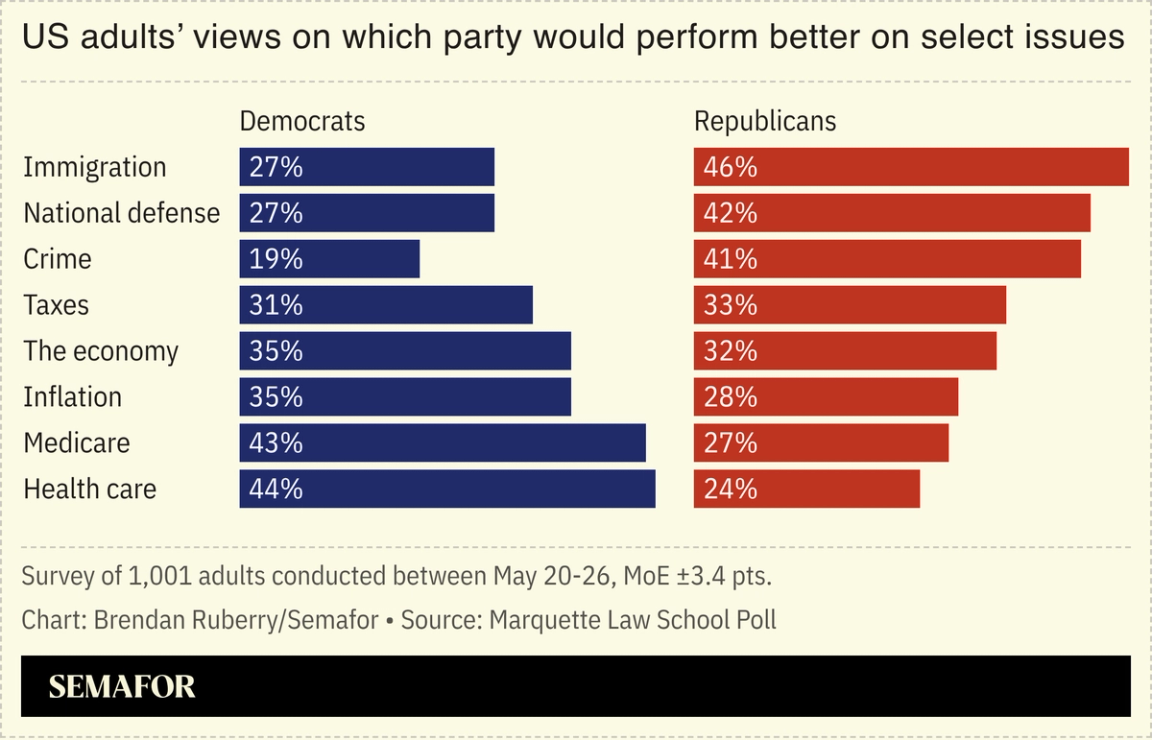 The head-to-head ballot test in Marquette’s national poll is the stuff that gives Democrats night sweats. The president’s approval rating is down to 38%, but the generic ballot question is a tie. The issue-by-issue questions explain what’s happening: Democrats have yet to win back trust on the GOP’s best issues from the last three elections. Voters side with Republicans on crime, years after the Democrats smothered their “defund the police” sloganeers. Voters also still side with Republicans, and Trump, on immigration. That’s a strike against the Democrats’ unofficial message on the issue: that the borders should be controlled, but the Trump administration has gone too far with enforcement that deports non-citizens with no criminal record. On the bright side, Democrats see a notable advantage on immigration and a slimmer one on the economy, which is a growing weak spot for the GOP and the president. |
|
 On Wednesday, June 10, Daphne Koller, Founder & CEO of Insitro, will join Semafor Tech in San Francisco to unpack the breakthroughs pushing technology into a new phase of economic and geopolitical consequence. Understanding innovation requires first-principles thinking: breaking complex problems down to their core inputs, constraints, and incentives — then rebuilding from the ground up to see what comes next. Semafor will host conversations with Charina Chou, Chief Operating Officer, Google Quantum AI; Aaron Levie, Co-Founder & CEO, Box; Jeetu Patel, President & Chief Product Officer, Cisco; Qasar Younis, Co-Founder & CEO, Applied Intuition; Max Hodak, Co-Founder & CEO, Science Corporation; Pete Shadbolt, Co-Founder & Chief Scientific Officer, PsiQuantum; and Glenn Fogel, CEO, Booking Holdings Inc.; to unpack how innovation is reshaping industries, redefining competitive advantage, and transforming the global economy. |
|
 Joel Angel Juarez/Reuters Joel Angel Juarez/ReutersThe New York Times’ Ruth Graham was exactly the reporter I wanted to read digging into Jim Rigby, Texas state Rep. James Talarico’s progressive Presbyterian pastor. Rigby “does not use male pronouns for God” because it might feel limiting to young girls, she notes. He “does not use the word ‘Lord,’ because it conjures a wealthy, European, male God.” As Republicans use the rest of the year to go after Talarico’s nontraditional version of Christianity — the major selling point for his campaign, and very attractive to donors — this piece will be worth re-reading. |
|
 Graeme Jennings/Pool via Reuters Graeme Jennings/Pool via ReutersAn emerging theme of this year, |
|
|


