| | Iranian drones hit Kuwait’s main airport, Donald Trump plans to attend the NATO summit next month, a͏ ͏ ͏ ͏ ͏ ͏ |
| |  | Flagship |  |
| |
|
The World Today | 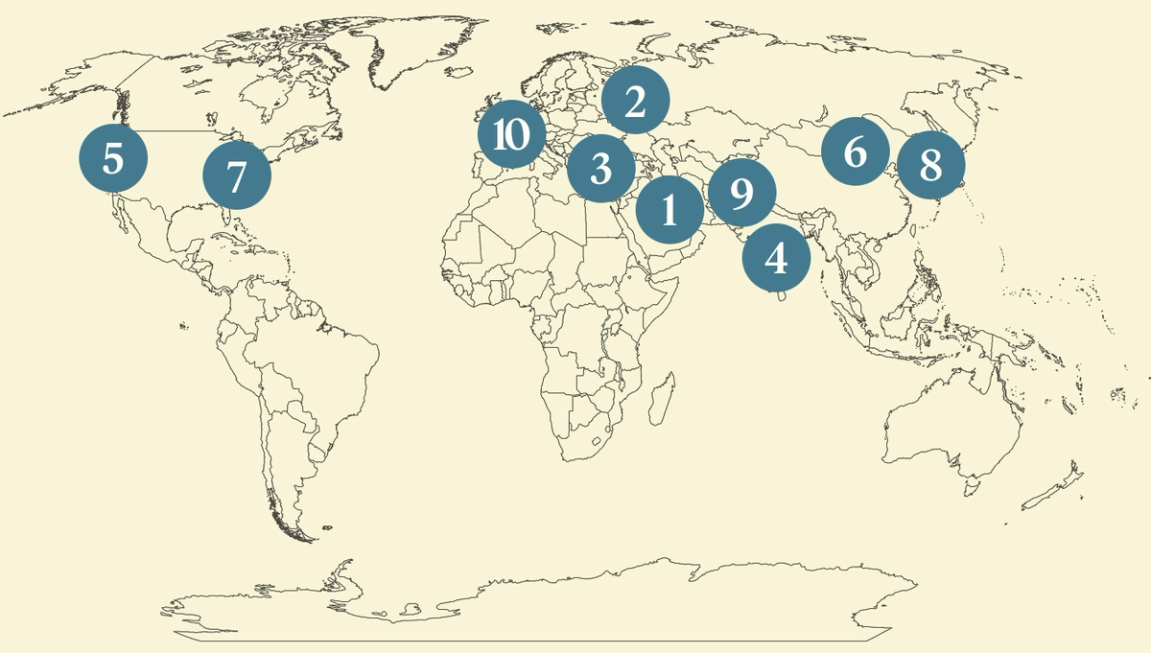 - Iran strikes Kuwait airport
- Kyiv hits ‘Putin’s Davos’
- Trump’s NATO plans
- Tech sovereignty push
- Sharing in AI wealth
- AI backlash scapegoat
- Data centers’ water problem
- Korean beauty grows in US
- UK chain is a hit in Kashmir
- Gulf owners of French hotels
 A debut novel that “tears through Britain’s social fabric.” |
|
Strikes on Kuwait airport test truce |
 Kuwait News Agency/Handout via Reuters Kuwait News Agency/Handout via ReutersIranian drones on Wednesday struck a passenger terminal at Kuwait’s main airport, killing at least one person, in the latest test of the fragile ceasefire between Tehran and Washington. Iran’s foreign minister said “no tangible progress” has been made in peace talks. The result of the deadlock is three regional truces “that look like war,” The Wall Street Journal wrote: Fighting persists in Iran, Lebanon, and Gaza, despite ceasefires on paper. The conflicts are also intertwined; Tehran warned that any Israeli attack on Beirut would “lead to a full-scale resumption” of its war with Washington. An interim agreement to end the US-Iran war will likely leave the Islamic Republic “battered but not broken,” Reuters reported, leaving the door open for future conflict. |
|
Ukraine drones hit near ‘Putin’s Davos’ |
 Stringer/Reuters Stringer/ReutersUkrainian drones struck a Russian oil terminal and naval base in St. Petersburg on Wednesday, just hours before an economic conference dubbed “Putin’s Davos” kicked off in the city. The attacks were a “clear attempt to embarrass the Kremlin chief,” Reuters wrote: Ukrainian drones have been striking deeper into Russia amid a military and diplomatic deadlock. Kyiv’s strategy of long-range drone assaults are denting Russia’s economic engine, leading to the risk of fuel shortages. Some Russian executives gathering in St. Petersburg argued the best way to restore growth is to cease hostilities with Ukraine. “The question is: does this war end or do we stare into a much tougher future?” one attendee said. |
|
Trump to attend NATO summit |
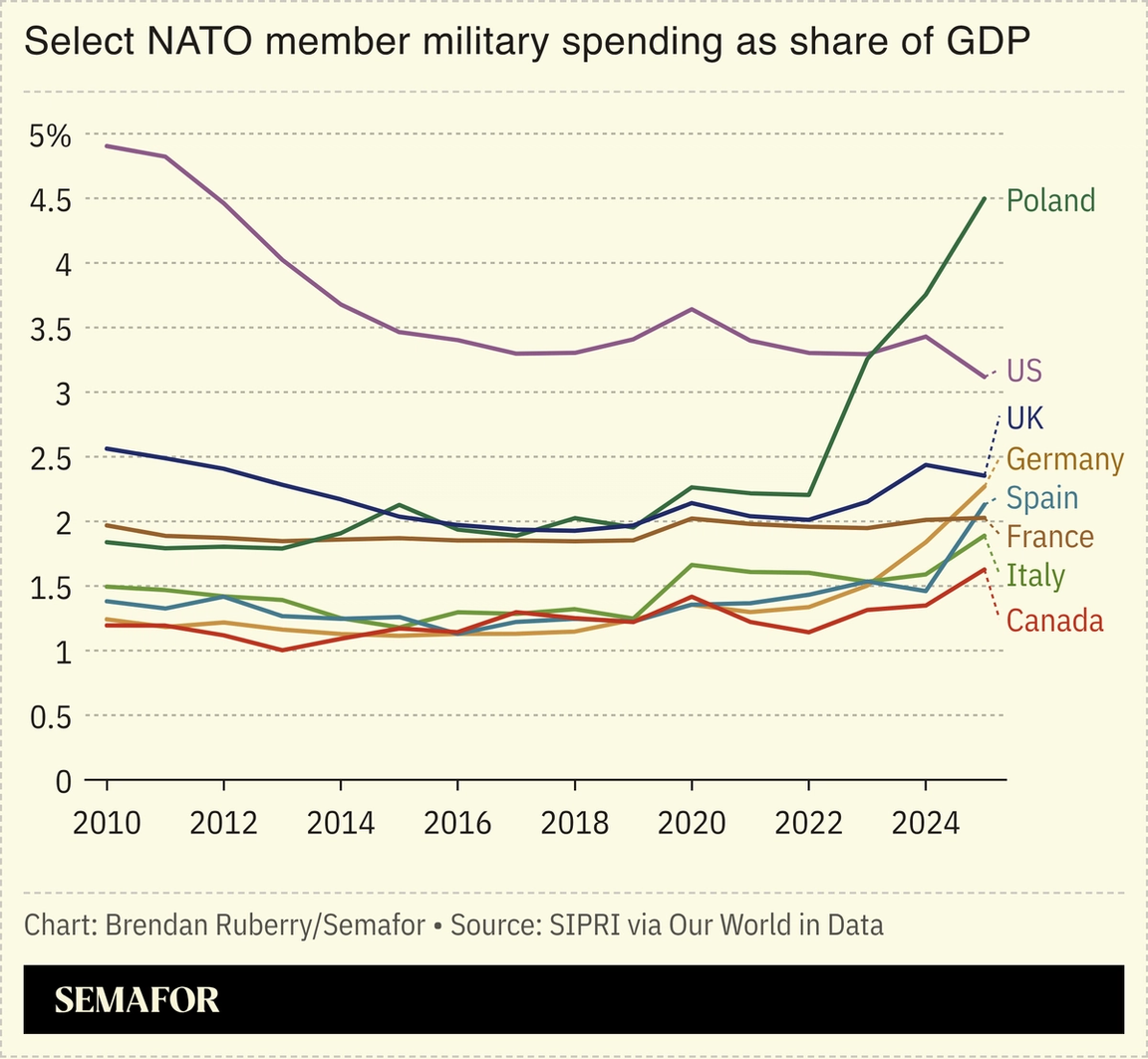 US President Donald Trump will attend the NATO leaders’ summit in Turkey in July, Washington’s top diplomat said Wednesday, relieving anxious European officials. Trump has lashed out at NATO and threatened to withdraw in recent months over alliance members’ reluctance to get involved in the Iran war. Transatlantic tensions are becoming “more difficult to manage,” NATO’s former secretary general said, as Trump reportedly plans to accelerate the withdrawal of US troops from European bases. On the other hand, Washington is discussing deploying nuclear weapons in additional NATO states, the Financial Times reported, in a bid to show that “reduced conventional military support does not weaken security guarantees.” |
|
EU, India push for tech sovereignty |
 Adnan Abidi/Reuters Adnan Abidi/ReutersWashington’s willingness to weaponize its technological dominance is pushing world powers to advance their efforts toward digital independence. The EU on Wednesday unveiled its plan to boost local players and reduce the continent’s reliance on foreign tech. Three American giants, Amazon, Microsoft, and Google, control more than two-thirds of the regional cloud market, raising fears in Europe that a geopolitical spat could lead US President Donald Trump to exploit a “kill switch.” India is also pushing for AI sovereignty, spurred in part by Beijing and Washington’s tightening grip on their tech and infrastructure. But that effort is hampered by years of computing underinvestment, a tepid venture capital environment, and a late start in building domestic AI models, Bloomberg reported. |
|
US senator proposes AI wealth fund |
 Ryan Murphy/Reuters Ryan Murphy/ReutersThe AI boom is creating considerable wealth, raising the question of who should share in it. Nvidia’s CEO this week pitched hundreds of family office and finance representatives on the “insane” returns they could get from investing in AI, Bloomberg reported. US Sen. Bernie Sanders meanwhile, proposed a bill that would give the US government a stake in leading AI companies — similar to the Trump administration’s move to take stakes in companies sitting in strategic sectors — and create a sovereign wealth fund that would benefit the American people. “When a public resource generates wealth, the public should share in that wealth,” Sanders argued. Lawmakers are wary of Sanders’ plan, but OpenAI’s Sam Altman was set to discuss it with him on Wednesday. |
|
China’s growing role in US tech discourse |
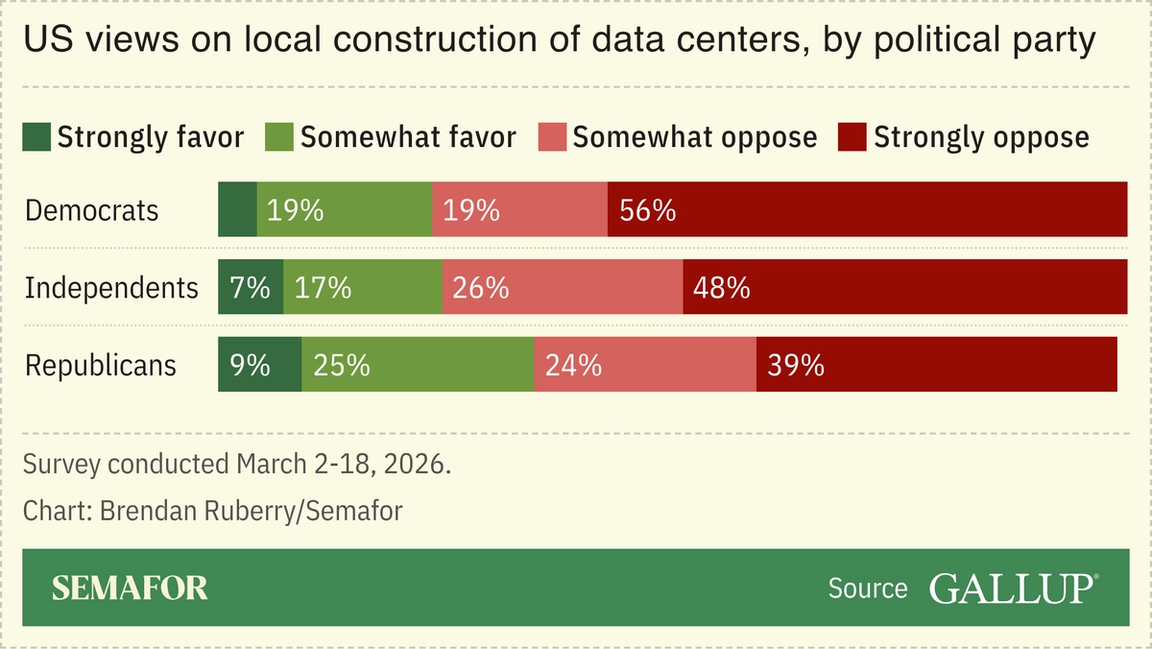 Some politicians and business leaders are claiming that China is driving the American backlash to data centers. A Republican lawmaker on Wednesday called for legal action against US nonprofits that he alleged are backed by China to sow opposition to the AI buildout. Canadian millionaire Kevin O’Leary recently claimed “nefarious accounts” linked to Beijing were behind the pushback to a data center project he’s backing. But the idea that foreign influence is seeding a populist campaign against AI facilities is far-fetched, experts told Semafor last month, noting that Chinese media is instead likely exploiting existing US divisions over the tech. The accusations reflect China’s growing role in US tech discourse, as the superpowers’ AI race heats up. |
|
Tech giants address water concerns |
|
 On June 18 in Abu Dhabi, Semafor will convene The Gulf’s Golden Age Interrupted to examine how the region can sustain its economic momentum amid renewed conflict and geopolitical uncertainty. The Gulf has emerged as a global crossroads for energy, capital, technology, and talent, generating growth amidst decades of regional instability. As new tensions reshape markets and test economic resilience, Semafor editors will host on-the-record conversations with leaders in finance and technology at the Abu Dhabi debut of Semafor Gulf Live, exploring how the region can navigate this moment and reinforce its position as a critical global hub for capital, innovation, and energy. |
|
K-beauty store opens in the US |
 Kim Hong-Ji/Reuters Kim Hong-Ji/ReutersSouth Korea’s leading beauty retailer opened its first US store, a mark of the global influence of K-beauty. Olive Young has more than 1,400 stores in Korea and surpassed $4.2 billion in sales last year; more than half of its global digital sales come from the US, the company’s US CEO told The Wall Street Journal. TikTok has fueled a global craze in Korean serums, peels, mists, and gels. While K-beauty products still form only a small percent of the overall American market, sales hit $2.4 billion in 2025, up 48% year-on-year, and 173,000 Americans visited South Korea for medical treatments, including cosmetic surgery and dermatological procedures. |
|
UK fast-food chain is a hit in Kashmir |
 Chicken Cottage in London. Hannah McKay/Reuters Chicken Cottage in London. Hannah McKay/ReutersThe unregarded British chain restaurant Chicken Cottage has become among Pakistan-administered Kashmir’s biggest fast-food franchises. The chain was founded in London in 1994 by Pakistani immigrants, offering halal KFC-style fried chicken. But returning migrants brought it home, advertised it as “Top brand from UK,” and played up its “British ambience” with images of Westminster and Piccadilly Circus, a UK and India-based magazine, Vittles, wrote. The growing anti-immigrant sentiment in the UK has not kept away the crowds buying into Chicken Cottage’s ersatz British image. Brand perceptions often change across countries: Pabst Blue Ribbon beer is downmarket in the US, but a luxury in China; Clarks shoes are dull school uniform accessories in the UK, but style icons in Jamaica. |
|
|


