| | In today’s edition: Nick Kristof under scrutiny. ͏ ͏ ͏ ͏ ͏ ͏ |
| |  New York New York | Washington |  San Francisco San Francisco |
 | Media |  |
| |
|
 - Kristof’s crucible
- Standard of living
- Baltic book review
- Mixed Signals
- Pomp and circumstance
- Out of the loop
|
|
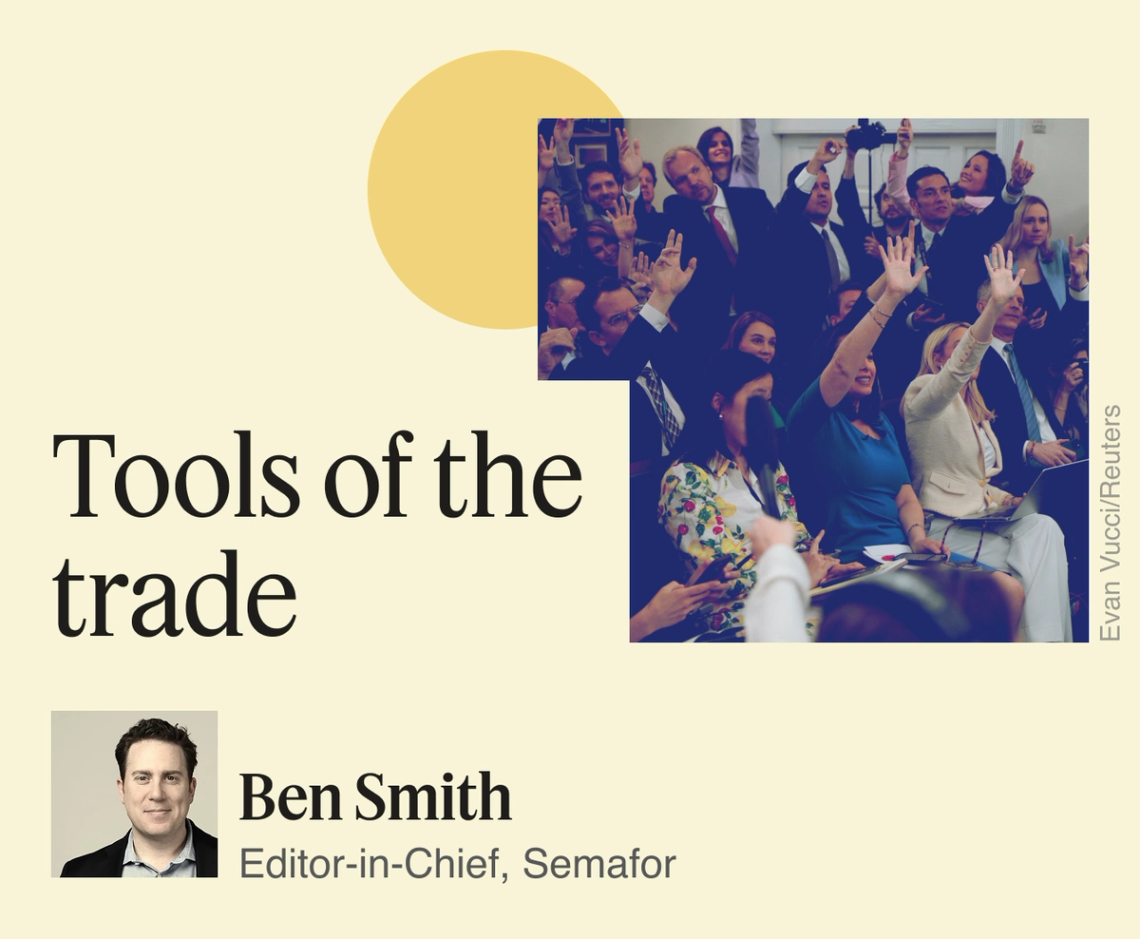 There are two ways of looking at journalism. In one light, it’s a profession, conducted by a credentialed professional class. In the other, it’s a trade, operated in service of customers who want to understand the world. This moment, from the Trumpian pressure on independent media to the related turmoil at CBS News to the uncertainty around AI, is a gloomy one for the profession. But Max lent me this space to share my most optimistic take: that there are hopeful signs that the trade of journalism is resurgent simply because many consumers prefer what it offers — true statements, hard questions — to the alternative. Here are a few signs: The great Silicon Valley podcaster Dwarkesh Patel surprised and delighted his audience in April by pressing Nvidia CEO Jensen Huang on the contradictions of US-China chip policy. A new Pentagon press corps, invited in by Defense Secretary Pete Hegseth in a wildly unsuccessful attempt at image management, has somehow forced the Pentagon chief into stonewalling tough questions from Gateway Pundit and The Daily Caller. “They are starting to feel the same frustration as we felt, that they can’t get information,” one surprised Pentagon reporter told me. The Silicon Valley newsletter Pirate Wires, born out of tech’s anger at the media, now breaks news and brings in varying perspectives (OK, mine, on this exact subject). And on the legacy end of the spectrum, the hosts of The New York Times’ Popcast told us on Mixed Signals that they attribute their success (and A-List bookings) to a hunger among both artists and fans for deeper engagement than social media softballs. “It’s like they’ve never seen a real interview before,” Jon Caramanica said of some of the show’s younger fans. This trend can be irritating to the professional journalist class, who will note that these upstarts are extremely messy in various ways — ideological, conflicted, wet behind the ears. But the professionals have our well-documented blind spots, too, which we write about in this week’s piece about New York Times opinion columnist Nick Kristof. And there’s another way to see it: Journalists should have the confidence of our convictions. That means believing — and helping — the gravity of good journalism to defeat boring propaganda and endless podcasts. Also today: One well-funded news outlet pushes up a whole city’s press corps’ pay, and a Father’s Day book recommendation. |
|
Kristof quoted former campaign donors in columns |
 David Swanson/Reuters David Swanson/ReutersWhen Kristof returned to the Times following a scuttled 2021 bid for governor of Oregon, the paper made a promise to readers: Kristof would refrain from writing about the financial supporters of his campaign, or would disclose those connections in his journalism. But in at least a dozen instances since then, Kristof failed to make those disclosures, referencing former donors like Bill Gates without noting their support. And after an inquiry from Semafor, the Times is reviewing his work. Kristof has been under particular public scrutiny since the May 11 publication of The Silence that Meets the Rape of Palestinians, a reported piece in which he interviews Palestinians who describe being brutally sexually assaulted by Israeli guards. A source flagged Kristof’s nondisclosures to Semafor after that May column was published, though it wasn’t immediately clear what had prompted the source’s interest in Kristof’s work now. The Times has defended his reporting and its fact-checking process, but the episode shows how closely the public can now scrutinize individual journalists. |
|
SF Standard’s expansion leads to media salary bump |
 Courtesy of Haymaker/Media Summit Courtesy of Haymaker/Media SummitThe SF Standard has used co-founder Michael Moritz’s money to boost reporters and editors’ salaries across the Bay Area, CEO Griffin Gaffney told me at Haymaker’s Media Summit in San Francisco last week. Referring to Moritz, who plucked Gaffney to launch the media venture in 2021, as the “chief typo officer,” Gaffney said the billionaire venture capitalist is heavily engaged in the upstart’s business but has never — and will never — meddle in editorial operations. His backing has helped the SF Standard poach staffers at other publications and, in some cases, nearly double their salaries. It’s also helped bring some distinct people onboard, including a staff comedian who’s been tapped to make funny social media videos to help build the outlet’s audience. It’s essentially a marketing expense, Gaffney said. The news site’s editor-in-chief, Kevin Delaney, was snapped up through the acquisition of his own company, Charter, which Gaffney called a no-brainer. While the SF Standard got a taste of its own medicine when the California Post launched (and poached some key talent), Gaffney said the two media companies are focused on different things. The Standard has focused on local reporting and keeping politicians and other stakeholders accountable, and will expand that approach to tech CEOs and other powerful residents. The company has also set its sights beyond San Francisco — nothing imminent on timing, but Gaffney said plenty of media ventures got their start in one city, only to expand further. — Shelly Banjo |
|
View: How Washington fell for Nord Stream conspiracy theories |
| |  | Ben Smith |
| |
 Marko Djurica/Reuters Marko Djurica/ReutersAfter someone blew a hole in the Nord Stream Pipeline deep under the Baltic Sea in September 2022, the world debated a geopolitical whodunnit. The American media, bolstered by official statements from unnamed officials, suggested Russia was behind the attack. “US and Europe condemn ‘sabotage’ as suspicion mounts that Russia was behind pipeline leaks,” read a representative CNN headline. Russia, meanwhile, blamed the CIA — and soon found support from the legendary American journalist Seymour Hersh, who published a detailed, single-source Substack post claiming that US Navy Divers placed C4 charges to be set off later by the Norwegian Navy. The actual attackers, backed by Ukraine, were “overjoyed by the proliferation of fake news,” reveals The Wall Street Journal’s chief European political correspondent, Bojan Pancevski, in his cinematic new book, The Nord Stream Conspiracy. The episode is a revealing moment in a story that Pancevski broke large parts of in the Journal in 2023, and a useful glimpse at Washington’s — and the world’s — disorienting fog of war in a broken information environment. |
|
Eli Pariser on ‘Mixed Signals’ |
 Eli Pariser coined the term “filter bubble.” Now, he thinks AI is about to change how you start your day. On this week’s episode of Mixed Signals, New_Public co-director Eli Pariser joins Max and Ben to talk about how soon your morning routine will change, and which platforms are most exposed to AI disruption. |
|
It’s all just media, says Pomp |
 Screenshot/YouTube/Semafor Screenshot/YouTube/SemaforWe’ve written much here about the increasingly blurry lines between television, streaming, and vertical video, but is the next big shift actually just the final convergence of “legacy” and “new” media? In a wide-ranging conversation with our Liz Hoffman and Rohan Goswami on Compound Interest, crypto guru Anthony Pompliano observed that legacy media outlets have struggled to gain traction akin to what the most successful independent creators have gotten: “Every once in a while, a video will go viral or something, but a lot of them have five, 10, 15 million subscribers, and they get a couple hundred views on videos.” But YouTuber-podcasters like himself also face certain limitations; as news consumers attempt to sift through the vast morass of financial and business information available online, they look for names and outlets with authoritative reputations. Crossover experiments in business media, like the team behind the Acquired podcast’s launch of a new Wall Street Journal column, are one potential solution, he said. “You want the internet-nativeness and the ability to go viral on [social] platforms, but you also want the heft and legitimacy that comes with the legacy media as well, and I think that’s why you’re starting to see these two groups come together,” he said. “Ultimately, it’s just gonna be media at the end of the day.” |
|
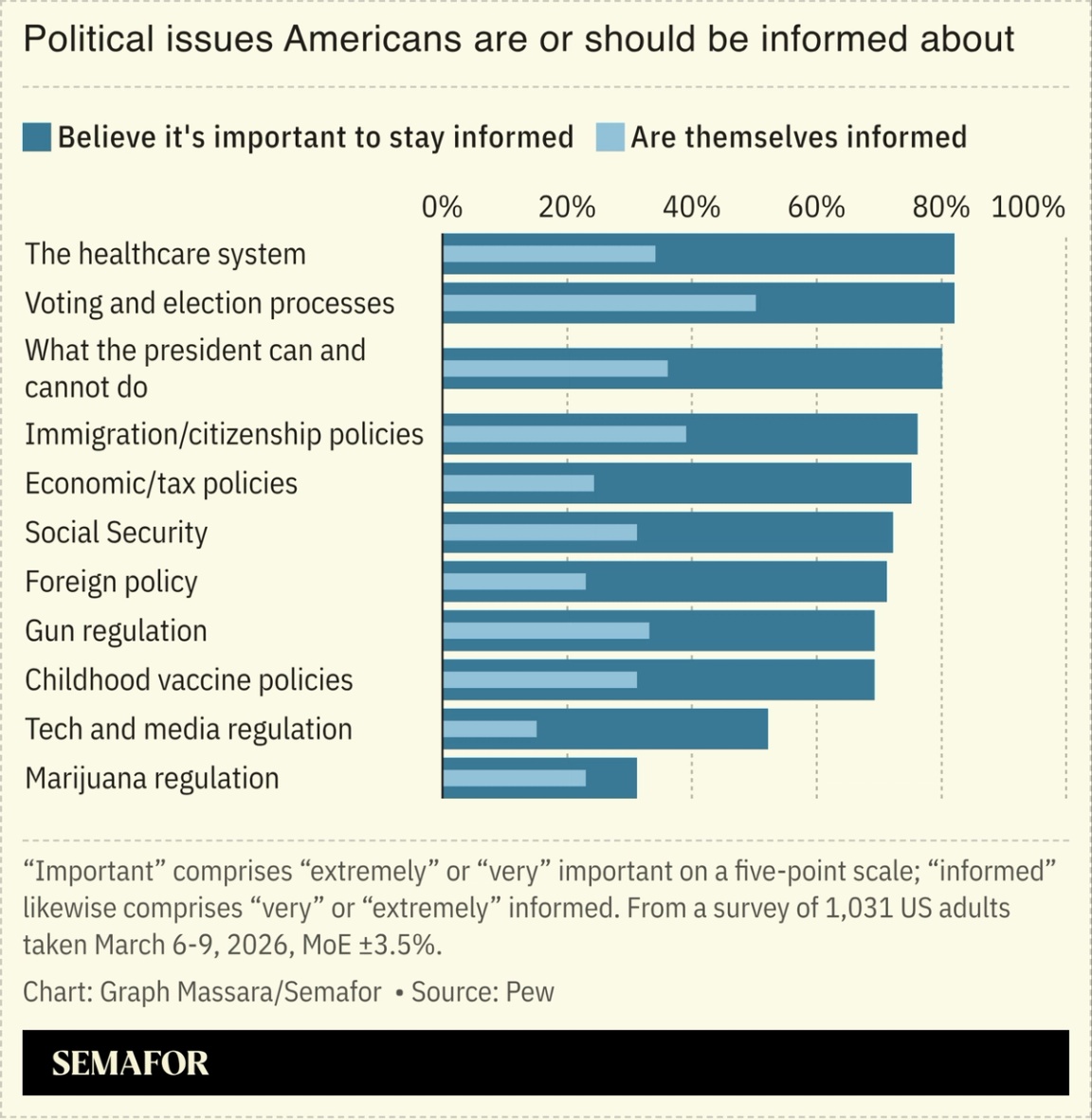 There is a yawning gap between the big political news stories Americans think they should be following and what they actually know. A Pew survey taken this spring found that US adults widely agreed on the importance of staying up-to-date on major policy questions, but about half as many professed that they themselves felt well-informed about each issue. For example, 80% said that understanding what President Donald Trump is legally allowed to do is important, but 36% said they felt informed about his powers. It’s a finding that dovetails with a related study Pew conducted last year, which found eight in 10 Americans believe it’s voters’ duty to read the news but only one in 10 expect them to pay for it — and a recent AP-NORC poll, which found that most Americans say that actually reading the news is stressful and overwhelming. — Graph Massara |
|
Variety: CAA and TPG have teamed up to form a new holding company meant to scoop up “leading Creator Economy businesses,” Todd Spangler reports. Status: In an effort to quell the civil war within CBS News, new 60 Minutes producer Nick Bilton has offered to rehire one recently let-go correspondent, Draggan Mihailovich, reports Oliver Darcy. NYT: The UFC fight on the White House lawn this evening is estimated to cost more than $60 million, Shawn McCreesh reports. Front Office Sports: Jay-Z and Alicia Keys’ 2009 classic Empire State of Mind saw a 1,245% spike in listens on Spotify after the New York Knicks won, per Ryan Glasspiegel. A Media Operator: Media startup 6AM City has reached profitability by blasting out hundreds of fully AI-generated newsletters a day, Kari McMahon writes. WSJ: Melinda French Gates and Laurene Powell Jobs’ Emerson Collective have expressed interest in investing in The Bulwark, Jessica Toonkel reports. Axios: The White House thinks that The New York Times’ Maggie Haberman and Jonathan Swan obtained audio recordings of Situation Room meetings for their new book, Jim VandeHei and Mike Allen scoop. |
|
|


