
|
 |



Sunday was the president’s birthday, which meant cage fights on the South Lawn of the White House. The weigh-ins at the Lincoln Memorial Saturday night were atrocious. The fights were scheduled to start shortly after I finished up this piece. I had no intention of watching the spectacle, so I headed out to dinner with a girlfriend. My phone blew up the whole time. But it was too nice of a night to ruin by watching Trump’s birthday Hunger Games now, so I’m going to do the last edit and send this off to you without watching the show. I apologize in advance for the length, but this piece should catch you up on the most important issues and get you ready to stay up to speed this week. I’ll catch up in the morning, but I do hope they had bad weather for the cage fights.
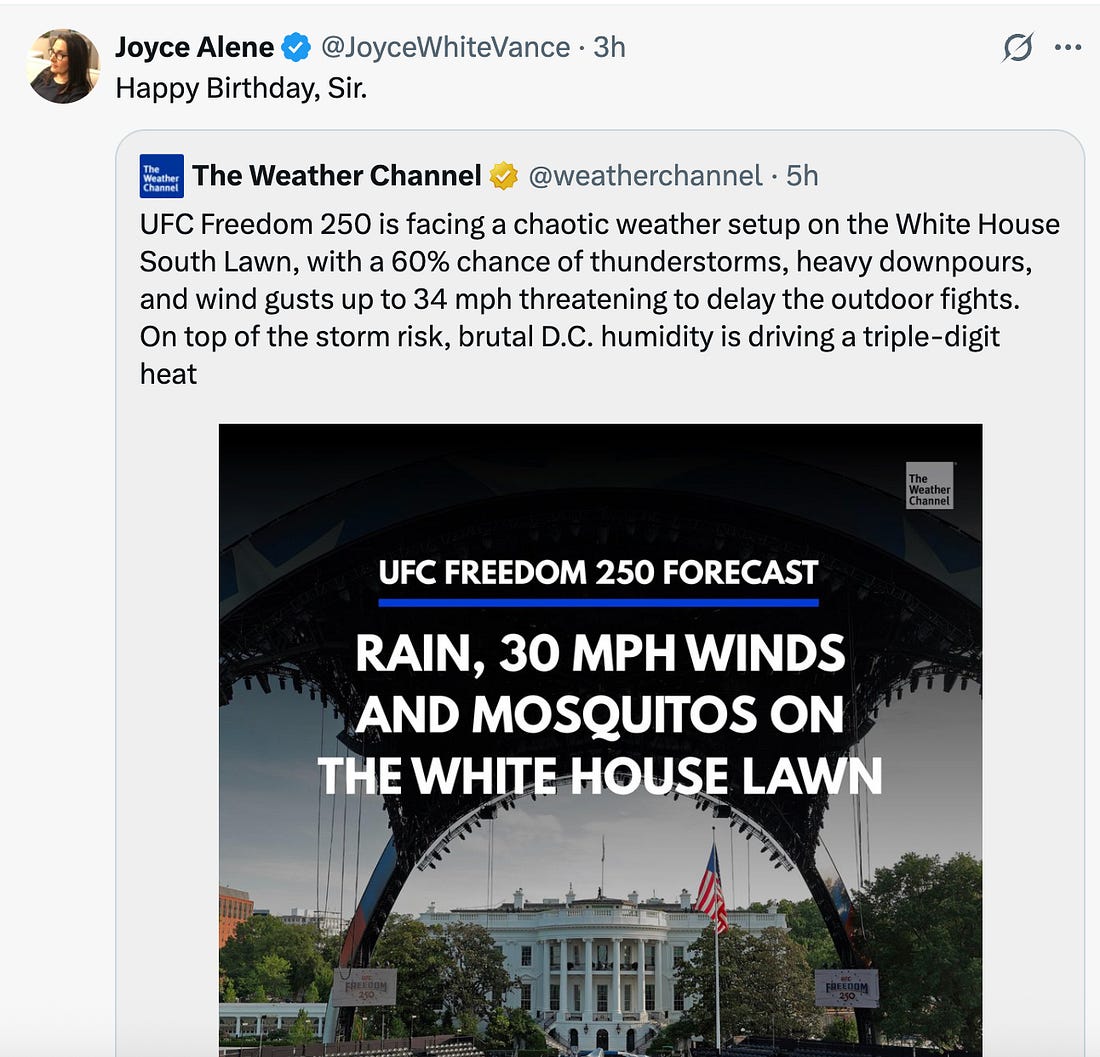 |
Never forget that much of the performative nonsense, like desecrating the White House lawn and the Lincoln Memorial with cage fighting, is all about distraction. This president has plenty to try and distract us from, starting with the fact that he’s the oldest president to ever hold office. His 80th birthday today highlights that. He falls asleep in meetings and at Knicks games (to say nothing of jinxing the team). He babbles nonsense. He has become a laughingstock to other world leaders. Even his numbers domestically are low enough to suggest he’s finally losing some of the support long believed to be immovable—the people who would give him a pass even if he shot a man on Fifth Avenue. I’ll just say again, Trump’s success is not inevitable. Keep questioning, keep thinking, keep planting seeds even with people you think will not come around, because people are, in increasing numbers.
 |
But there’s obviously far more to distract from.
The Epstein Files are top of that list. I haven’t forgotten that last December, Marjorie Taylor Greene claimed Trump called her on the phone to yell at her about signing the discharge petition that got the transparency act across the finish line. According to Greene, Trump told her he opposed releasing the files because some of his “friends will get hurt.” Could that include his “friend” John Barron? There are plenty of unanswered questions. Cage fighting seems like just the solution.
After reporting emerged last week about a Situation Room meeting about the files that excluded Trump but included Todd Blanche, his nominee to be Attorney General, the survivors issued a statement that said in part:
“We are deeply disturbed to learn so many senior members of the Trump administration gathered in the Situation Room to discuss the release of the Epstein Files as a reputational problem, rather than an opportunity to pursue investigative leads and try to figure out what actually happened. … we are separately concerned Todd Blanche was at that table. Blanche has consistently minimized legitimate concerns about how the files have been handled, including problematic redactions and the exposure of survivors’ personal information.”
The reporting further underscores the sense that the release was queued by the Justice Department in a way that protected powerful people, not as an attempt to get to the truth. There’s still a lot we don’t know about people who possibly could be, but aren’t being held accountable for the abuse of girls and women. Trump supporters thought he would release the files, not protect the well-connected people in them.
There’s also the war in Iran, which is either over or not over, depending on when you’re checking. Even if there is an exit strategy, numerous commentators have pointed out it doesn’t seem very different from the one President Obama got, the deal Trump has relentlessly criticized. The House has already passed its part of a concurrent resolution that would invoke the War Powers Act and require Trump to stand down. The Senate still has to consider the measure. Under the special rules in play here, the concurrent act doesn’t require Trump’s signature. But there are open questions about enforceability, with the White House certain to claim that this is an unlawful incursion into presidential power.
The Trump administration will be back in court this week. They’ve filed their brief in Trump v. IRS, which they’ve styled as: “PLAINTIFFS’ RESPONSE TO THE COURT’S MAY 29, 2026 ORDER AND IN FURTHER OPPOSITION TO THE MOTION OF THIRTY-FIVE FORMER FEDERAL JUDGES FOR RELIEF FROM THE ORDER OF DISMISSAL.” This relates to Trump’s slush fund, and it’s a bit confusing at this point because there are multiple cases.
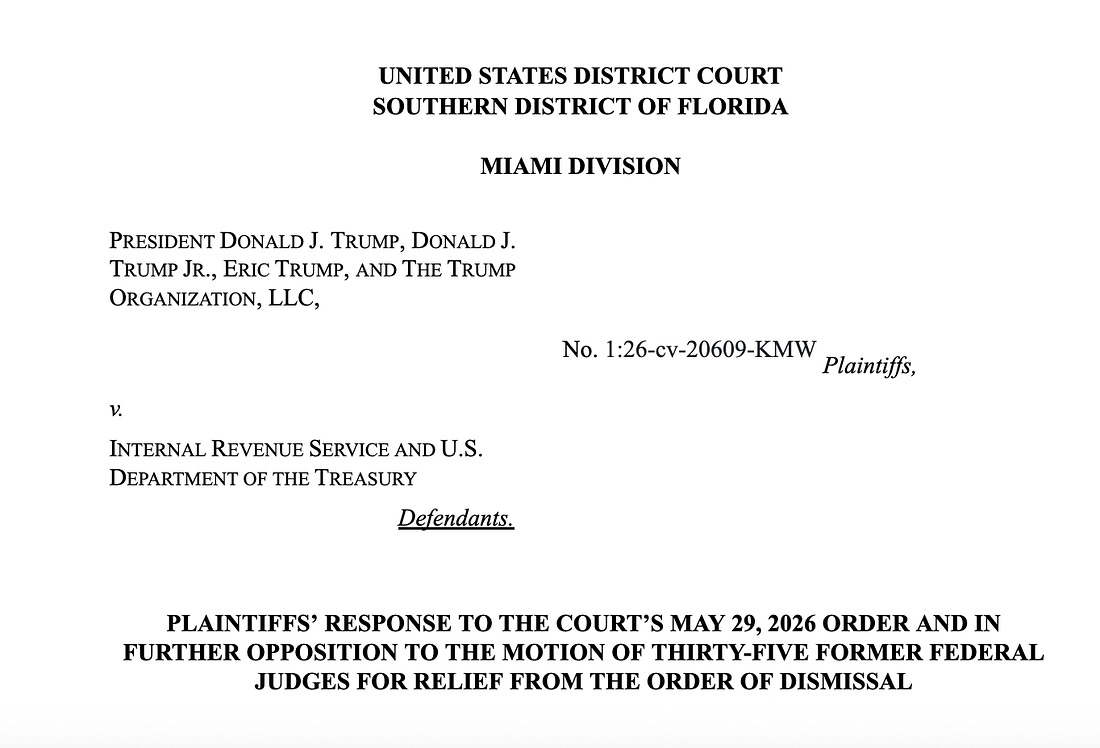 |
The brief we’re looking at tonight was filed in the Florida case, the one Trump filed seeking damages from the government after a contractor with the IRS released his (and about 399,000 other people’s) tax returns. A proposed “settlement” of the case came to light that had nothing to do with damages resulting from that incident, the slush fund, which was subsequently challenged in the two different cases that we’ve been discussing for the last few days, one in Virginia (where a judge enjoined the slush fund from going into operation) and one in the District of Columbia (where a judge held that taking any action would be premature).
The issue in the Florida case is different. It’s whether Judge Kathleen M. Williams was misled by the Trump plaintiffs when she dismissed the case, as a brief from a bipartisan group of 35 retired federal judges argues. It’s complicated, but also critically important. Before we discuss the new brief filed by the Trump plaintiffs, let’s briefly review how we got here, and I’ll link to the earlier posts in case you want a refresher:
Kleptocracy, May 19. We looked at the original lawsuit Trump filed, its potentially fraudulent nature with Trump on “both sides of the v” since he controls how the IRS handles the case, and early news about the possible settlement. “When everything is bad, nothing is bad. People get desensitized. They can no longer keep track of it all. It’s all so awful that none of it gets processed anymore. So I need you to hear me when I say tonight: This is bad. Really, really bad. … Here’s the bottom line. Donald Trump wants to take $1.8 billion dollars of money that taxpayers like you and me have paid to the government, and he wants to give it to his most hardcore followers, the people who stormed the Capitol on January 6.”
It got worse the next day. Almost as good as a pardon, May 20. “DOJ posted a settlement document on its website in the case. It was unexpected, because we’d already seen a settlement agreement in this case, the one