
|
 |



Donald Trump, still vibrating from the joys of his UFCstravaganza at the White House last night, is feeling himself this morning, and has apparently decided to make the Fourth of July America 250 Party even Trumpier than before: “On July 4th, at the Lincoln Memorial and Washington Monument, we are going to host the most spectacular TRUMP RALLY of them all,” he wrote on Truth Social this morning. The event would feature “more than 300 Members of our strong and talented Military Bands, Orchestras, and Ceremonial Units” who will “perform Patriotic Melodies and American Classics, and my Playlist (We will have none of those people that put you to sleep and constantly complain!)”. And, of course, “I will deliver keynote remarks that you will not want to miss.”
Hey, man, glad you’re having fun. Happy Monday.
Join Sam Stein and Will Sommer live on Substack and YouTube at 10 a.m. EDT today for MAGA Mondays.
 |
Bread and Capitulation
by William Kristol
It would have been nice to write this morning about the remarkable and inspiring Knicks and the joyful scenes of celebration in New York City that followed their championship. I would have relished a word about the happy removal of our current president’s name from the John F. Kennedy Center for the Performing Arts in D.C.
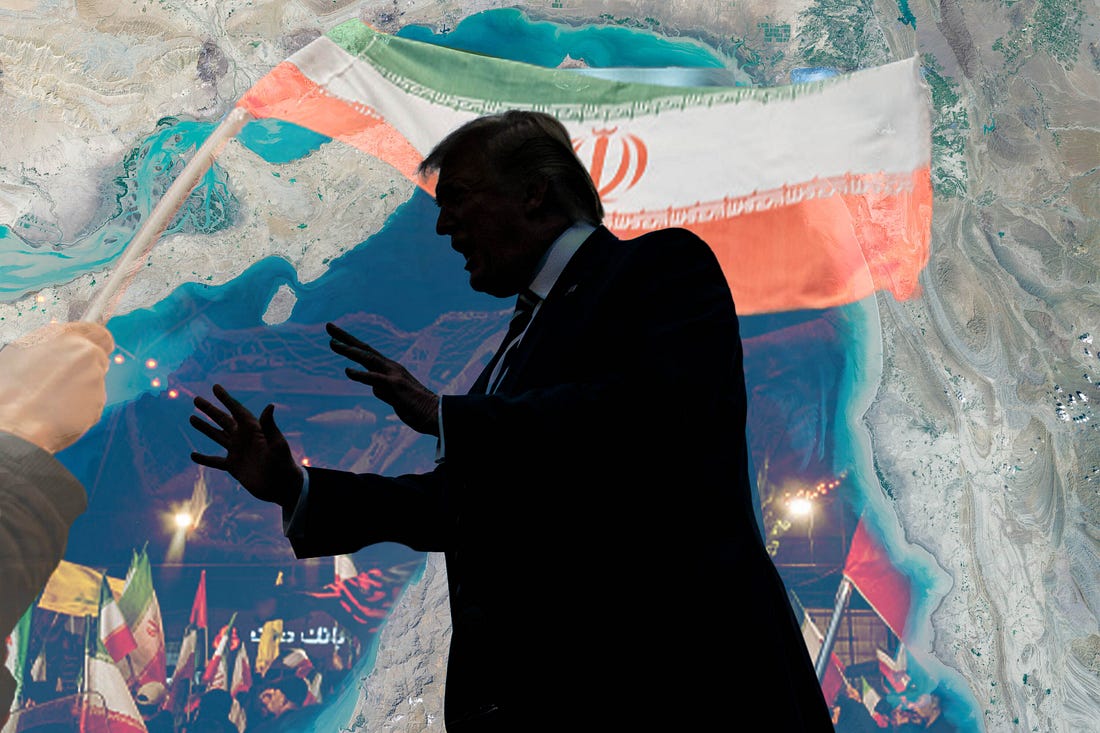
But the stern siren of duty calls. There is an Iran deal to discuss, and discuss it I shall, even if writing about a defeat for our country is genuinely painful.
Fortunately our friend Tom Nichols of the Atlantic is made of sterner stuff. He stepped up last night to perform the distressing task of analyzing the deal that will apparently bring to an end Donald Trump’s misbegotten war against Iran:
The United States has little to celebrate: Trump and his team, in record time, just lost a war to a militarily mediocre—but nonetheless extremely dangerous—adversary. . . . It is clear that Trump has failed to achieve every one of the goals he put forward for this war of choice, and now he is determined to sign, seal, and deliver America’s capitulation as quickly as possible. . . .
The reality is that the war will close with the regime in Tehran intact and in the grip of the Islamic Revolutionary Guard Corps; the Strait of Hormuz will remain under the threat of Iranian attacks; Iran will continue to possess significant drone and missile stocks; the regime will maintain the capability to be a state sponsor of terror; and many sanctions will be lifted and billions of dollars in unfrozen assets will flow to Iran. In other words, the Iranians have achieved their key strategic aims—regime survival above all—while the Americans have achieved none of their own.
Indeed, the United States has perhaps done worse than gaining nothing. Iran, while temporarily weakened, is now an even more powerful political actor: The regime in Tehran stood up to a massive U.S. onslaught, survived, and then inflicted pain on various states in the Gulf as punishment for going along with Trump’s war. . . .
The war leaves Iran battered, but more powerful and with more cash at its disposal, while it leaves America weaker.
I’m sad to say that Tom has it right. And I’ll mention one point in particular that seems not to be getting the attention it deserves. The memorandum of understanding to be signed Friday reportedly says that Iran will not impose tolls in the strait of Hormuz for the next sixty days. This is presumably the basis of Trump’s claim that the strait will be “toll-free.” But the government of Iran says that the strait will operate in the longer run “under Iranian arrangements.” This seems likely to be true, since Iran has established the principle that it can close the strait, has paid no price, hasn’t repudiated a right to do so in the future, and will be more interested and able to enforce its will in the months and years to come than we’ll be able to stop them.
So Iran comes out a winner. But Iran’s victory isn’t the most important outcome of Trump’s foolish war. The most important outcome is our defeat. Trump’s failure in Iran has confirmed and accelerated the broader retreat during his second term from our standing as the linchpin and guardian of an American-friendly international order. We were a great power—the greatest world power—from 1941 to 2025. Now we appear to be one power among many, even one bully among many, perhaps the preeminent one, but one without much credibility among either allies or enemies.
Our allies at the G7 meeting in France over the next couple days will have no interest in highlighting the fact of our decline, as they want to buy time to make their adjustments. But everyone with eyes to see understands what Trump has wrought. This failed war will leave us both less feared and less respected than before, and will leave the world more dangerous and its future less hopeful than before.
The coincidence yesterday of the announcement of an agreement on a deal and the cage match at the White House has led to much discussion of imperial decadence, and of our entering an age of bread and circuses. The phrase comes from the Roman poet Juvenal, writing around 100 A.D.: The people “shed their sense of responsibility long ago . . . the mob . . . reveals its anxiety for two things only, bread and circuses.”
But the Roman Empire remained great for quite a while after Juvenal’s lament. In his History of the Decline and Fall of the Roman Empire, Edward Gibbon identified the subsequent eighty years or so as the peak of the Empire in size and power, the height of the Pax Romana, and also as a golden age of peace, prosperity, and human happiness. So a