
|
Big Technology is possible thanks to support from our readers. Sign up today to help us do this work and gain access to perks like members-only articles and our private Discord server:
Elon Musk Sold Investors The Future. Now SpaceX Has To Build It.
SpaceX is trading up on its first full day on the public markets. Here's what it has to do to maintain the momentum.
|

| |||||||||||||||


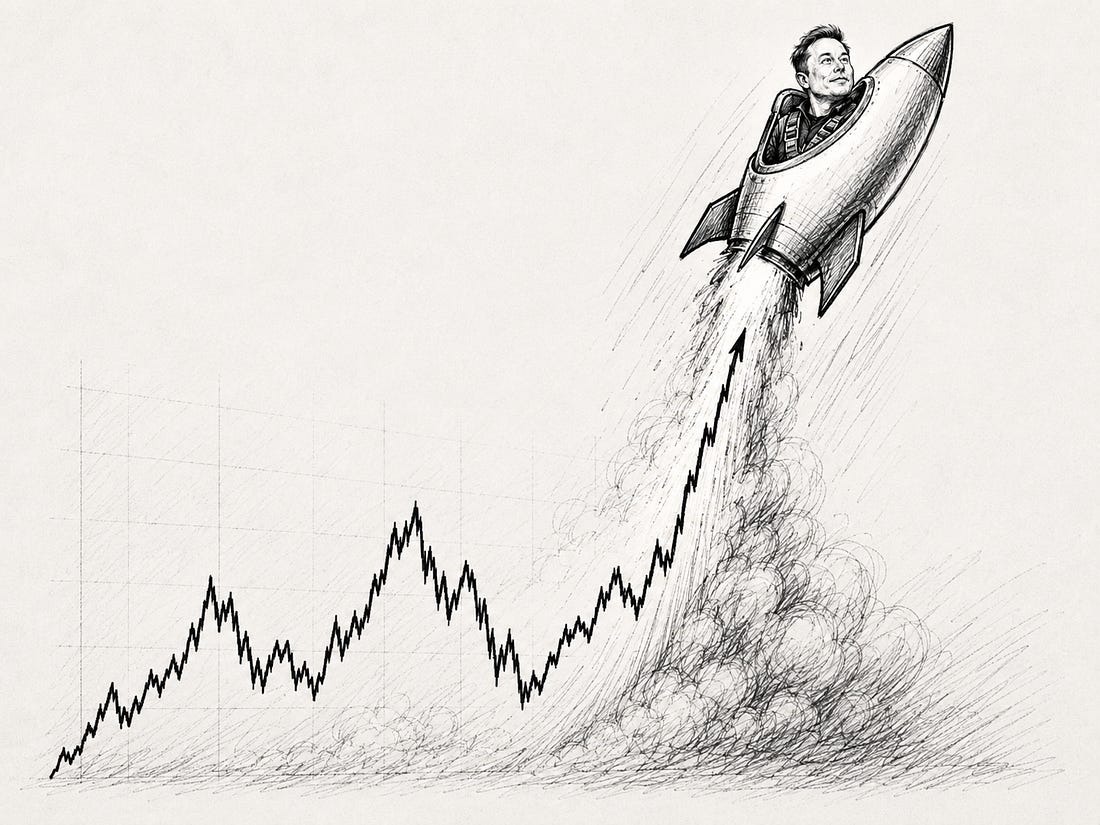 |
On its first full day of trading, SpaceX is building on its massive IPO’s momentum. The company is up more than 14% on Monday, hitting a market cap above $2.4 trillion, which places it firmly within the ten largest companies in the world.
Now comes the hard part.
To maintain its momentum and lofty valuation, SpaceX will have to turn projections into real projects that attract real customers with real revenue. The company’s ambitions include lunar missions, a major enterprise AI business, renting massive compute, and someday launching data centers into orbit. But for now, it’s still a connectivity business with AI and rocket add-ons.
Looking forward, here’s what the company’s success will hinge on, from retail to the broader sentiment about AI:
Retail investors arrive onboard
SpaceX reportedly gave retail investors 20% of IPO shares, a higher percentage than the usual IPO range between 5% and 7%. That widened access, but it could also make SpaceX more volatile. For example, the company could experience sentiment-driven swings based on how shareholders feel about SpaceX’s moonshots or the AI trade more broadly. We’ll also soon see how much of the early enthusiasm around the company was FOMO versus a genuine belief in its business.
First AI company to launch
Because xAI sits under SpaceX, the IPO could influence the success of OpenAI and Anthropic’s own public offerings, or maybe even create a new reference point for investors. SpaceX, for its part, must follow through on plans that are more ambitious than OpenAI and Anthropic’s, such as its plan to launch space data centers. SpaceX’s IPO release also showed Anthropic agreed to pay it $1.25 billion a month for compute capacity through 2029, turning it into a neocloud of sorts. But there’s a caveat: Either party can cancel the deal with 90 days’ notice. A cancellation wouldn’t be great for the stock.
Into the AI money furnace
By folding xAI into its IPO, Elon Musk gave investors a first detailed look at the economics of a private AI lab. In some ways, the IPO could expose the cost of competing in frontier AI. SpaceX’s prospectus showed xAI spent $12.7 billion in capital expenditures in 2025, another $7.7 billion in the first quarter of this year and quarterly operating losses for xAI that rocketed from $936 million in Q1 2025 to $2.47 billion in Q1 2026. That could end up being a new kind of disclosure benchmark for cost and returns for Anthropic and OpenAI, whose eventual filings could be similarly be compared to xAI’s rather than just Microsoft, Meta, and Google.
Concentrated power
At SpaceX, nobody can outvote Musk. Post-IPO, he still owns about 82% of voting power. That’s power to choose most of SpaceX’s board, determine shareholder votes, take policy and business risks, and exert influence over major financial decisions.
Ripples in space
Beyond the AI market, it’s also possible SpaceX could help boost the broader space market. Over the weekend, The Wall Street Journal reported other venture-backed U.S. space-tech companies are experiencing more interest from potential investors. However, the report also noted smaller startups have a harder time being as resilient as giants like SpaceX. Even Jeff Bezos’s Blue Origin is in flux after its New Glenn rocket blew up last month.
A monthly outlook for leaders navigating what’s next (sponsor)
 |