
|
 |
When AI Has To Guess, Somebody Pays
Why your content ambiguity may be increasing your AI operating costs
|

| |||||||||||||||


 |
Content ambiguity can increase AI operating costs because AI systems often have to work to retrieve and process more information when important context is missing or unclear. As organizations begin measuring AI costs and consumption more closely, content design decisions may become part of the cost conversation.
Most discussions about AI costs focus on language models. That’s understandable. Models have names, rankings, benchmarks, pricing pages, and marketing campaigns.
Content gets far less attention. That’s surprising because AI systems spend much of their time looking for information before they generate an answer.
That distinction becomes more important as organizations move beyond experimentation and begin deploying AI-powered support systems, internal assistants, knowledge portals, and agentic search experiences at scale.
Stripe, the online payments company that processes transactions for millions of businesses, recently caught my attention for exactly that reason. The company announced AI usage billing, a capability that charges customers in proportion to what they consume (e.g., tokens processed, compute seconds, API calls, agent actions) rather than a flat fee.
The announcement wasn’t about model quality. It was about consumption. How many tokens were used? Which application consumed them? How should those costs be allocated? How should they be recovered? By whom?
Once organizations can see AI consumption, they’re eventually going to ask why some AI-powered experiences cost more to operate than others. In many cases, part of the answer may be the content itself.
Why Does Content Ambiguity Increase AI Costs?
AI systems often consume more resources when documentation leaves important context unstated.
Tech writers have always worried about ambiguity because it frustrates readers. AI systems introduce another reason to care.
Suppose a procedure says:
“Approve the request after validation completes.”
Most people working in that environment can probably figure out what’s happening. They know who performs the approval and they understand what validation means. They probably know what event signals validation completion.
AI systems don’t share that background knowledge.
If the role, condition, or triggering event isn’t documented, the AI system often searches for that information elsewhere. As documentation repositories grow, those searches become more expensive. The answer may already exist, but the system may retrieve multiple documents, compare competing explanations, and evaluate additional context before it can decide which information to use.
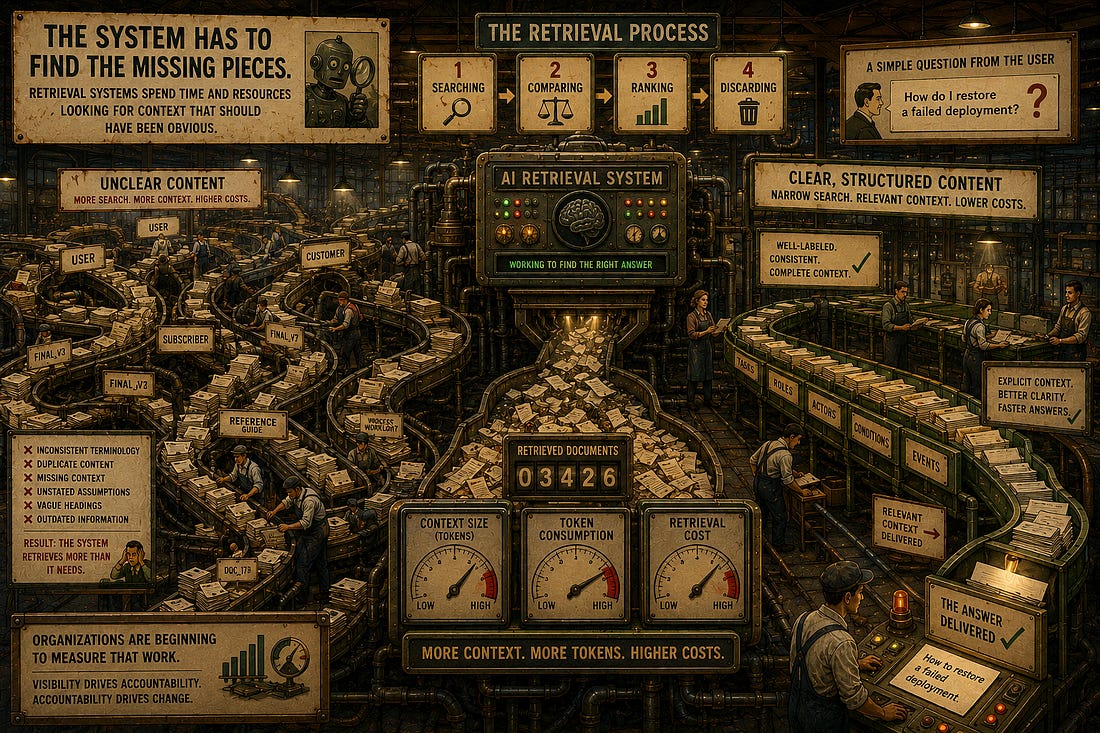 |
The System Has To Find The Missing Pieces
Retrieval systems often compensate for unclear content by pulling more information into the decision-making process.
Many organizations assume AI works like a very fast employee who already knows where everything is. In reality, AI systems spend a surprising amount of time searching, comparing, ranking, and evaluating information before generating an answer.
A user asks a simple question. The retrieval system may pull multiple documents, compare overlapping explanations, evaluate terminology, identify the most likely workflow, and discard information that appears unrelated.
When our documentation is clear, the search narrows quickly. But, when our content contains inconsistent terminology, undocumented assumptions, duplicate information, or missing workflow context, the system often retrieves more material than it otherwise would.
Organizations are beginning to measure that work.