| | In today’s edition: The Atlantic’s pivot to video, Netflix M&A, and soccer’s lasting appeal.͏ ͏ ͏ ͏ ͏ ͏ |
| |  Cannes Cannes | New York | Washington |
 | Media |  |
| |
|
 - Netflix-Lionsgate latest
- Conservatives to Cannes
- Atlantic video
- Dialog box
- Soccer fandom
|
|
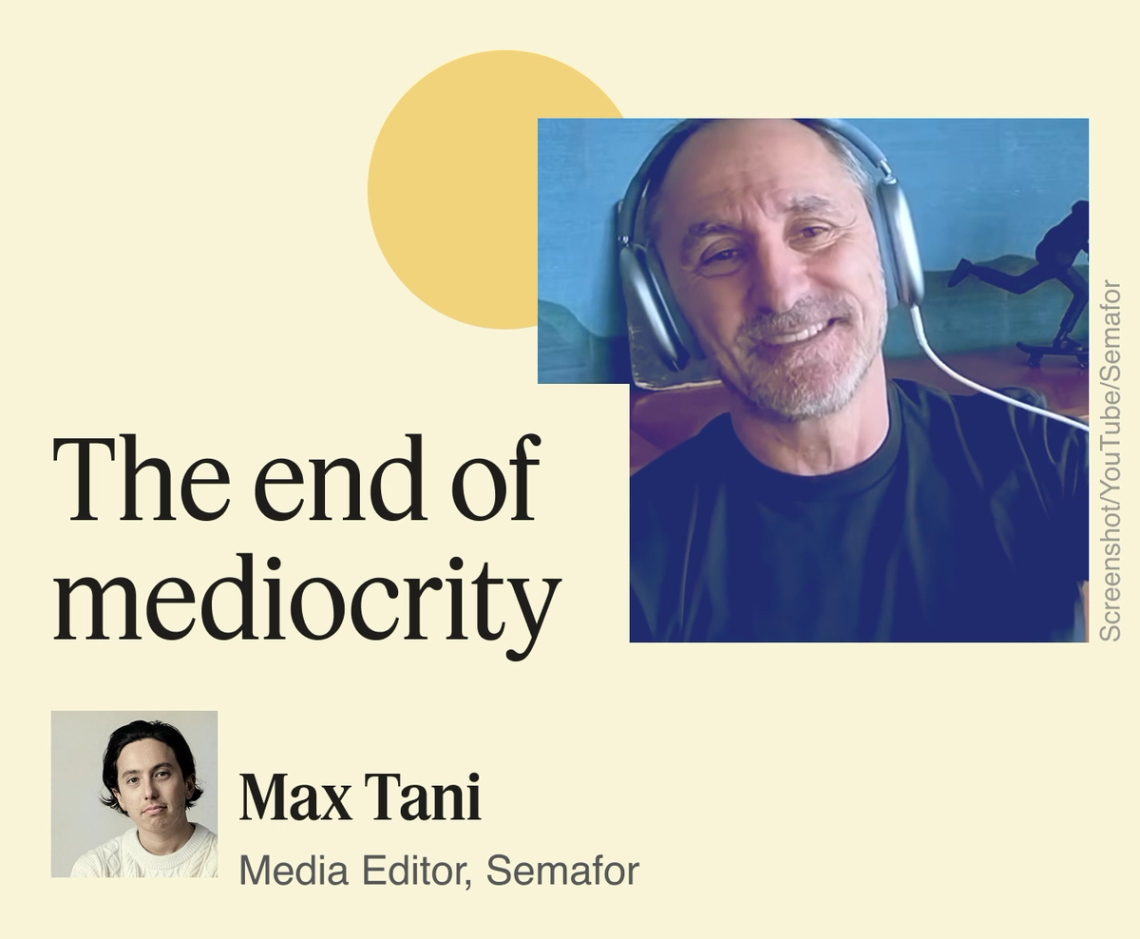 Originality can’t be duplicated, the admaker David Droga told me and Ben Smith recently, before we headed off to the Cannes Lions International Festival of Creativity for some on-the-ground reporting from the center of the advertising world this week. The end result of the AI revolution, Droga said, will be the end of a market for human mediocrity in creative fields. “The majority of stuff done in marketing, advertising, entertainment, music, journalism, is pretty formulaic and average. So have at it. Get rid of that,” Droga, the founder of the agency Droga5 and former CEO of Accenture Song, told us on Mixed Signals. “But the need for distinctions, originality, strategy, context, taste, all these incredible things that set apart things that actually move us forward — AI’s not gonna do that.” Such confidence from the guy widely regarded as the last of advertising’s Don Draper types might be reassuring to human admakers. But read another way, it’s more alarming: The vast majority of work that has made up the “mediocre” middle of creative industries is about to get washed away by AI. And that looming transformation will be on everyone’s minds here in Cannes. (Make sure you’re signed up for our Cannes briefing, and come say hi if you’re there!) Also today: The Atlantic’s pivot to video, Netflix M&A, and soccer’s lasting appeal. |
|
 Francis Mascarenhas/Reuters Francis Mascarenhas/ReutersNetflix shares dropped last week after Semafor reported that the company had taken a look at buying Roku and was interested in Lionsgate. The company denied it was pursuing the studio. It all brought back a bit of deja vu: Netflix co-CEOs Ted Sarandos and Greg Peters both repeatedly downplayed their interest in Warner Bros. Discovery — until they didn’t. Netflix’s growing M&A interest — “We really built our M&A muscle,” Sarandos said in April about the potential for more deals — is now sparking worries across Wall Street from those who think the company’s vaunted build-it-yourself model is breaking down, or at least showing some cracks. That may help explain the company’s response to our report, but it did little to calm investor concerns. Netflix had trained investors to reward its growth, and now that growth is slowing. (The company said it would stop reporting quarterly subscriber numbers last year.) To increase its user base, it’s going to need more, better content, especially as other streamers firewall off hit shows, while milking more cash out of its existing subscribers. And it needs to make sure that its insights into viewer habits aren’t diluted by a rival, as Fox-Roku promises to do. The two don’t compete on original content meaningfully, but Netflix has ambitions (sports, live programming) that would put it more squarely in competition with Fox. Any one of those problems is hard to solve on its own. All of them combined suggest a big deal for Netflix isn’t an if, but a when. — Rohan Goswami |
|
Conservatives go to Cannes |
 Screenshot/YouTube/@wearelskr Screenshot/YouTube/@wearelskrThis week, The Daily Wire will make its Cannes debut. The conservative digital news site will host a day of programming with LSKR, an Atlanta-based creative firm that says the ad industry is “built on groupthink — run by the same people, with the same ideas, targeting the same audiences. And they’re missing half the market.” And The Daily Wire isn’t the only right-leaning media brand making its presence known this year at Cannes. Trump Media & Technology Group, the company behind Truth Social, also sent executives, who are taking meetings with media and ad brands along the Croisette. The politically heterodox Piers Morgan, now an increasingly popular YouTuber, is co-hosting a party on a yacht with an AI company later this week. Together, these players are offering an overtly partisan alternative to ad industry gatherings that often stay as far away from politics as possible. “Brands are realizing they can’t afford to ignore large portions of the market,” LSKR creative director Matthew Mazzone said. “Too many voices have been absent from conversations at Cannes, while the industry focused on vanity metrics and secondary objectives instead of advertising’s core job: connecting brands with consumers and helping them sell goods and services more effectively.” |
|
The Atlantic beefs up video podcasts |
 Screenshot/YouTube/@TheAtlantic Screenshot/YouTube/@TheAtlanticOn Monday, The Atlantic’s flagship podcast, Radio Atlantic, will expand to produce twice-weekly episodes, as one of the nation’s oldest magazines strengthens its video presence. Adam Harris will host a new video episode on Mondays that promises to focus on “the stories that set the agenda for the week,” complementing the current Thursday show, hosted by Hanna Rosin. It’s one of multiple video podcasts The Atlantic has launched since the start of 2025. Its other offerings include The David Frum Show, which regularly racks up hundreds of thousands of views, and Galaxy Brain with Charlie Warzel. Later this year, the magazine plans to introduce a weekly video podcast with David Brooks. In an email to Semafor, a company spokesperson said it had expanded its video team from around 10 to almost 20, and said revenue from its podcasts has grown 104% year-over-year. Most of the video growth has been concentrated on YouTube. “We see video as another place where we can reach and engage with audiences to bring them smart, analytical journalism at a time when it’s needed across all mediums,” Claudine Ebeid, The Atlantic’s executive producer for audio, told Semafor. |
|
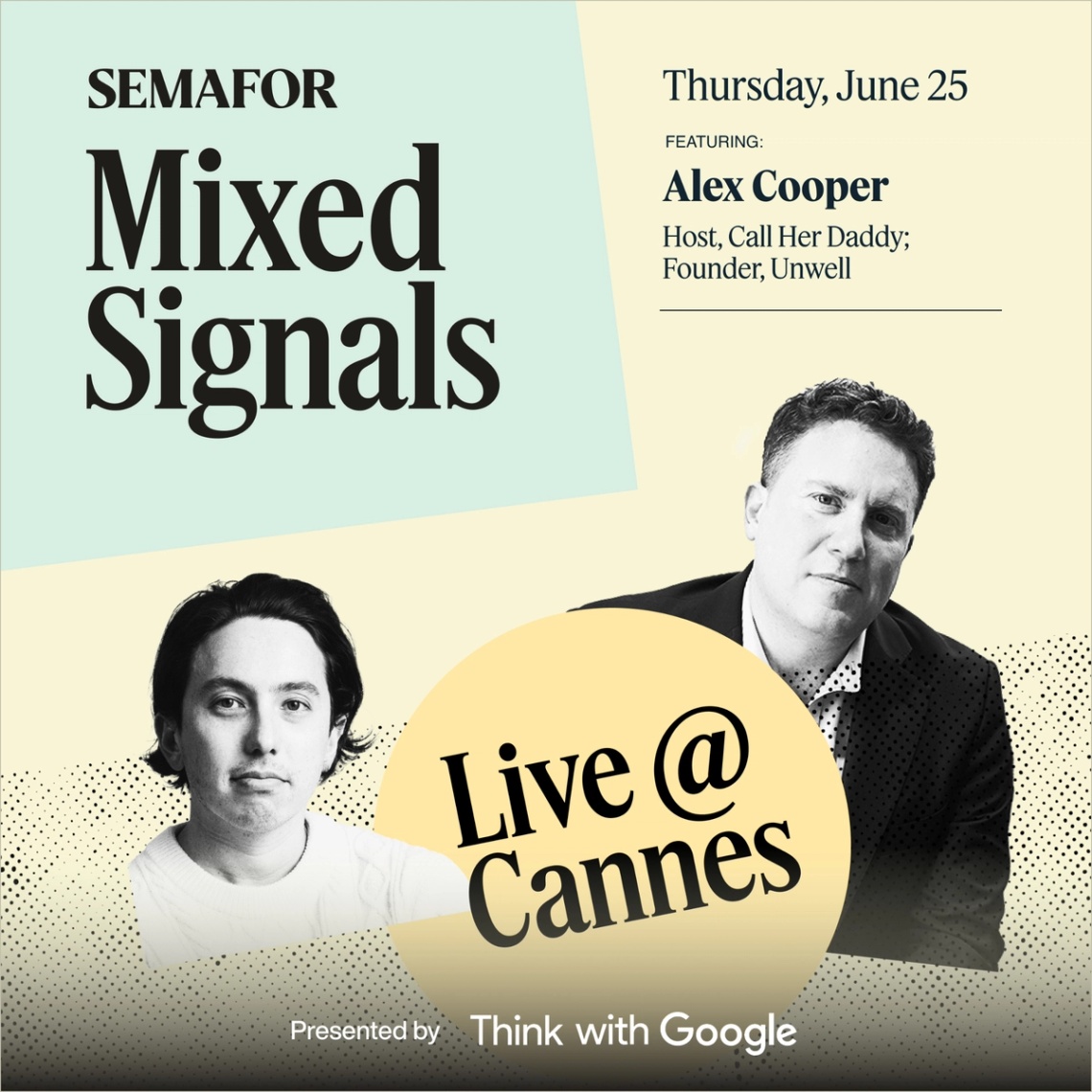 On Thursday, June 25 at Google Beach in Cannes, Semafor Editor-in-Chief Ben Smith and Media Editor Max Tani will sit down with Alex Cooper, host of Call Her Daddy and founder of Unwell, for a special live taping of Mixed Signals. The conversation will examine the radical changes in the media landscape through the lens of one of the industry’s most influential creators and entrepreneurs. June 25 | Cannes | Request Invite |
|
| |  | Rachel Keidan |
| |
 Matias Baglietto/Reuters Matias Baglietto/ReutersOn Tuesday, Wired published a story, titled Leak Exposes Members of Peter Thiel’s Secretive ‘Dialog’ Society, on a data breach that released the names of 200-plus elites who took part in a retreat featuring panels on subjects from “cult-building and sex to prepping for World War III.” The framing sparked a weeklong online skirmish as bold-faced names on the guest list rushed to contextualize their attendance or distance themselves. Actor Josh Brolin wondered “what the f*ck he got himself into.” Maryland Gov. Wes Moore’s spokesperson spent days insisting the governor was only a speaker, not a member. In an X post, New York Times columnist Ezra Klein dismissed the “secret society” framing. As a previous attendee, I found the Wired story entirely divorced from reality, and the subsequent responses to it amounted to an absurd cycle (one which this write-up admittedly continues). The conference was less Illuminati cabal than a nerdy Socratic retreat meant to spark frank conversations across various industries and ideologies. The discussions were designed to be thought-provoking, so some veered into edgier topics like biohacking and artificial wombs, but I saw more panels focused on geopolitics and AI than on cult-building or doomsday prepping. The Wired piece raised the specter of a Dialog dating function that seemed to conjure something between Eyes Wide Shut and a Gilead mating scheme. Another former attendee recalled that the reality was closer to “a singles mixer at a local YMCA”: stale pretzels, Dixie cups, cheap wine, and the unmistakable “wave of disappointment” upon a survey of the prospective matches. And as someone who works in communications, I found the responses notable. Our collective attention span is short and spread across the innumerable algorithms and screens that make it hard for anything to penetrate meaningfully. With more than 200 people’s names released in the data breach, most could have stayed quiet and faded into the background. Instead, with each post attempting to distance an attendee from Thiel and his alleged shadow cult of elites, the story gained momentum — and inevitably, only those who spoke up are likely to be remembered as part of it. Myself included. |
|
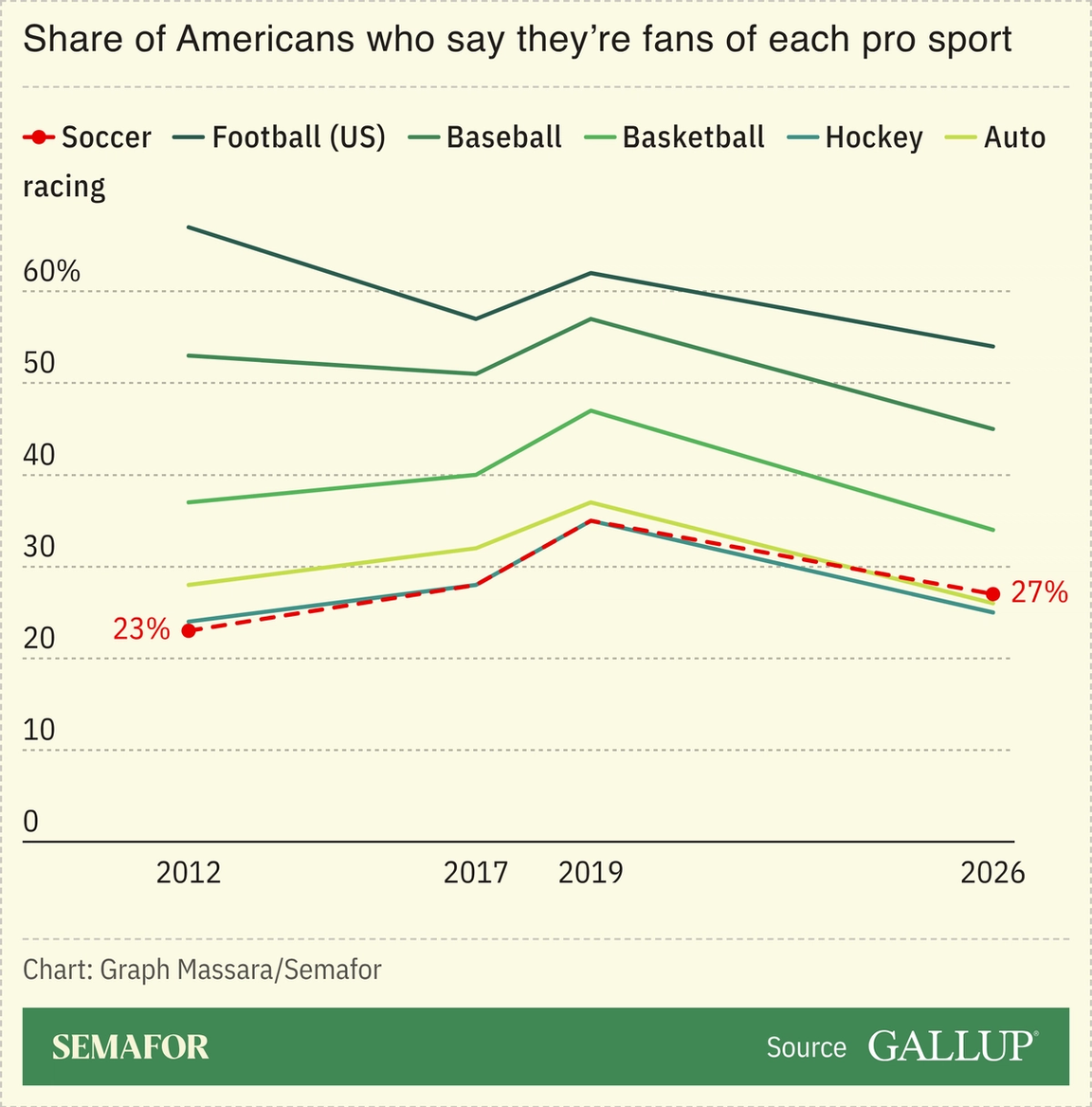 Four in 10 Americans say they plan to watch the World Cup at some point, according to Gallup — roughly the same proportion that said they planned to watch in 1994, the last time the US hosted. If that seems unimpressive relative to the staggering ratings pro football and, more recently, the NBA Finals have pulled in recently, Gallup found the proportion of self-described soccer fans has held steady over the last decade, even as Americans’ interest in other, more popular sports has dipped. Soccer fans also skew younger, more diverse, and more online, according to a recent Nielsen survey, which could make for a more durable fanbase — and may explain why Fox, the rights-holder for the World Cup, has been so eager to make space for extra ad slots during lucrative hydration breaks. — Graph Massara |
|
Pirate Wires: Harris Sockel recalls working for Medium, the once-ubiquitous writing platform, which at its peak felt like being a “bartender at one of the biggest parties on the internet.” NYT: There will be no Washington Star newspaper war, after Robert Allbritton’s NOTUS agreed to look for a new name rather than fight Dovid Efune, Katie Robertson reports. (Allbritton had looked into the “Washington Sun” at one point, Semafor scooped.) Puck: Amazon dumped Artificial, a critical biopic about Sam Altman a la The Social Network, Matt Belloni writes; CAA is looking to rehome the film. WSJ: Polymarket paid dozens of young creators to “film themselves making fake trades and sometimes scoring fake wins,” Katherine Long, Caitlin Ostroff, Neil Mehta, and Brenna T. Smith report. |
|
|


