| | In today’s edition: Progress in US-Iran talks, Qatar gas explosion, and more from Semafor’s Abu Dhab͏ ͏ ͏ ͏ ͏ ͏ |
| |  Abu Dhabi Abu Dhabi |  Lucerne Lucerne | Ras Laffan |
 | Gulf |  |
| |
|
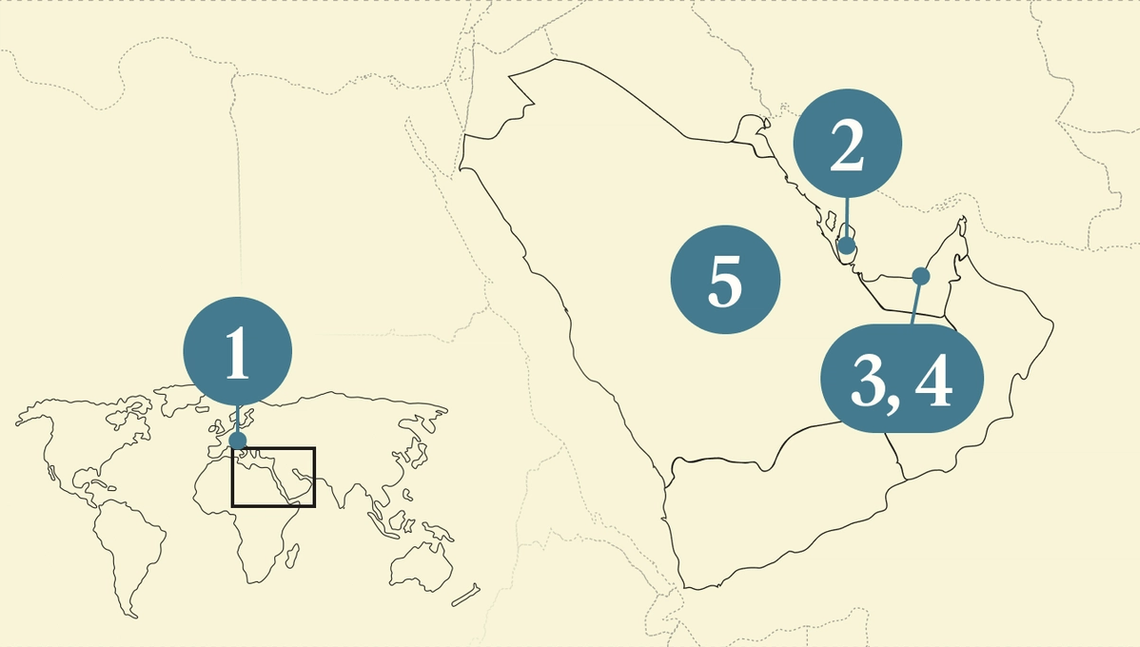 - ‘Progress’ in Iran talks
- Qatar gas explosion
- Abu Dhabi’s AI exports
- SWFs are on the hunt
- Saudi private credit surge
 A face for the UAE’s AI diplomacy. |
|
Hopeful signs at Swiss peace talks |
 Qatari Prime Minister Mohammed bin Abdulrahman Al Thani, US presidential adviser Jared Kushner, and Vice President JD Vance at the Bürgenstock resort, Switzerland. @MBA_AlThani_/X. Qatari Prime Minister Mohammed bin Abdulrahman Al Thani, US presidential adviser Jared Kushner, and Vice President JD Vance at the Bürgenstock resort, Switzerland. @MBA_AlThani_/X.Iran and the US made what mediators described as “encouraging progress” in the first round of talks at a Qatari-owned Swiss Alps resort, but significant challenges remain to agreeing a durable peace. The meeting began against an inauspicious backdrop, with Iran announcing it had closed the Strait of Hormuz, and US President Donald Trump threatening to resume bombing. Still, negotiators emerged with a roadmap for a final deal within 60 days. Working groups will focus on issues such as Iran’s nuclear program and sanctions, a hotline has been set up to deal with shipping in the strait — where some oil at least continues to get through — and a “de-confliction cell” will oversee the ceasefire in Lebanon. Iran’s foreign minister said the conflict in Lebanon — where Israeli Prime Minister Benjamin Netanyahu has vowed to keep a security zone “as long as is necessary” — was the deal’s “first real test,” and he praised mediators’ efforts to end the fighting in the Levant. |
|
Explosion at Qatar’s gas export hub |
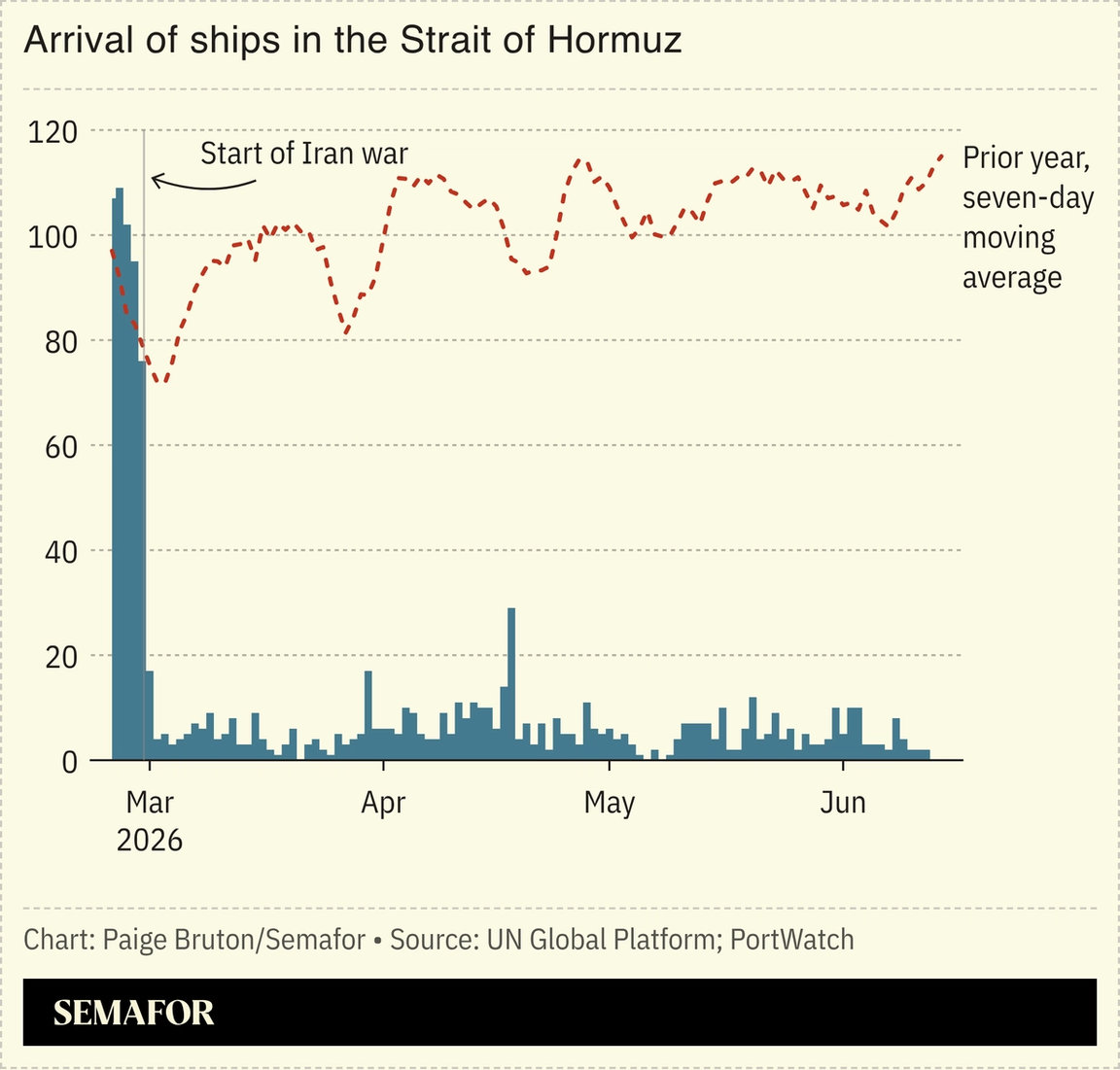 An explosion at a QatarEnergy gas facility in Ras Laffan on Sunday injured 54 people and left another 18 missing, in a setback for the country as it races to get its energy industry running again. The Barzan plant supplies gas to Qatar’s domestic market; other export-oriented plants were also damaged by Iranian strikes in March. For Doha, resuming exports is a top priority: Its economy is expected to contract sharply this year, as a result of lower gas output. Prior to the US-Iran conflict, QatarEnergy had been pursuing plans to nearly double LNG output by 2030. Three empty Qatari LNG tankers are reportedly heading back to Ras Laffan through the Strait of Hormuz; the resumption of such traffic is crucial to ramping up production at the industrial complex. |
|
AI for oil to be next Abu Dhabi export |
 Semafor’s Kelsey Warner, left, with AIQ CEO Dennis Jol at Semafor Gulf Live. Semafor. Semafor’s Kelsey Warner, left, with AIQ CEO Dennis Jol at Semafor Gulf Live. Semafor.Abu Dhabi-backed AI firm AIQ has developed nearly 300 AI use cases to improve safety and production at ADNOC’s oilfields. The firm is now pitching these tools internationally against the backdrop of the UAE’s $1.4 trillion investment commitment to the US, CEO Dennis Jol said at the Semafor Gulf Live event on Thursday. “We’ve proven we can do it here. Now it’s time to export,” Jol said. His pitch centers on practical systems trained on 70 years of ADNOC data.
Applications include AI embedded in closed-circuit cameras to check that workers are safely outfitted, automation to shut down equipment to prevent accidents, and subsurface modeling to decide which wells to turn off and which to pump — a tool that Jol likened to Uber’s logistical routing, but for energy production.
The firm’s push into international markets comes at a crucial moment for the energy industry, which has been impeded by the closure of the Strait of Hormuz. The UAE’s exit from OPEC earlier this year, along with factors such as the US efforts to rebuild reserves, is helping to create an environment in which producers are pushing to maximize their output. Jol said US oil and gas sits at the top of his priorities, along with the North Sea, Canadian tar sands, and the “global south,” where the UAE enjoys strong government-to-government relationships. — Kelsey Warner |
|
Gulf SWFs set to ramp up dealmaking |
 Semafor’s Matthew Martin, left, with Wael Younan, co-head of sovereign wealth management at TCW. Semafor. Semafor’s Matthew Martin, left, with Wael Younan, co-head of sovereign wealth management at TCW. Semafor.Gulf sovereign wealth funds are expected to ramp up dealmaking as they look to profit from market volatility in the wake of the Iran war, according to US asset manager TCW. Sovereign funds in the Gulf, which control around $5 trillion, have enough liquidity available that “when everyone else steps back, sovereigns step in,” Wael Younan, co-head of sovereign wealth management at TCW, said at a Semafor event in Abu Dhabi. Indeed, data indicates the region’s sovereign funds showed no signs of slowing their dealmaking over the past three months, despite the war. Getting closer to Gulf sovereign wealth has been one of the big initiatives for Wall Street firms over the past five years. Many have opened offices in Abu Dhabi, Doha, Dubai, or Riyadh (sometimes all of them) in order to win favor with deep-pocketed firms controlled by Gulf royalty, which are prepared to pour billions of dollars into global deals. That trend won’t slow down, Younan said. Gulf sovereigns are no longer just investors, they are “an integral part of the global economy,” he said. — Matthew Martin |
|
Private credit deals soar in value |
 The value of private debt deals signed by Gulf startups soared eightfold last year to $4.1 billion, with most of the cash going to firms in Saudi Arabia, according to figures compiled by Stride Ventures. Private credit for early-stage companies was virtually non-existent a few years ago, but in 2025 it exceeded equity investments in the region for the first time, according to the report. The figures show the rapid adoption of private credit and venture debt as a way for startups to get funding, at a time when Saudi banks have been suffering a liquidity squeeze. Saudi-based buy now, pay later firm Tamara secured a $2.4 billion private credit facility from a group of lenders that included Goldman Sachs last year. Stride aims to invest $500 million in the region by 2028. |
|
 Checking In- The UK — one of the region’s top sources for tourists — lifted its travel advisory for Bahrain, Kuwait, Qatar, and the UAE after the Iran-US preliminary peace agreement. British Airways is expected to resume its service to Dubai in October, but Virgin Atlantic has withdrawn from the route entirely. — The National
Deals- Abu Dhabi climate fund ALTÉRRA is backing Inkia Energy, Peru’s largest independent power producer. The co-investment with I Squared Capital and Canada Pension Plan Investment Board supports a 4GW renewable energy pipeline in a power-hungry market driven by mining and heavy industry.
- Abu Dhabi’s MGX has been working on a possible takeover offer for Singaporean data center operator DayOne, which would neuter the latter’s planned $20 billion IPO in the US. — Reuters
Defense- Iran set up cells in Iraq to carry out attacks on Gulf countries during the war, rather than using its established network of militia groups in the country. — Reuters
Logistics- Fujairah’s ruler established the Fujairah Ports Authority, which will have its own financial and administrative powers that could speed up development in the area. Fujairah’s location outside the Strait of Hormuz has made its coastline more strategically valuable for the UAE.
|
|
 Courtesy of the International Affairs Office at the UAE Presidential Court Courtesy of the International Affairs Office at the UAE Presidential CourtIn what may be the best thing to happen to government communications — or perhaps the worst — the UAE government has appointed an AI spokesperson. The country was quick to embrace the technology, appointing the world’s first minister for AI in 2017 and committing more than $100 billion to the sector globally. Its new artificial rep, called Zayed, will serve as the interface for the International Affairs Office at the UAE Presidential Court, talking about its initiatives and strategies. This could actually be useful, given the country’s digital government services rank among the best in the world, although for now it’s not clear if Zayed will be taking questions from the media or public. |
|
|


