| | The US eases oil sanctions on Iran, SK Hynix becomes South Korea’s most valuable company, and Lionel͏ ͏ ͏ ͏ ͏ ͏ |
| |  | Flagship |  |
| |
|
The World Today | 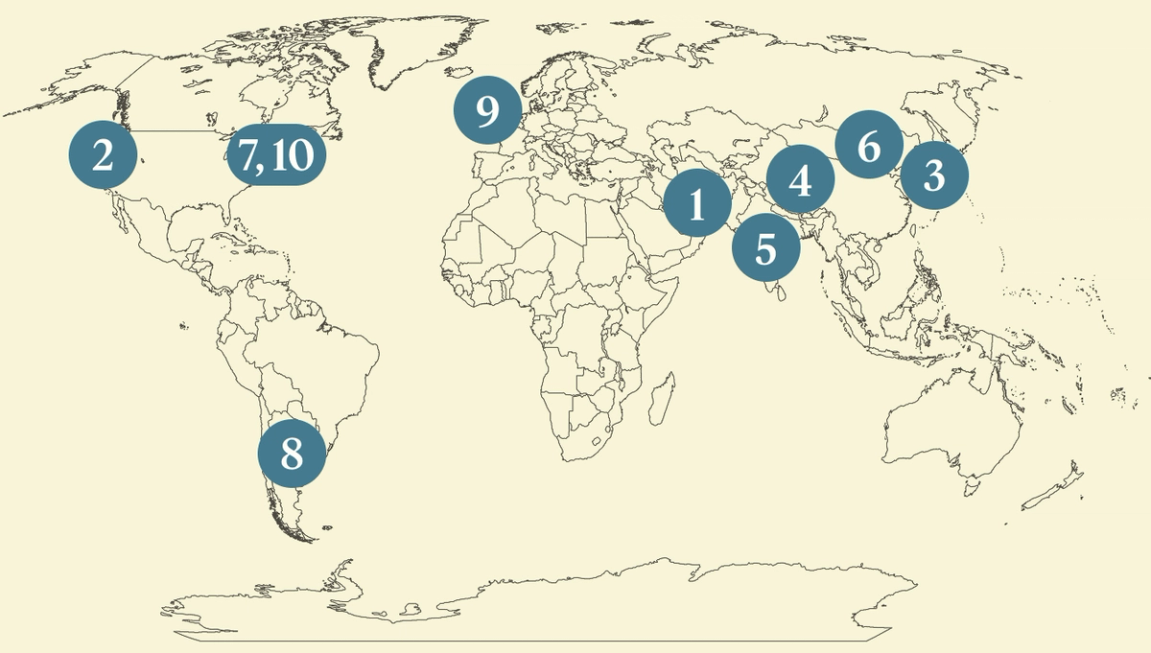 - US eases Iran sanctions
- Big Tech stocks fall
- Korea’s most valuable firm
- China’s green exports surge
- Tata hit by cyber breach
- Robots threaten gig workers
- Titan of US Fed chairs dies
- Lionel Messi breaks record
- ADHD diagnoses increase
- A new maggot for therapy
 A novel that ‘predicted the strangeness of the world we live in today.’ |
|
US eases oil sanctions on Iran |
 Nathan Howard/Reuters Nathan Howard/ReutersThe US eased oil sanctions on Iran on Monday after Washington insisted the Islamic Republic had agreed to resume UN nuclear inspections, though Tehran said it made “no new commitments.” Iran cited “major progress” after all-night talks, and the US vice president touted “a very good foundation for a successful final deal,” raising hopes that an agreement could be reached before the 60-day deadline. But dueling claims over the nuclear inspections could possibly undermine progress toward a pact that now “echo[es] key parts of an Obama-era nuclear accord that President Trump tore up in 2018,” The New York Times wrote. A CBS poll found that most Americans suspect the US has not permanently stopped Iran’s nuclear program. |
|
SpaceX, Alphabet lead tech rout |
|
SK Hynix surpasses Samsung valuation |
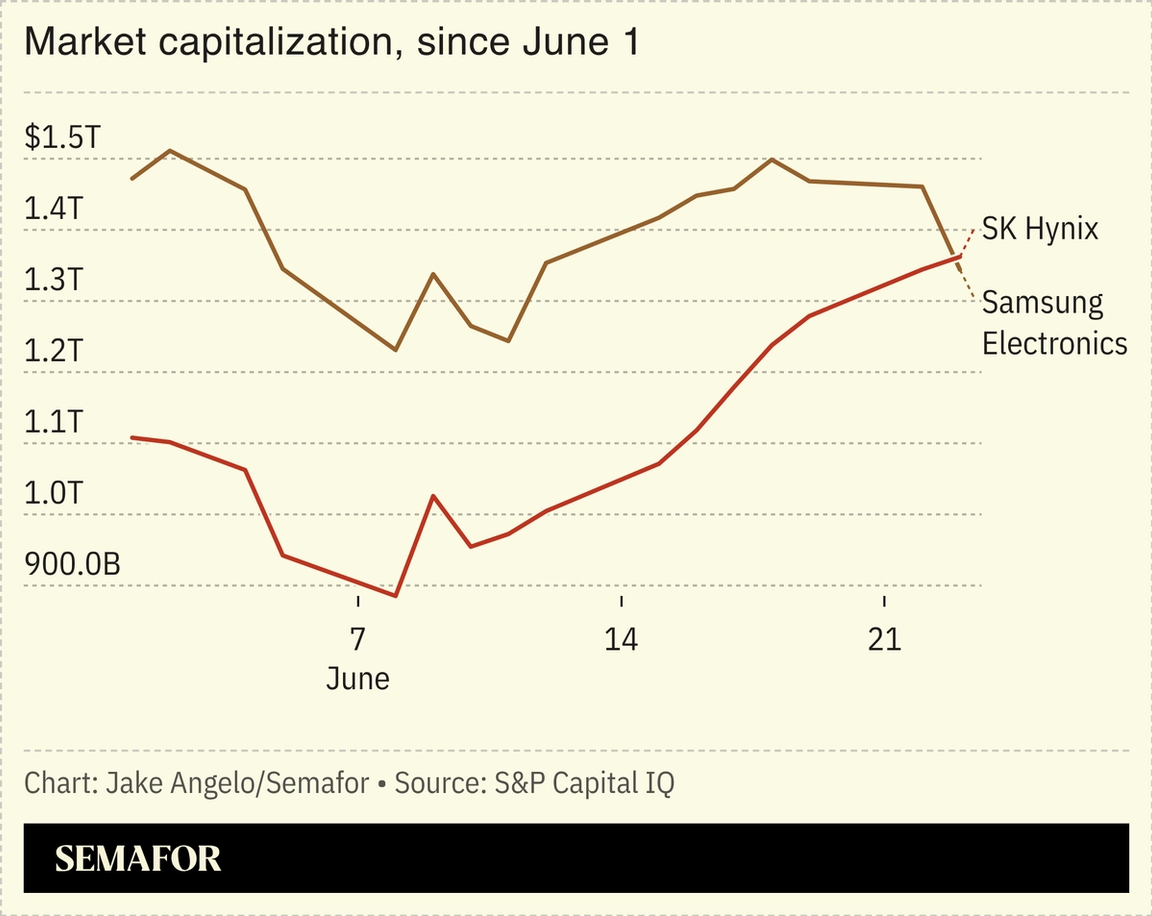 SK Hynix on Monday topped Samsung as South Korea’s most valuable company, propelled by the AI-powered chip boom. It marked a stunning reversal for a once debt-ridden company that earned the Korean epithet for a penny stock — “Dongjeon-ju,” Reuters wrote. Its shares have more than quadrupled this year, and it joined rivals Samsung and US-based Micron in crossing a $1 trillion valuation in May. The fortunes of all three have soared as the aggressive AI buildout transformed memory chips from commodities to critical infrastructure — Micron’s shares also surged Monday after a deal with Anthropic — but consumers are bearing the brunt of the resulting capacity crunch, The Wall Street Journal reported: Electronics’ prices are increasing thanks to rising memory chip costs. |
|
China’s growing green energy exports to US |
 David Gray/Reuters David Gray/ReutersThe US is importing more Chinese energy products to power its AI ambitions. China’s customs data showed strong gains in exports of green energy and battery products to the US last month, SCMP reported, reflecting thawing trade tensions between the superpowers following the US president’s visit to Beijing, as well as the global shift to renewables accelerated by the Iran war’s energy crisis. But the figures also underscore the US’ insatiable appetite for energy to sustain its expanding AI infrastructure. Tech companies are also turning to natural gas to power their data centers: Chevron on Tuesday struck a deal to sell electricity to Microsoft as it builds what could be one of the country’s largest data centers in Texas. |
|
Apple vulnerable in Tata cyber breach |
 Danish Siddiqui/Reuters Danish Siddiqui/ReutersIndian firm Tata Electronics disclosed on Monday it was the victim of a recent cyberattack, which researchers believe may have exposed Apple and Tesla trade secrets. India’s largest conglomerate, Tata is one of Apple’s most important manufacturing partners outside of China, accounting for roughly a third of its iPhone production in India. The firm is also key to New Delhi’s plans for making the country an electronics powerhouse, Reuters noted. Last year, cyberattacks crippled Tata-owned Jaguar Land Rover manufacturing for six weeks. Earlier this year, Washington said Iran-linked cyberattacks were targeting US infrastructure, and the Five Eyes intelligence alliance warned on Monday that the timeline for AI-powered attacks capable of overwhelming Western cyber defenses is “not years, [but] months.” |
|
Robot threat to China’s gig workers |
 Humanoid/Handout via Reuters Humanoid/Handout via ReutersThe head of a major Chinese ecommerce group warned that its 700,000 delivery workers would “sooner or later” be replaced by robots. JD.com’s Richard Liu said his company was working with schools to retrain couriers, so that displaced workers “[do not] go without meals, without jobs.” Youth unemployment is high, cognitive AI is threatening white-collar work, and Liu’s comments highlight growing concerns that China’s rapid adoption of robots could be a similar threat to blue-collar employment and, in particular, vulnerable gig workers, the Financial Times reported. Gig workers make up around 40% of urban employment in China, but robot workers, while rare, are growing: Shenzhen alone has several pilot projects, including robots for airport food delivery and retail-store restocking. |
|
Long-serving Fed chair Greenspan dies |
 Mike Theiler/Reuters Mike Theiler/ReutersAlan Greenspan, the former chairman of the Federal Reserve who served during the pinnacle of US economic power, died on Monday at 100. The self-taught economist became chair in 1987, overseeing the longest economic boom on record and fiercely defending the central bank’s independence with laissez-faire theory and a “temperament for navigating relentless political pressure,” The Wall Street Journal’s chief economics commentator noted. He was also famous for public statements mumbled in “Fedspeak,” coining phrases like “irrational exuberance” and earning a reputation for “never using one syllable when six would do,” The Economist wrote. Over his 18-year tenure at the Fed, Greenspan embodied the omnipotent technocrat — a legacy critics say was fatally undermined by his failure to spot the 2008 housing bubble. |
|
Messi breaks World Cup goal record |
 Kai Pfaffenbach/Reuters Kai Pfaffenbach/ReutersSoccer superstar Lionel Messi became the all-time leading FIFA men’s World Cup scorer on Monday with two goals against Austria. “God has truly spoiled me,” the Argentine said after beating Algeria last week, in one indication of what a Financial Times columnist described as “the most overtly religious World Cup in memory.” Majority-Catholic countries have won 18 of the 22 past tournaments, but evangelical Christianity and Islam are growing more common: Muslim players, like Egypt’s Mohamed Salah, have celebrated goals with the “sujood” — kneeling toward Mecca — while evangelical players lead pre- and post-match prayers. A religious pluralism advocate also celebrated the increasingly diverse team rosters of Western European countries, where anti-immigrant sentiment is on the rise, as “symbolic, yet substantive.” |
|
Why ADHD diagnoses are rising |
 Ronen Zvulun/Reuters Ronen Zvulun/ReutersThe rapid rise of ADHD and autism diagnoses worldwide is driven by changing diagnostic criteria, not an increase in underlying prevalence, research suggested. The study looked at the genes of 140,000 Danish people born between 1981 and 2008. It found those diagnosed in later years had lower genetic risk scores for autism than those diagnosed earlier, implying that thresholds had lowered. The more recent diagnoses still had higher-than-average genetic risk, suggesting that those diagnosed were not chosen at random and really did have some traits of autism or ADHD. Rising diagnoses in the UK and US have placed enormous financial demands on care systems, and have pushed nearly half of British local governments close to bankruptcy. |
|
US greenlights another maggot for therapy |
 Ajeng Dinar Ulfiana/Reuters Ajeng Dinar Ulfiana/ReutersUS regulators approved a second type of maggot for use in hospitals. “Maggot debridement therapy” involves applying sterile fly larvae to chronic wounds — the maggots remove dead tissue. The FDA cleared the use of Lucilia sericata, the green bottle, in 2004, but has now greenlit the use of Lucilia cuprina, the Australian sheep blowfly, as well. Maggots have been used in healthcare for centuries, but that is not necessarily a guide to efficacy; so were leeches and bleeding. A systematic review last year found that maggot therapy sped up the removal of dead tissue from wounds, but found little evidence that it shortened healing time overall or reduced infection risk. |
|
|


