
|
 |


New week, more losses in court for the Trump administration.
In Minnesota, there was one you don’t see often. A federal judge quashed grand jury subpoenas, something that’s almost unheard of. Federal prosecutors issue subpoenas on their own authority; they don’t need approval from a judge or from the grand jury itself. Typically, an effort is made to voluntarily obtain information or items before a subpoena is issued, and subpoenas have to be narrowly tailored to obtain relevant information— prosecutors aren’t permitted to go on a fishing expedition. Prosecutors know, and routinely abide by, the rules. Unless it’s a subpoena to an attorney or a member of the media, in which case approval from Main Justice is necessary, prosecutors routinely issue and enforce subpoenas without any interference.
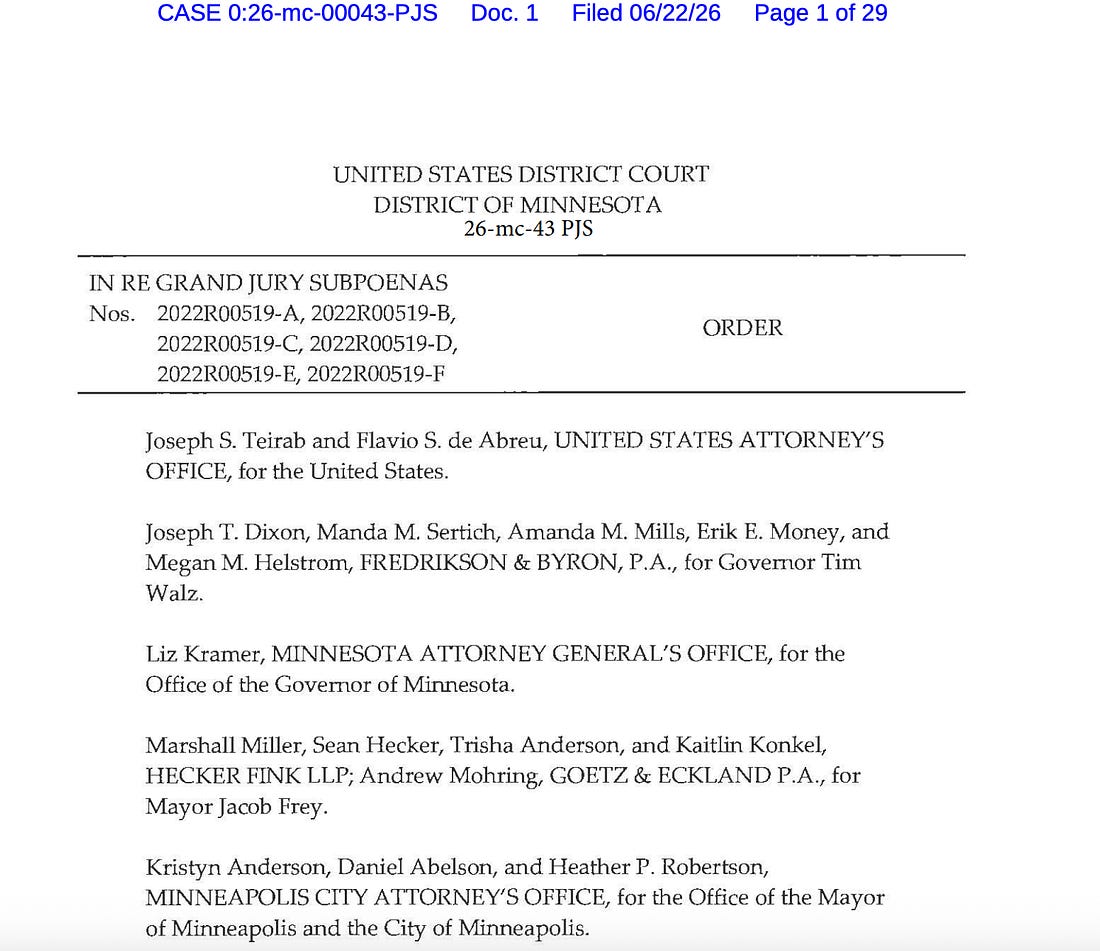
But today, Judge Patrick Schiltz, a George W. Bush appointee who clerked for Justice Antonin Scalia, quashed subpoenas that prosecutors issued as part of an investigation into Minnesota Governor Tim Walz and Minneapolis Mayor Jacob Frey. Judge Schiltz called the subpoenas part of a retaliatory effort because the two refused to assist in executing the administration’s mass deportation policies.
 |
You may recall that Mayor Frey had harsh words for ICE in the hours after Renee Good’s death on January 7, 2026. He called their interpretation of the video of her death, which they characterized as self-defense, “bulls---.” Frey said the agent who pulled the trigger was “recklessly using power that resulted in somebody dying” and made an angry demand in a press conference that was nationally televised that ICE “get the f--- out of Minneapolis.” He told the federal agents, “We do not want you here.”
The subpoenas, which called for the production of records relating to enforcement of federal immigration laws going back to January 1, 2025, were served later in January on:
the Minnesota Governor's office;
the Minneapolis Mayor's office;
the St. Paul Mayor's office;
the Minnesota Attorney General's office;
the Ramsey County Board of Commissioners;
and the Hennepin County Board of Commissioners.
That’s a lot of subpoenas, sent to a lot of different entities, regarding conduct that it’s hard to discern the criminality in. In other words, a classic fishing expedition of the sort that isn’t permitted. The Judge called it “extremely broad categories of records relating to federal immigration enforcement in Minnesota.”
Judge Schiltz’s careful order goes through the history of Trump’s “Operation Metro Surge,” in Minneapolis. “President Trump has repeatedly insulted Minnesota generally and its Somali population in particular,” the Judge wrote, providing examples like telling Representative Ilhan Omar to "go back to your own country," and calling Minnesota a "hellhole."
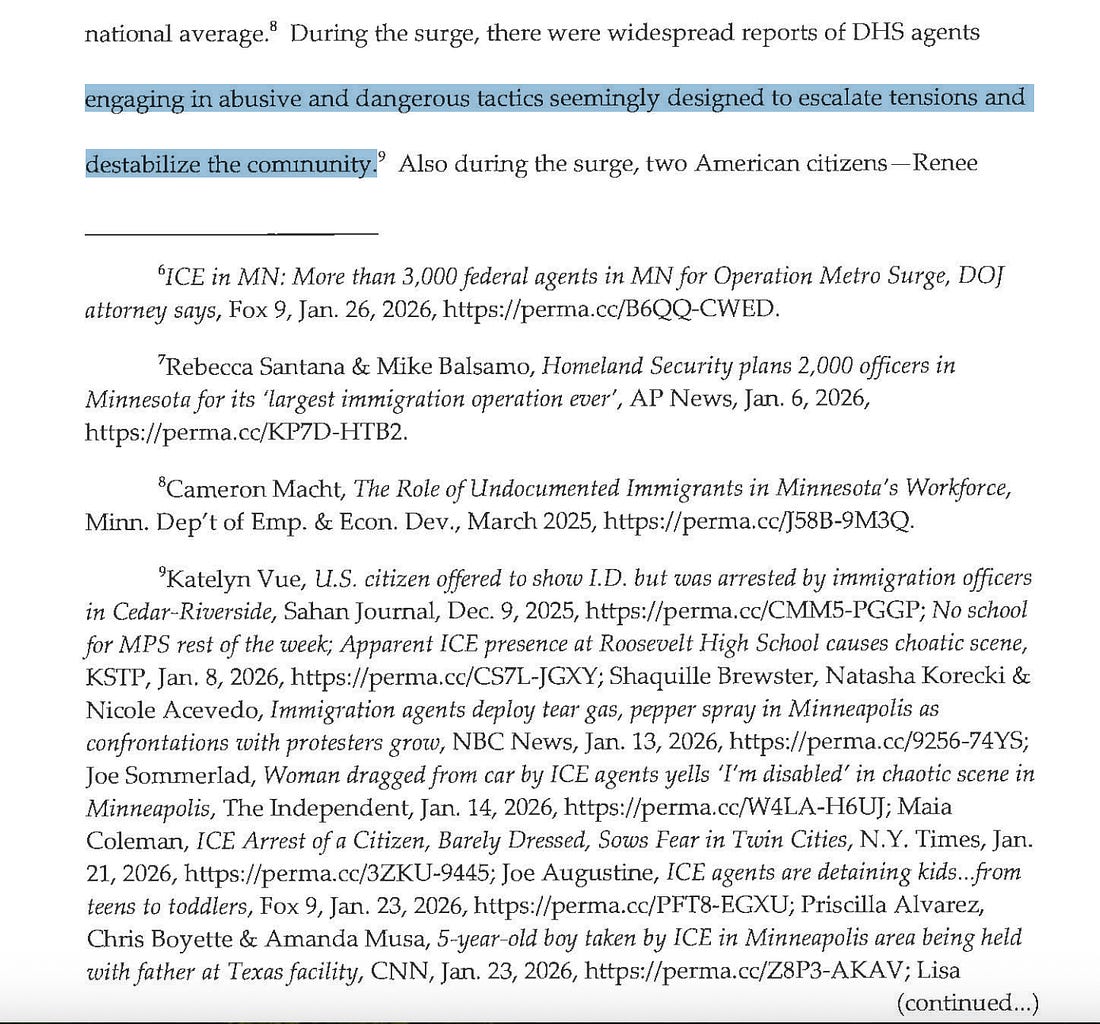
The Judge was to the point in describing ICE’s behavior during the surge as “abusive and dangerous tactics seemingly designed to escalate tensions and destabilize the community.” He noted the deaths of Renee Good and Alex Pretti, who were “killed by DHS agents.”
Eight pages of the 29-page order are devoted to laying out the facts of the surge. They are heavily footnoted with cites to examples of what the city experienced under the federal presence, like this:
 |
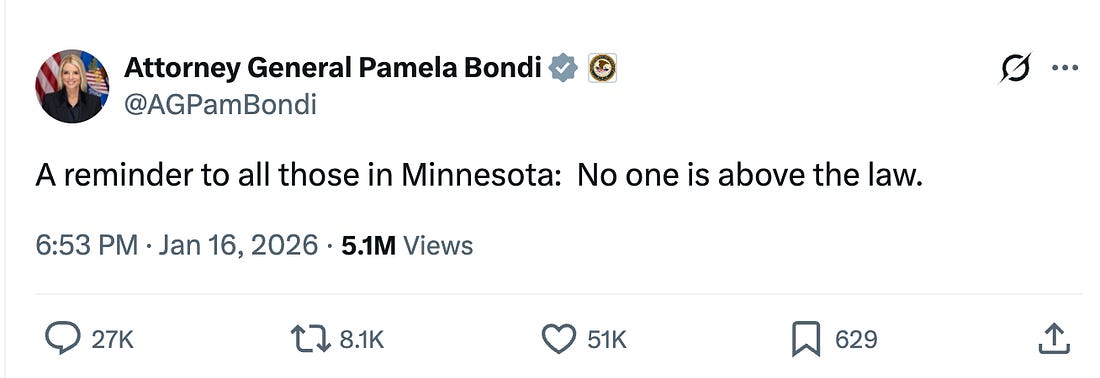
Throughout, it was clear that the audience of one had personal animus towards Minnesota Democrats, including the governor, who was Kamala Harris’ 2026 running mate. The order notes that “On January 14, then-Deputy Attorney General Todd Blanche accused Walz and Frey of ‘encouraging violence against law enforcement’ and vowed that he would stop their ‘terrorism by whatever means necessary.’” What conduct earned them that accusation? Based on the timeline, it appears to have been a lawsuit filed to challenge Operation Metro Surge. Blanche said their conduct was “close to a federal crime” and then-Attorney General Pam Bondi posted on Twitter: "A reminder to all those in Minnesota: No one is above the law."
 |
After the subpoenas were spread across the state, Bondi wrote to Walz directly, in a letter that was reportedly engineered by Trump aides. She told Fox News that “[w]e said [Walz] BETTER support President Trump, the men and women in law enforcement.”
The Judge notes the broad authority of prosecutors, utilizing grand juries, to investigate possible crimes. But, he notes correctly, “The investigatory powers of the grand jury are nevertheless not unlimited.” He explains the limits, including:
“a court may quash a grand jury subpoena ‘if compliance would be unreasonable or oppressive.’”
“grand juries may not ‘select targets of investigation out of malice or an intent to harass.’”
grand juries “are prohibited from engaging in ‘arbitrary fishing expeditions’ and initiating investigations ‘out of malice or an intent to harass’”
Judge Schiltz concludes that “A subpoena may be quashed if its ‘dominant’ purpose is improper, even if it was issued partly for valid reasons,” or if it is “unreasonable or oppressive," even if it seeks relevant evidence. But grand jury subpoenas enjoy the presumption of regularity (that we have been discussing recently because so many judges have concluded this administration is no longer entitled to it), so the burden of showing the subpoenas are legally defective is on the party that wants to avoid compliance. Here, the Judge holds that burden is met: