
|
 |
One thing that sets Popular Information apart from a lot of other independent newsletters is that we don’t put our work behind a paywall. Why? We produce journalism to hold the powerful accountable and spur change. That means it needs to reach as large an audience as possible.
Our reporting would not have forced the Social Security Administration to abandon a destructive plan to restrict telephone service or secured paid sick leave for 170,000 restaurant workers if it was hidden behind a paywall.
This decision, however, has come at a very high cost. Similar newsletters that paywall their content have two or three times as many paid subscribers, on a percentage basis. That means we have fewer resources available to pursue our work than if we took a traditional approach that maximized revenue.
I still believe that forgoing a paywall is the right decision for Popular Information because it is central to our mission. I am being transparent about the consequences, because I hope it will inspire more people to support our work by upgrading to a paid subscription.
You can make a real difference for $50 per year or $6 per month.


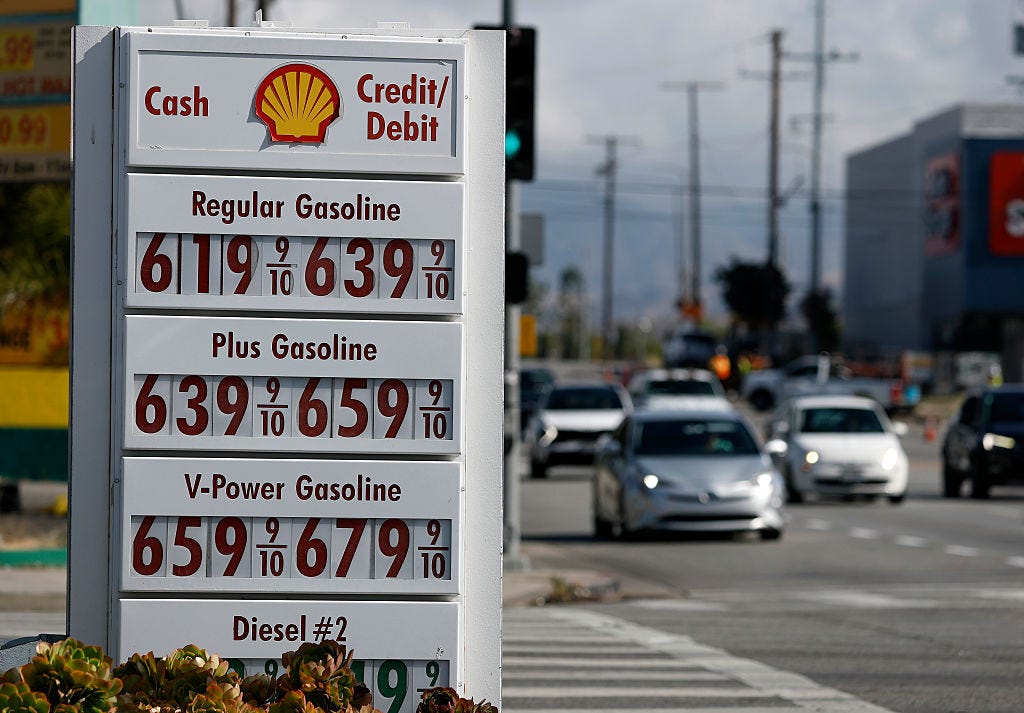 |
A new federal lawsuit alleges that gas station companies across California are engaged in an illegal conspiracy, powered by AI software, to raise prices.
The class action lawsuit claims the corporate owners of over 1,700 California gas stations — including Marathon Petroleum, 7-Eleven, Walmart, and Circle K — are using Kalibrate, an AI-powered platform, as part of “a conspiracy to extinguish retail price competition.” Kalibrate, the complaint argues, “relies on the data of competing gas stations to coordinate high prices and wring more money from the pockets of consumers throughout the state.”
According to the complaint, gas stations that use Kalibrate software charge between 6 cents and 30 cents more per gallon. In California, “a single cent increase at the pump will drain a whopping $134 million from California drivers’ wallets every year across the state.”
As the lawsuit notes, gas stations traditionally “competed for customers by aggressively undercutting one another’s retail prices.” Independent operators “chase one another’s prices down as far as they were able (taking account of their costs), in the hope of convincing more drivers to fuel at their pumps.”
Kalibrate encourages gas station owners to abandon this system and allow their AI software to automatically determine prices. The software, known as Kalibrate Fuel Pricing, connects directly to gas station signs and pumps. “Kalibrate promises that if gas stations surrender their pricing decisions and competitively sensitive cost and volume data to Kalibrate Fuel Pricing, the software will enable them to avoid competing with other area stations and to charge higher prices to consumers,” the lawsuit alleges.
The lawsuit quotes extensively from Kalibrate’s interface and marketing materials. In one striking example, the plaintiffs highlight a feature that allows gas stations to coordinate a “restoration,” which the complaint describes as “a phenomenon where nearly all gas stations in an area raise their prices contemporaneously and by a large amount.” Kalibrate’s software “includes a feature that allows customers to initiate or join these market-wide price hikes.”
 |
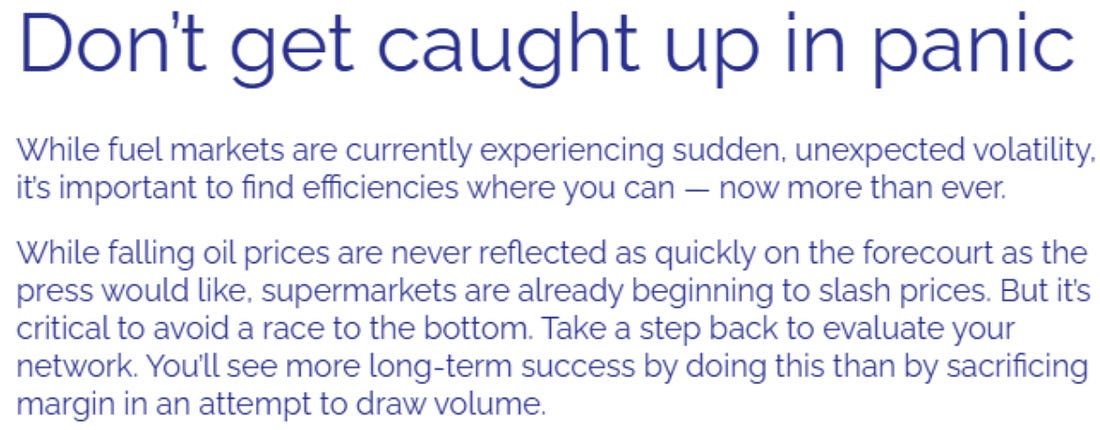
Kalibrate’s marketing materials warn gas station owners that when faced with “falling oil prices… it’s critical to avoid a race to the bottom.” The company advises gas stations to avoid “sacrificing margin” to increase their volume of sales.
 |
Prospective customers, according to the lawsuit, are told that using Kalibrate will give them “complete visibility on your competitors.” The company’s marketing materials also warn gas station owners that lowering prices could trigger “a downward spiral and has negative implications for everyone operating in that market.”
Notably, the lawsuit claims “Kalibrate also has shown potential customers the confidential, non-public, competitively sensitive information of competing gas stations—including non-public, competitively sensitive fuel sales volumes—that Kalibrate would make available to them.”
Kalibrate touts that its software will help operators “squeeze out profits” by selling fewer gallons of gas at higher prices. In one example highlighted by the company, a station using Kalibrate’s software sees its volume of sales decrease by 2.2% but its profits increase by $587 per week.
Although the lawsuit is focused on California, “Kalibrate Fuel Pricing is widely used in the United States.” Kalibrate claims that it “sets fuel prices for ‘8 of the top 10 fuel retailers in the USA,’ and for 14 of the top 20 convenience store chains.”
The new law at the heart of the lawsuit
The lawsuit against Kalibrate and its customers is based on AB 325, an amendment to California’s antitrust laws that went into effect on January 1, 2026. Under AB 325, it is “unlawful for a person to use or distribute a common pricing algorithm as part of a contract, combination in the form of a trust, or conspiracy to restrain trade or commerce in violation of this chapter.” A “common pricing algorithm” is defined broadly as “any methodology, including a computer, software, or other technology, used by two or more persons, that uses competitor data to recommend, align, stabilize, set, or otherwise influence a price or commercial term.”
“Kalibrate Fuel Pricing is software used by two or more persons that uses competitor data to recommend, align, stabilize, set, and influence gasoline prices,” the complaint alleges.