
|
 |
This is a public post so please share it widely. If you enjoy this newsletter, I hope you’ll consider upgrading to a paid subscription.
For those who don’t want a Substack account, you can keep Off Message going with a donation. All support is appreciated, and donations of $75 or larger come with a comped annual subscription—all content unlocked and emailed to the address provided.
Obama, Trump, And The Outmoded Politics Of Indirection
We can say what we mean about the bad guys; it might work better.
|

| |||||||||||||||


 |
Right-wing consciousness of guilt is one of few amusing phenomena of the Trump era. It is so pitched, and conservatives so self-aware, that any nod to virtue strikes them as an accusation, and they lash out angrily.
Observe in a campaign speech or on social media that lying is bad; produce a film or write a book in which the antagonist is immoral; praise a politician for keeping his word or serving all of the public; and they will interpret it as a partisan political attack, skipping the step where anyone actually has to say anything explicitly negative about Donald Trump.
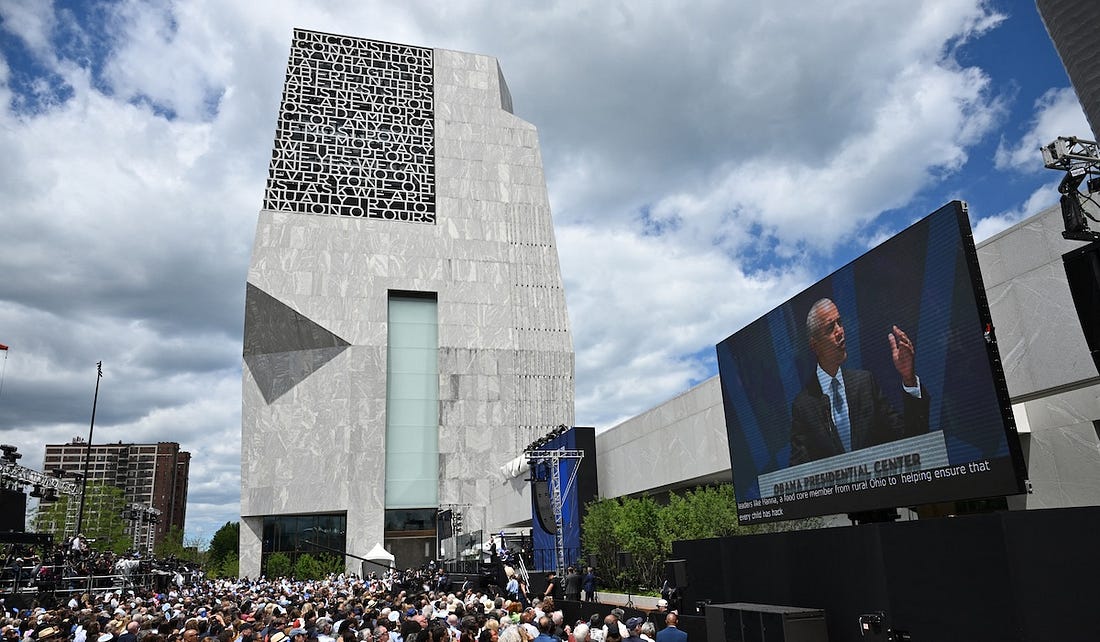
This is why they interpreted Barack Obama’s speech at the dedication of his presidential library last week as a partisan attack, while many of the rest of us were struck by how oblique it was.
Fox News called Obama “classless” for taking “partisan shots” at Donald Trump, whose name went unmentioned all day. Others took it personally—as a “cheap shot”—that Obama gestured at the importance of the peaceful transfer of power. Obama’s admirers and members of his inner circle, meanwhile, were quick and proud to note that Trump’s name went unuttered.
Obama’s politics have always been indirect in this way. Rarely—and almost exclusively in the heat of campaigns against Donald Trump—has he expressed exactly what he means about the people he opposes.
This has been a bit of a sore spot in Democratic politics—especially now after most politically engaged Democrats have concluded that Michelle Obama’s famous mantra—“when they go low, we go high”—was well-intentioned but bad political advice.
There is a small but vocal (and by some measures ascendant) faction of progressives who believe or claim to believe Obama was actually a bad president. Not incompetent, not woefully naive, but a villain.
Abutting them, are another set who deem him a failure almost by definition—after all, if his politics and leadership were so successful, why did the country reject his anointed successor and elect Trump?
I think these arguments are essentially ludicrous. At the most extreme, they echo the committed communists who view FDR as an enemy for rescuing capitalism from the just verdict of history. They’re almost ludicrous by definition, insofar as Obama left office popular and has only grown more so in the afterglow of his post-presidency. But they’re ludicrous on other terms, too, such as: compared to whom?! Most of our presidents have been mediocre to terrible. Even the best ones have checkered records, because humans are flawed, politics is hard, and governing (particularly in a two-party democracy) is impure.
Our best president was followed by arguably our worst—not by some minority-rule glitch in the electoral system, but because Abraham Lincoln dumped his abolitionist vice president, and replaced him on his re-election ticket with a southern bigot who sabotaged what might have been an even more impressive legacy.
A large majority of American liberals admire Obama. But there is a rift—between those who believe he did the best he could, and thus floats largely above reproach, and a more malcontented bunch (including me) who really wish he’d gone about some things differently, and would change some things going forward.