| | The global tech rout hits South Korea, Washington’s pro-Ukraine tone unnerves Russia, and Meta build͏ ͏ ͏ ͏ ͏ ͏ |
| |  | Flagship |  |
| |
|
The World Today | 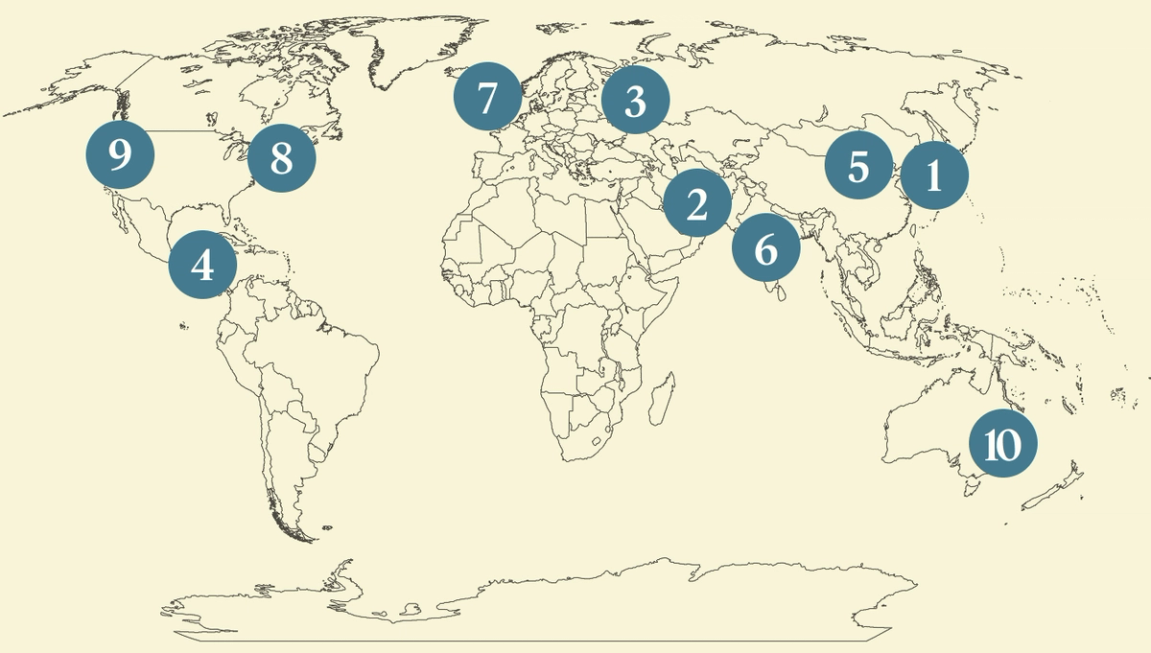 - Tech rout goes global
- Iran deal disagreements
- Russia sours on Trump
- Kyiv’s defense clout grows
- US-China economic war
- Different robotics strategies
- UK warns of AI jobs losses
- Mamdani’s influence tested
- Meta plots prediction app
- Longest non-stop flight
 A book about trade policy that reads nothing like a book about trade policy. |
|
Global tech rout hits South Korea |
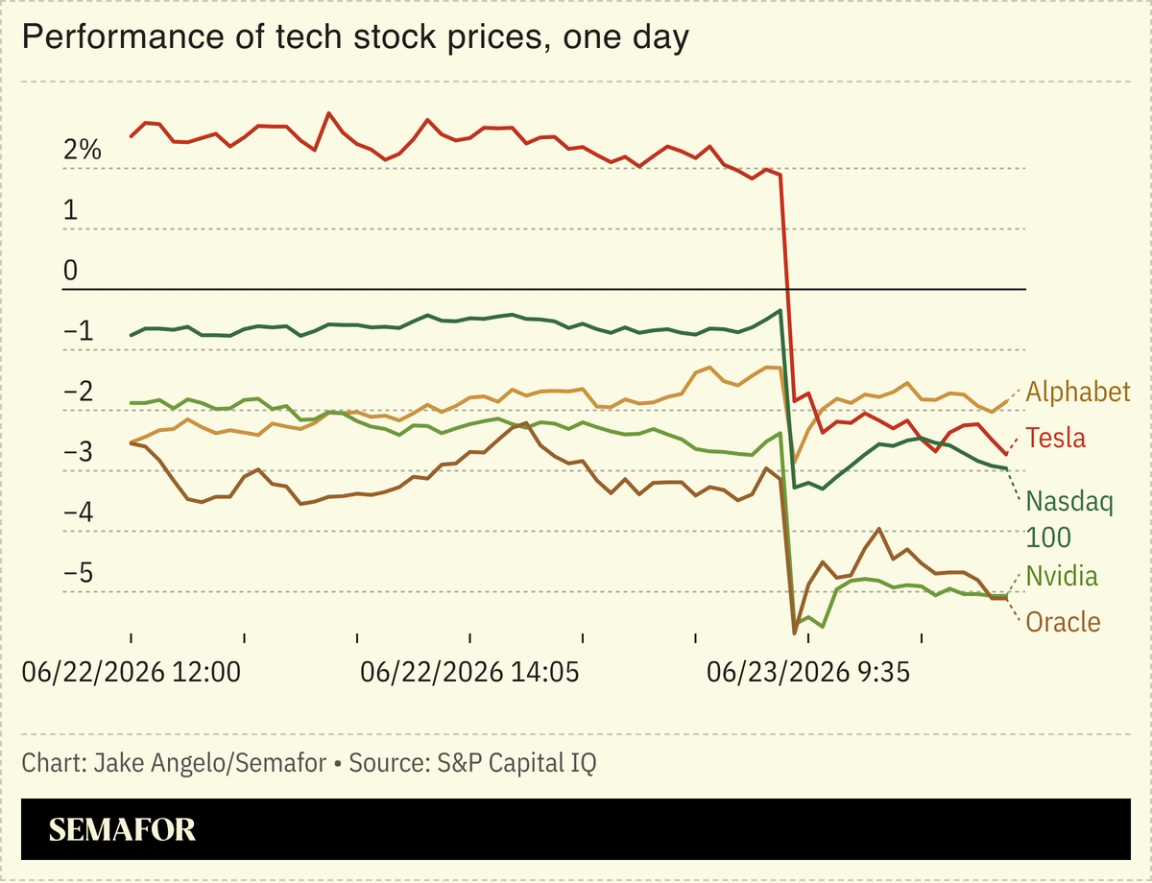 The tech stock rout stretched into a second day and spread globally following a dramatic dip on Wall Street on Monday. South Korean stocks took the biggest hit, with Samsung Electronics and SK Hynix each plunging by more than an eye-popping 12%. It appears that the “market’s snooze button on AI spending fears” has timed out again, Semafor’s Liz Hoffman wrote, and it’s unlikely the US Federal Reserve will come to the rescue of investors as a growing consensus expects an interest rate hike by the end of the year. Stock volatility of this nature has become commonplace as AI jitters reverberate across the market. “It just feels very, very frothy,” an equity strategist said at a conference in Seoul. |
|
US, Iran disagree on deal terms |
 Evelyn Hockstein/Reuters Evelyn Hockstein/ReutersUS President Donald Trump on Tuesday insisted that Iran had agreed to more UN nuclear inspections, rebuffing Tehran’s denial of such a commitment. “They’re wrong,” Trump said, with the disagreement raising fears that future talks would fail to yield a final resolution to the conflict, even as the US secretary of state traveled to the Gulf to reassure Washington’s allies on the deal’s benefits. There are also conflicting accounts on what the agreement means for the future of the Strait of Hormuz; Monday saw 35 commercial vessels transit the waterway, the busiest day in the strait since the war began. The deal has also overshadowed fresh Lebanon-Israel talks, with an Israeli diplomat saying, “this train is in danger of derailing.” |
|
US’ pro-Ukraine tone unnerves Moscow |
 Sputnik/Gavriil Grigorov/Pool via Reuters Sputnik/Gavriil Grigorov/Pool via ReutersRussia accused the US of failing to follow through on “understandings” reached at last year’s Alaska summit, reflecting Moscow’s frustration with Washington’s recent pro-Ukraine shift in tone. President Donald Trump is reportedly impressed with Ukraine’s drone strikes deep inside Russia, and has signaled more support for Kyiv and further sanctions on Moscow. Trump likes to back winners, and Ukraine’s battlefield victories have given it new leverage, a Financial Times columnist noted: Ukrainian drone experts are advising the Pentagon and Kyiv’s military tech is in high demand. While Ukraine advocates are well aware that Washington’s rhetorical shift doesn’t always translate to policy, Moscow is still nervous, an analyst told Reuters, predicting a “Russian push to get Trump back onside.” |
|
Honduras to buy Ukrainian drones |
 Leah Millis/Reuters Leah Millis/ReutersHonduras will buy Ukrainian drones to fight drug trafficking, further evidence of Kyiv’s growing defense-industry clout. The two nations’ presidents met last week; Honduras is a transit route for South American cocaine into North America, and may be evolving into a producer as well as a conduit. Since Russia’s 2022 invasion, Ukraine has become a world leader in military drone technology, both in attack and defense. A dronemaker CEO recently flew to Tokyo to tap markets in Asia as tensions grow over Taiwan, and Kyiv has already signed licensing agreements with Canada and several Gulf countries. A German defense manufacturer is also hoping to build Ukrainian-designed cruise missiles, which are cheaper than their US equivalents and similar in range. |
|
US-China economic war enters new phase |
 Carlos Barria/Reuters Carlos Barria/ReutersThe economic war between the US and China is entering a new phase, ensnaring some of the countries’ largest firms, while Europe dithers on how to battle with Beijing, analysts argued. The differing approaches on either side of the Atlantic “are instructive,” Semafor’s China columnist noted: Washington has erected high tariffs, pulled its trading partners away from Beijing, and is nurturing private innovation in EVs. The EU, meanwhile, is “debating the terms of its own industrial surrender,” failing to even name China as a threat. The US recently broadened its blacklist of PLA-linked firms to include commercial giants like Alibaba, and unlike in previous years, Beijing is retaliating, risking a “wider round of… supply-chain disruption,” Washington Post Intelligence wrote. |
|
Countries grapple with China’s robotics lead |
 Florence Lo/Reuters Florence Lo/ReutersMajor economies have starkly different instincts in response to China’s lead in the embodied AI race. China installed a record 295,000 industrial robots in 2024 — 54% of the global total — as it looks to do with robotics what it already has with EVs and solar panels. In the US, robotics firms are urgently pushing for a national strategy to counter Beijing. German companies, however, are confident that industrial customers will prioritize the reliability and data security of domestic bots over Chinese alternatives, Semafor reported. For India, which installed merely 9,100 industrial robots in 2024, the stakes cannot be higher, a prominent academic warned, as it needs to confront a future where robotics threaten the country’s decadeslong cheap-labor advantage. |
|
UK report warns of AI job losses |
 Chris J. Ratcliffe/Reuters Chris J. Ratcliffe/ReutersAI could cause major job losses by 2030 and eventually pose existential risks, a UK government report warned. The report envisaged plausible AI futures, including those in which development slows, continues steadily, or accelerates; in a rapid take-off scenario, it said, a race dynamic between major players could cause them to deprioritize safety unless regulatory steps are taken. Britain, despite its various problems, has a strong AI ecosystem and, in the AI Security Institute, a leading safety research organization. But AI is “not a priority” for the UK’s presumed next prime minister Andy Burnham, Sky News’ technology correspondent reported, beyond a hope that it can be used to improve public services and concerns about the concentration of its economic benefits. |
|
 You can do a lot in 10 minutes… like make sense of the global economy. Each day, the Marketplace Morning Report podcast explains what’s happening in the economy, why it matters, and what it means for the way you live and work. It’s essential analysis from award-winning reporters you can trust. Listen now. |
|
NY primaries test Mamdani influence |
 Eduardo Munoz/Reuters Eduardo Munoz/ReutersNew York’s congressional primary elections on Tuesday are the most significant test yet of Zohran Mamdani’s political capital and his efforts to remake the Democratic Party. In endorsing a slate of leftist candidates who are challenging powerful incumbent Democrats, the New York City mayor is staking his political future on the idea that he “knows where to take the Democratic Party,” Semafor’s David Weigel wrote. But supporters worry that if he loses, Mamdani runs the risk of critics saying, “this is more man than movement,” an elections analyst said, and that his rise was merely “a comet: beautiful, singular, gone.” But voters’ fury over rising prices and party leadership is contributing to the most “perilous political environments for incumbents” since 2016, Politico noted. |
|
Meta eyes its own prediction market |
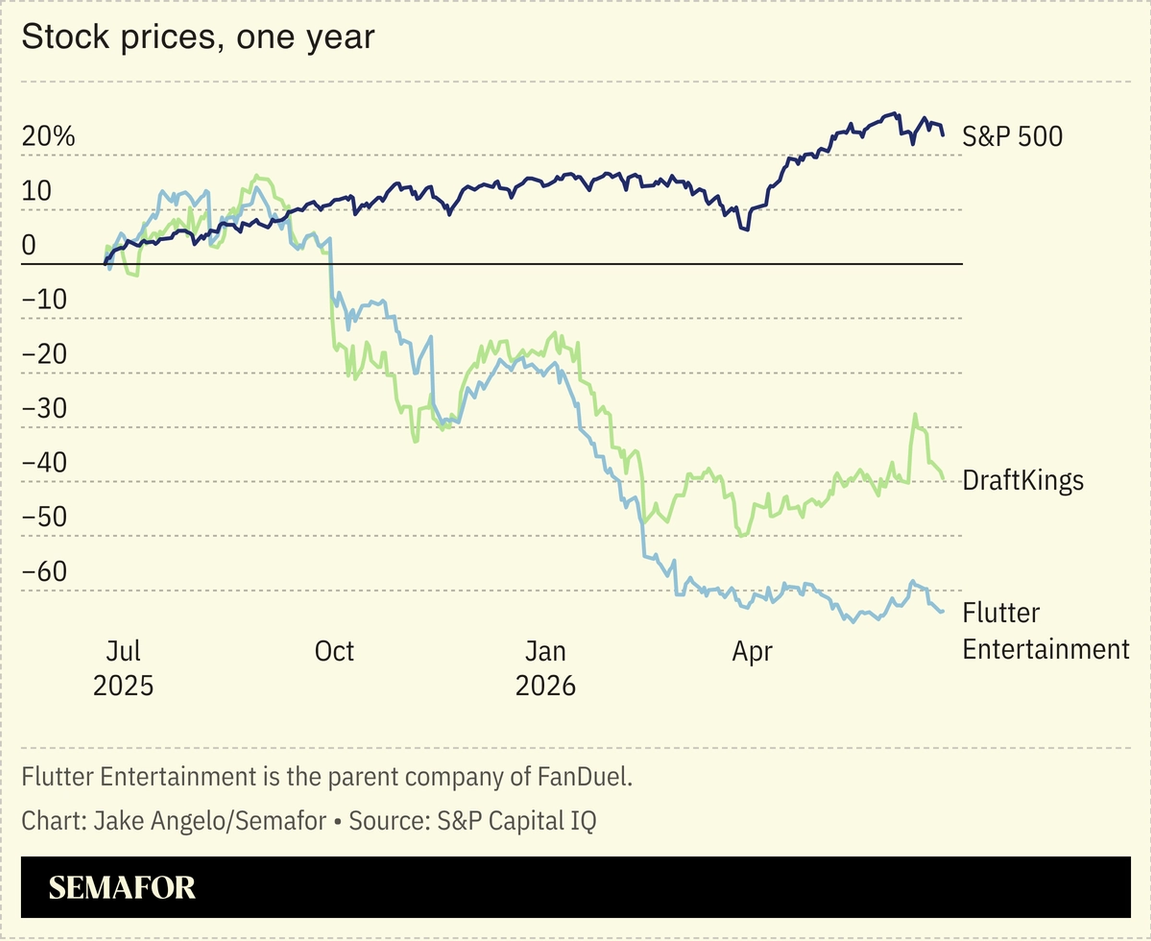 Meta plans to build a prediction markets app, The New York Times reported, as one of Big Tech’s traditional champions seeks to carve out a slice of the retail futures bonanza. DraftKings and FanDuel’s parent company fell on the news, reflecting the challenge prediction markets, which have flourished amid lax regulations, pose to digital sportsbooks, CNBC noted. Meta’s app would leverage existing Instagram and Facebook users, using a points system but possibly real cash in the future. Despite criticism over opaque and deceptive practices, prediction markets’ election favorites won most of the time, a Washington Post anal |
|
|


