|
|
|
|
|
|
|
|
|
The Home of the Week is a historic Cabbagetown semi-detached that's been renovated true-to-character. Birdhouse Media/Bird
|
|
|
|
|
This week: Why the housing downturn is making more exes live together after they break up, and B.C. and Ottawa’s controversial new affordable housing plan. Plus, Airbnb’s failed play in the World Cup and one property worth a look. |
|
|
|
|
|
|
|
|
|
|
Ottawa and B.C.’s controversial plans to buy-up unsold condos |
|
|
|
|
|
|
|
|
|
|
|
|
|
Construction workers at the site of a condo tower in Delta, B.C., in July, 2025. DARRYL DYCK/The Canadian Press
|
|
|
|
|
|
|
|
|
|
|
Conservatives have attacked the vague initiative as a “bailout” for developers, but Carney insisted it is about putting Canadians first. As Marieke Walsh and Bill Curry report, the Prime Minister said the plan will establish a rent-to-own program for families and individuals who can’t afford a down payment and key details are still being hammered out. “That is a more effective way of getting affordable housing immediately into people’s hands than building again,” Carney said Thursday. |
|
|
|
|
As Rachelle Younglai reports, it’s the latest way Carney’s government is trying to jumpstart the stalled condo markets
in B.C. and the GTA. Last week, Ottawa and B.C. said they would spend up to $3.2-billion to cut development charges and help reduce building costs and home prices. But preconstruction condos have been some of the toughest to move as the downturn drives away investors: nearly 4,000 newly built units are sitting empty in the Vancouver area and the federal-provincial HST rebate on new homes
has helped Toronto home sales, but not condos. Read more about the unsold condo plan in B.C. here. |
|
|
|
|
|
|
|
|
|
|
Housing costs and downturn keep exes living under the same roof |
|
|
|
|
|
|
|
|
|
Brenda Trinh says fears of how she would afford to live alone kept her and her ex together for longer, and then living together after their break-up. Sammy Kogan/The Globe and Mail
|
|
|
|
|
Everything you own in a box to the left? Not so fast. More couples are delaying separating or continuing to live with their exes
well after breaking up because they aren’t sure they can afford to rent or buy alone, according to a survey by the Bank of Montreal. One third of Canadians felt financially pressured to move in with their partners in the first place, and nearly two-in-five say they delayed separation or divorce because of the costs. |
|
|
|
|
As Mariya Postelnyak reports, the financial and emotional turmoil is being exacerbated by a housing downturn that means selling the shared home likely requires taking a loss – and probably losing most of the equity you put in. “It’s definitely something I’ve been noticing a lot lately with my own friends. Relationships aren’t easy, but what I’m seeing is that people feel stuck,” Mariya told me. “They’re trapped in small starter homes and condos, unable to meet that next life milestone together, or feel like they can’t venture out on their own.” |
|
|
|
|
But still, the numbers of exes staying under the same roof surprised Mariya. “We often talk about the rising number of single people,
so there’s often a sense that we’ve shed any expectations of being together for reasons such as finances, traditional gender roles, housing and kids," she said. “But the opposite seems to be true lately. Groceries, travel, insurance and so many of our other living expenses are becoming less affordable just as home values are taking a nosedive.” Read the full story about how the market is affecting matters of the heart here. |
|
|
|
|
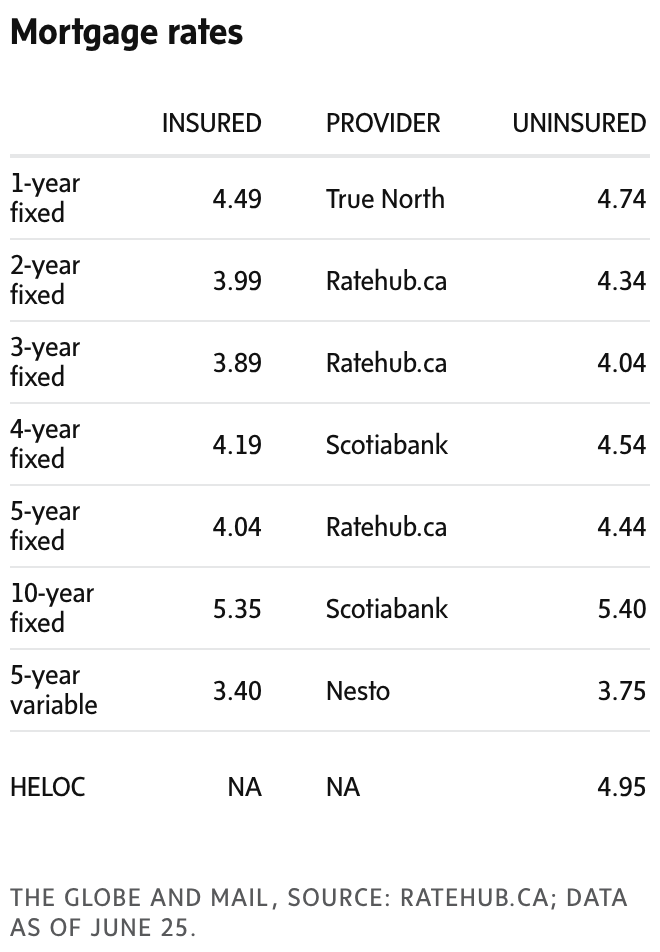
This week’s lowest fixed and variable mortgage rates in Canada |
|
|
|
|
|
|
Rates shown are the lowest available for each term/type and category (insured vs. uninsured) as of market close on Thursday, June 25. |
|
|
|
|
|
|
|
|
|
|
Airbnb used the World Cup to lobby for relaxed rules. Demand didn’t keep up |
|
|
|
|
|
|
|
|
|
Airbnb's lobbying to relax rules for the World Cup came up short – and that's a good thing, Thomas Wieditz argues. DARRYL DYCK/The Canadian Press
|
|
|
|
|
With the World Cup in full swing, it’s time to take stock of some plays off the pitch. Airbnb spent millions lobbying host cities to relax short-term rental rules,
and it worked on some, including Los Angeles. But the platform’s attempts to get B.C. and the City of Vancouver to waive host fees and the principle residence requirement came up short, just like demand for accommodations has in Vancouver and Toronto. |
|
|
|
|
As Thorben Wieditz writes, the nightmare scenario of no room left at the inn didn’t come to pass, and in fact, the opposite. Hotels in both Vancouver and Toronto remained less than 50-per-cent full
after seven match days, tracking more than 20 per cent lower than ordinary June-levels. Short-term rentals didn’t fare much better: Vancouver’s occupancy rates are expected to be 10 per cent lower than the same period last year. |
|
|
|
|
And though some Airbnb hosts have cried foul,
“B.C.’s refusal looks pretty wise today,” Thomas argued. Tighter rules help lower rents for locals and the introduction of principle residence requirements has saved Canadian tenants roughly $192-million in rent each month, according to a new study. “As history has caught up to Airbnb’s predictions about a lack of available rooms, it’s easy to recognize that its predictions were nothing but an opportunistic attempt to pad its bottom line,” Thomas writes. “The next time the company tries that, governments shouldn’t believe its pitch.” |
|
|
|
|
|