| | In this edition: The extinct impeachment voter, progressives notch more wins, and El-Sayed gears up ͏ ͏ ͏ ͏ ͏ ͏ |
| |  DENVER, CO DENVER, CO | DETROIT, MI | BAR HARBOR, ME |
 | Americana |  |
| |
|
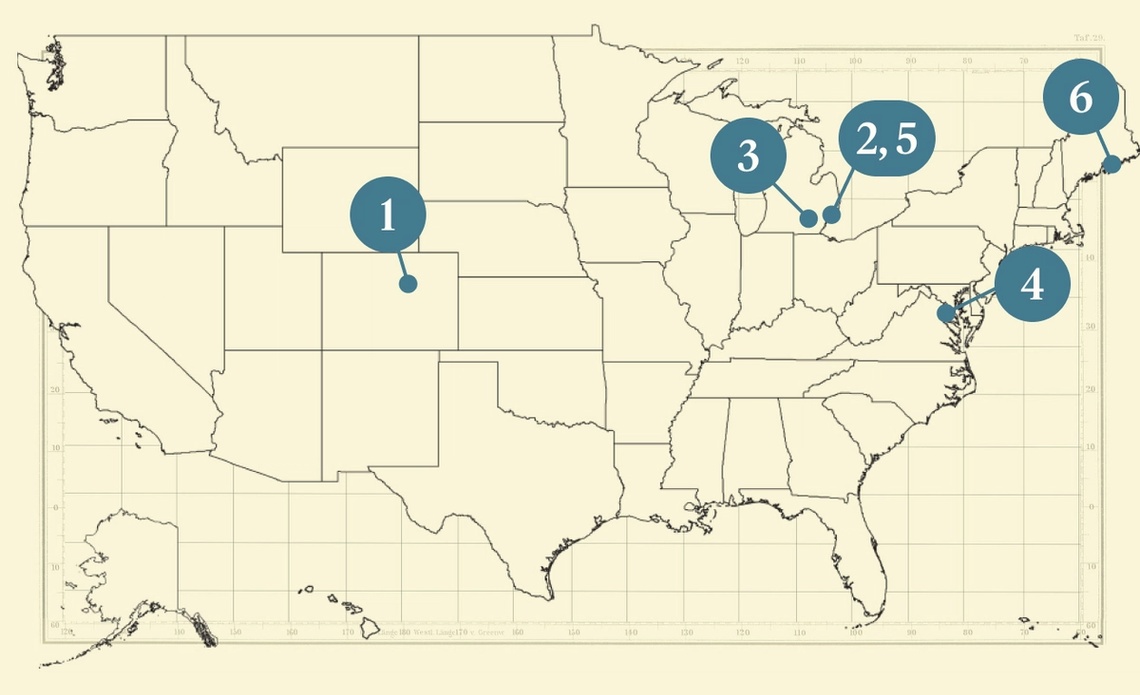 - Socialists rising
- El-Sayed speaks
- Dems evade old tweets
- Selling Trump’s agenda
- Ad Watch
- Poll Watch
|
|
 Last month, Colorado Democratic Rep. Diana DeGette sat next to her challengers and explained why she deserved a 16th term in Washington. “Who is going to be the best choice to stand up to Donald Trump and the real threat he poses to our democracy?” DeGette asked at the Denver Press Club. “The answer is clear. I fought against Donald Trump as an impeachment manager in his first term.” On Tuesday night, Denver voters rejected that pitch — as loudly as possible. Melat Kiros, a young attorney who lost her job after defending student Gaza protesters, defeated DeGette by double digits. Three Democratic incumbents have now lost to progressive challengers as midterms season kicks into high gear. The liberal group Justice Democrats, reeling after two left-wing “squad” members lost in 2024, is celebrating its best cycle ever, with more targets on the board next month. Primary season is more than halfway over, after 31 states and the District of Columbia picked their nominees. There’s a three-week pause before intra-party contests start again with Arizona. That means it’s a good time to take stock of what’s happening. Here’s one big takeaway: Democrats don’t care if you resisted Trump and lost. DeGette went down one week after Rep. Dan Goldman, D-NY, whose role as an impeachment counsel during Trump’s first term was central to his campaign. A few weeks earlier, Maine Secretary of State Shenna Bellows, who’d fought to disqualify Trump as a presidential candidate over his actions on Jan. 6, came fourth in a five-way race for governor. And shortly before that, Rep. Al Green, D-Texas — the first Democrat to introduce Trump impeachment resolutions during both of the president’s both terms — lost his newly gerrymandered seat to Rep. Christian Menefee, D-Texas. Impeachment wasn’t the issue in those races. But it was striking how little Democratic primary voters cared about a political tool that had twice been wielded against Trump (before it shattered uselessly in the Senate). When I asked Goldman how he could say he “beat Trump,” given that Trump won his second reelection battle after two impeachments, he explained that in 2020 “Republican senators acknowledged we proved the case, we brought the American public along, and then Donald Trump, eight months later, lost the election.” Primary voters disagreed. |
|
Progressives get more good news in Colorado |
 Melat Kiros. Elizabeth Frantz/Reuters Melat Kiros. Elizabeth Frantz/ReutersLeft-wing Democrats notched another win in Denver, where Kiros, a progressive attorney, ousted DeGette and denied her bid for a 16th term. For the third time this month, a candidate supported by her city’s chapter of the Democratic Socialists of America defeated a progressive with deeper roots in the party. “Denver voters of all ages, of all races, of all religions sent a clear message: We will not wait,” Kiros told supporters after DeGette conceded the race. DeGette’s defeat came on a weak night for Democrats identified with the party in DC, and a good night for Colorado progressives, who’ve watched Republicans become less relevant in their one-time swing state. State Attorney General Phil Weiser bested Sen. Michael Bennet, D-Colo., to win the party’s gubernatorial nomination — a race that had less to do with ideology and more with Weiser’s lawsuit against the Trump administration while Bennet was stuck trying to push back on the president from the Senate. Sen. John Hickenlooper, D-Colo., held off a progressive challenger, while losing the city of Denver — where he’d served two terms as mayor. Like DeGette, he’d pulled out of the state assembly process (its convention system) once it was clear that party activists wouldn’t support him. (DeGette nearly lost her ballot slot as delegates rushed to Kiros.) Moderate Democrats also lost in the swingy 8th Congressional District, where the Blue Dog Democrats’ PAC couldn’t help state Sen. Shannon Bird. State Rep. Manny Rutinel, who had some shifting progressive views, won in a landslide. Republicans had their own battle between party leaders and the base, with a gubernatorial primary that won’t be called until more ballots are counted. State Sen. Barbara Kirkmeyer, who lost a 2022 race in the 8th district, is narrowly ahead of Victor Marx, a conservative pastor with a patchy and possibly fabricated biography.
|
|
El-Sayed puts on the gloves |
 Andrew Roth/Sipa USA via Reuters Connect Andrew Roth/Sipa USA via Reuters ConnectALLEN PARK, Mich. — The scale of recent left-wing victories in New York brightened the spotlight on progressive Democrats everywhere, especially in politically competitive states. Abdul El-Sayed is ready for it. The 41-year-old public health expert, who ran for governor of Michigan eight years ago and lost, has forged ahead in this year’s Senate primary, worrying Democrats who think he’d endanger a seat that moderates have controlled for decades. I sat down with El-Sayed on the first stop of a tour through towns that voted for Joe Biden in 2020 and then Trump in 2024, just over a month before the Aug. 4 primary. I asked if the reason Fox News is booking and covering him might be the same reason Republican PACs spend to help progressive candidates — they see them as easier to beat in the general election. “It’s amazing to me how deeply they’re misjudging this,” El-Sayed told me. “I’m like: You have never fought a counterpuncher.” |
|
Progressives run from their old tweets |
 William Lawrence for Congress/YouTube William Lawrence for Congress/YouTubeLike other progressives this cycle, including Darializa Avila Chevalier and Graham Platner, Democrat Will Lawrence has deleted controversial social media posts that have since been resurfaced. Now, he’s trying to put distance between himself and the musings as he tries to defeat other Democrats in the primary for Michigan’s 7th Congressional District. In an interview with Semafor earlier this week, Lawrence rejected past comments he made supporting the “defund the police” movement before his congressional campaign. Lawrence said what a lot of Democrats have since 2020: That was another time, exploding with ideas, and he doesn’t now believe every single thing that he posted at the time. Michigan’s 7th district, which narrowly backed Trump in 2024 while also electing a Republican, is one of the tougher targets for a Bernie Sanders-endorsed challenger. The Vermont senator’s chosen candidates are mostly running in deep blue seats, like New York’s 13th Congressional District, where no Democrat thinks that Avila Chevalier’s old posts about Marxism can help Republicans win in November. “I hate injustice, and I spent my life working to understand the causes of injustice and how to build power together to have an affordable and dignified life,” Lawrence said. “That’s what I’m focused on, and it’s all a process. I’m sure I’m saying things in the course of this campaign that I’ll disagree with in five years.” Read more about the progressives moving on from far-left ideas. → |
|
|
Trump’s doomed voting bill is red meat for his base |
 Nathan Howard/Reuters Nathan Howard/ReutersRepublicans notched an expected victory from the Supreme Court on campaign finance yesterday. But the court’s other rulings highlighted a different problem: Running on Trump’s accomplishments isn’t all that effective. After the administration’s positions on birthright citizenship and mail voting were rejected by the court, the president jumped on Truth Social to demand that congressional Republicans do something about it. “Until the day we confirmed [Brett] Kavanaugh, the base was on fire. Once it’s done, they don’t thank you,” Ralph Reed told Semafor on the sidelines of his Faith and Freedom Coalition’s Road to Majority conference last week. “You try turning out any voter today based on the border. It’s one of the ironies of politics: you solve a problem that got you elected, it’ll never elect you again.” The three-day gathering of Republicans and conservative Christians was full of praise for Trump’s second term, with Treasury Secretary Scott Bessent making an appearance to talk about the benefits of last year’s tax cuts bill. But the president himself spent more time talking about the SAVE America Act, a collection of election reforms that includes proof of citizenship for all voters. It has never had enough support in the Senate to pass, but Trump sees it as a key motivator for the base. The SAVE America Act drama helped block this week’s business in the House, as conservatives rejected annual defense policy legislation to protest Senate inaction on the voting bill. And on Fox News, Vice President JD Vance suggested that the administration’s 5-4 loss on birthright citizenship should motivate Republican voters to turn out and give the party a chance of replacing a liberal justice some day: “We actually have an opportunity to reverse this decision just as we reverse so many bad decisions throughout the generations.” |
|
Michigan Dems make their Senate pitch |
 Abdul El-Sayed/YouTube Abdul El-Sayed/YouTubeWith votes counted in Colorado, the next fight over what the Democratic Party stands for will unfold in Michigan next month. El-Sayed was the first Democratic candidate for US Senate to go on the air for his own campaign with “Chorus,” a product of Fight Agency that uses the themes the candidate has worked for years — starting with his roots, “as Michigan as you get.” Progressive Sen. Bernie Sanders, I-Vt., appears in it several times, endorsing the candidate again, calling him a “doctor” (the campaign believes it won the fight over him using that title despite not practicing medicine), and saying voters shouldn’t “worry about his name.” In “Open This Damn Bridge,” her first ad, state Sen. Mallory McMorrow walks past the Gordie Howe bridge and says that a million-dollar donor convinced Trump not to open it. “You better believe I approve this message,” she says; Thematic Campaigns made the spot, following its formula of grounding the candidate in her state and putting her in front of the camera. Right now, Rep. Haley Stevens is appearing on the air via AIPAC’s United Democracy Project, ads that return to what worked for her 2018 and 2022 bids: Stevens’ role working for the 2009 auto rescue and congressional work on drug prices. Stevens’ voice doesn’t appear in “Proven Fighter,” which sells her as the pro-Obama, pragmatic candidate “fighting back against Trump’s Medicare cuts.” |
|
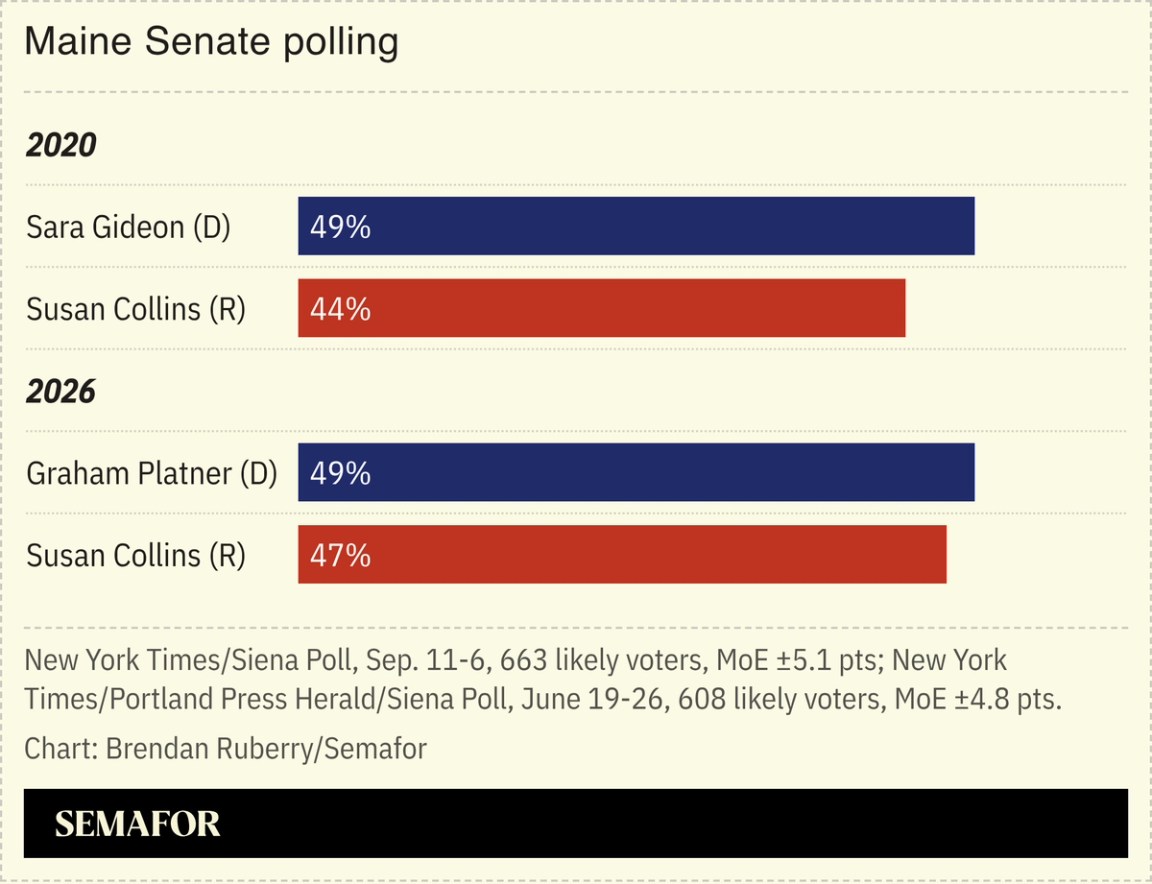 “Establishment” Democrats have made an uneasy peace with Platner’s US Senate bid. Left-wing Democrats are fully committed to it — not just for the chance to beat GOP incumbent Sen. Susan Collins, but for the chance to prove that their theory of populism can win elections. Platner has not made that easy for them. In this poll, there’s no sign that Platner’s military background or job as an oyster farmer have increased his appeal among working class voters who stopped voting for Democrats after 2012. Just 36% of white voters without college degrees support Platner, compared to 68% of white voters with degrees. That’s a much larger education gap than the one Democrats were confronting six years ago, when, they now acknowledge, polling was not reflecting their real weakness with working class voters. Platner leads because higher-education voters like him have looked past his controversies. In 2020, Collins won non-college educated white voters by about the same margin as she currently leads Platner in this poll. But she won the race by holding her opponent to just 55% of the vote among college-educated white voters. Platner is in the hunt because those voters have been racing away from the GOP — not because he’s clawing back voters who look and sound like him. |
|
 Caitlin Ochs/Reuters Caitlin Ochs/ReutersWe stick mostly to electoral politics here, but the story of violent anti-ICE protesters who got near-life sentences in Texas has some big implications for democracy. In his recap of the “Prairieland Eight” trial, Ken Klippenstein explains how a key government witness convinced a jury that left-wing activists who vandalized equipment and shot a police officer weren’t just dangerous — they were part of a terrorist network. “Silence isn’t innocence; it’s tradecraft. No leader means a decentralized cell. No membership list means superb security hygiene,” he writes. It’s a bad time to be a left-wing “accelerationist,” and assume that a Trump backlash will create the conditions for your rise. |
|
|


