|


 |
“What other country would have done this?” — Daniel Inouye
“We don’t repeat this every day, but there are 33 words that are very sacred to all of us. We do the repetition a little differently but ‘We hold these truths to be self-evident. That all men are created equal. That they are endowed by their creator certain inalienable rights. That among these are life, liberty, and the pursuit of happiness.’ It’s operational. Believe me.” — Daniel Inouye
China’s last imperial dynasty, the Qing, lasted 268 years. The Ming Dynasty that preceded it lasted just slightly longer, at 276, while the celebrated Tang made it to 289. Decades before each of those dynasties officially fell, they were shells of their former selves, with much of the land outside the control of the central government.
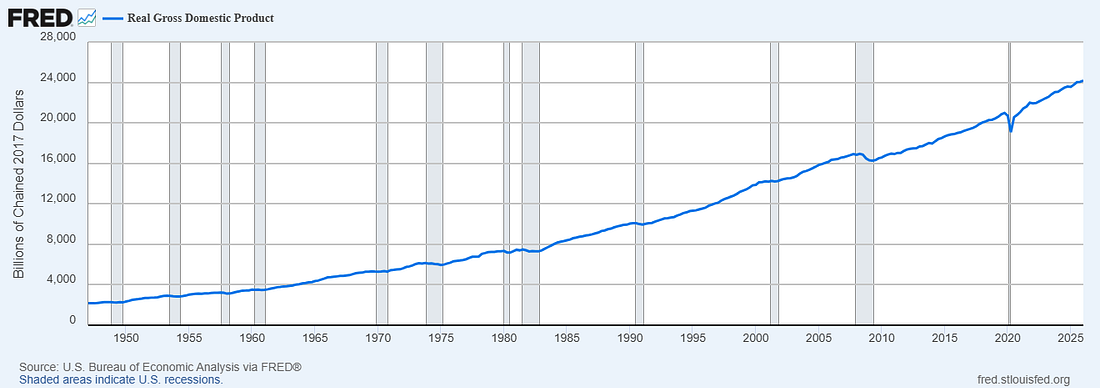
Barring abrupt catastrophe, the United States — which today marks a quarter of a millennium — will probably last as long as the Qing, the Ming, and probably the Tang. The country’s foundations are certainly shakier than when I was a child, but we have not yet entered an obvious terminal phase. The economy is still robust — our GDP remains on the smooth upward trend it has been on since we started measuring such things eight decades ago:
 |
We cannot (or will not) build a functional passenger train network, but our AI industry is upending the world. Our health care costs twice as much as that of other rich nations, but our houses are huge and luxurious. Our cities are burdened with crime and disorder, but e-commerce delivers everything we need, straight to our door. The hour of the wolf is not yet upon us. It seems a safe bet that there will still be a United States of America in 2044, 2052, and probably 2065.
And yet we’ve reached the stage where we can peer through the fog and see how this grand experiment might be heading toward its conclusion. Much of the country has eased into a comfortable equilibrium of sclerosis; local veto power either prevents the construction of factories, housing, energy, transportation, and other infrastructure, or delays it by decades, or raises the cost to multiples of what other rich countries pay. The past has become more valuable than the future to many Americans; they cling desperately to the power to enforce stasis, preserving a facade of the country they grew up in at the expense of the very dynamism that made that country great.
That sclerosis seeps into everything else. Immigration, and even migration from city to city, becomes a vicious zero-sum fight over a fixed housing supply. Cities decay into museums of themselves. The industries of the future can only be built in America if they take up nearly no land, use nearly no energy, require very little bank financing, and are able to procure skilled labor as needed from abroad. Somehow the internet industry satisfied all of those conditions for three decades, but that time is done.
Our politics, meanwhile, has degenerated into movements defined more by who they hate than by any positive vision for the country’s future. Rightists are consumed by their hatred for immigration, leftists by their hatred for Israel. Even intellectual liberals — my own movement and social class, if only by process of elimination — increasingly subordinate other goals to their dream of lowering the social status of wealthy technologists.
To the extent that popular visions of a better America exist, they are rank and obvious fantasies — homogeneous harmony that rightists will never be able to create, or socialist plenty that socialism is incapable of delivering. There are plenty of workable, feasible future visions that would advance the frontiers of freedom, dignity, and prosperity; no faction of the engaged American public seems particularly interested in them.
Political discourse in America is still the baleful thing it became in the 2010s — a vicious free-for-all of social media influencers using hatred, division, fear, and misinformation to win the ear of the powerful political staffer, think tank, and journalist classes. Everything exists in the shadow of the almost-revolution of the late 2010s — an upheaval whose force has mostly receded but whose damage has yet to be fully assessed. Meanwhile, the country’s powerful enemies abroad are sharpening their knives.
If there is a reason to be pessimistic about America’s future, it’s that so few of the country’s citizens seem to believe in it. We used to be an unusually patriotic nation; now Americans are less proud of their nation than Europeans, Asians, or people in any other major world region:
|