
|
 |
America’s 250th Survived Trump’s Sabotage
The president tried to make the event all about himself. He failed. And for that, the country succeeded.
|


| ||||||||||||


We trust everyone had an enjoyable Independence Day weekend—unless you were on the National Mall and had to deal with (in addition to the usual D.C. heat and humidity) the sad spectacle of the Great American State Fair, the torrential storms, the president’s egomaniacal insistence on being seen by crowds of inconvenienced people, and, well, the president himself.
Andrew Egger is off for two weeks, but somehow we’ll keep this newsletter going until he gets back. Happy Monday.
Join Sam Stein and Will Sommer for MAGA Mondays at 10 a.m. EDT today on Substack and YouTube.
 |
America Lives Abroad
by William Kristol
Well, it’s July 6. And I think I can say this with some confidence: Donald Trump tried to hijack our 250th anniversary, and he failed. Both the Declaration of Independence and our subsequent history turned out to be too weighty and too elevated to yield easily to Trump’s insane grandiosity and insistent mediocrity.
Before his July 3 speech at Mt. Rushmore, Trump posted a video that showed a kind of golden sculpture of the mountain, with his image added to those of George Washington, Thomas Jefferson, Abraham Lincoln, and Theodore Roosevelt. Trump’s voiceover on the video claimed, “I will be the greatest president for many, many years to come.” The president did protest too much, methinks. Deep down, or not even that deep down, he knows that in years to come, no one will think he is in their league. To say the least.
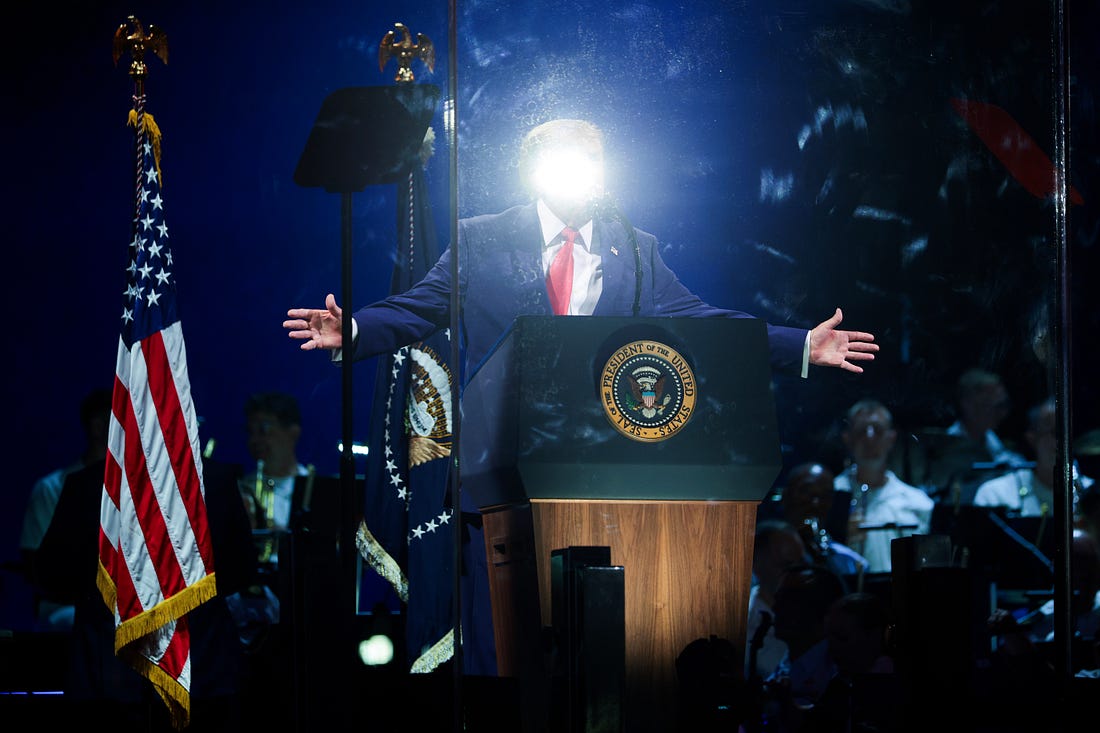
Then there was Trump’s July Fourth extravaganza. For all of his narcissism, even he knew it was a flop. As soon as he returned from the Mall, Trump turned frantically to Truth Social. He posted over 100 times on July 5, lauding his own achievements, attacking his opponents, and generally behaving like someone who sensed that the 250th anniversary, despite or because of his attempts to hijack it, made him look small. Former BBC foreign correspondent Nick Bryant , who covered American politics for decades, put it well: “On America’s 250th birthday, Donald Trump was dwarfed by history.”
And he was dwarfed by the World Cup. Trump’s 250th anniversary sport of choice was the ugly gladiatorial spectacle he hosted at the White House for his eightieth birthday on June 14. Three days later, the World Cup matches began throughout the United States, Canada, and Mexico. We’ve had three weeks of enjoyable and often memorable contests. Who now remembers the unpleasant cage matches on the South Lawn?
Trump’s behavior over the weekend was also dwarfed by the example set by the first American pope. On July 3, Pope Leo XIV accepted a Liberty Medal from the National Constitution Center in Philadelphia. He spoke live from the Vatican to a crowd gathered in front of Independence Hall, where the Declaration of Independence was adopted—and which Trump did not choose to visit.
As the chronicler of Pope Leo, Christopher Hale, points out, “The pope opened his remarks with a sentence no previous pope could have spoken: ‘As a son of this great country, founded by courageous men and women who dreamed of liberty and of a better life for themselves and for their children, I join you in asking God’s blessings upon America’s future.’” Leo continued by emphasizing that, in fulfillment of the Founders’ vision, America became “a byword for freedom, as the country opened its doors to successive waves of immigrants, enabling them and their children to play their part in shaping the future of the nation.”
On Independence Day itself, the Pope made a remarkable visit to the tiny Sicilian island of Lampedusa, where many migrants from Africa to Europe have landed—and in hopes of reaching which so many have perished. You can read Hale’s moving account of the pope’s visit and his remarks here.
I trust—but I also believe—that Leo’s vision of America will end up prevailing over Trump’s.
This evening, President Trump will fly to Ankara, Turkey, for the annual NATO summit. For more than 75 years, NATO has been a distinctive American contribution to world peace as well as being an instrument of American greatness. We’ll have to hope that Trump doesn’t do too much more damage to NATO or further embarrass the United States on the world stage.
But we’ll also be able to watch and listen to another president, Ukraine’s Volodymyr Zelensky, who embodies the principles of NATO and really of the United States, better than our president. After the summit, a bipartisan congressional delegation will head to Hungary to meet with new Prime Minister Péter Magyar, a recent example of a fighter for liberal democracy prevailing over its antagonists. Needless to say, Trump won’t be there.
The American founders. The first American Pope. Zelensky and Magyar. It is their spirit that captures the true meaning of our 250th anniversary. It is their spirit, if I can adapt William Faulkner’s line from his 1950 Nobel Prize address, that will not only endure but will prevail.