
|
Big Technology is possible thanks to support from our readers. Sign up today to help us do this work and gain access to perks like members-only articles and our private Discord server:
Automation Makes The World Cup Worse. But We Can’t Help Ourselves, Can We?
Advanced sensors and robot refs make the games more accurate and fair. But better? No, not at all.
|


| |||||||||||||||


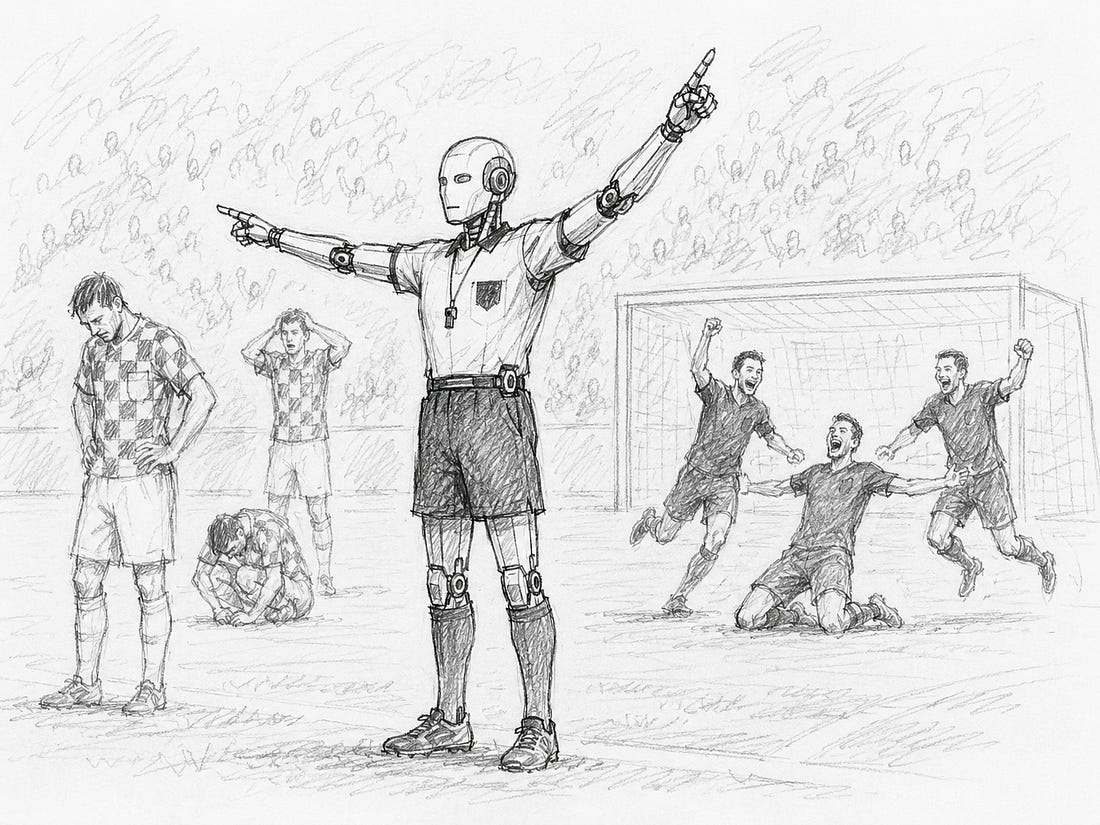 |
An epic World Cup has been marred by an overreliance on technology and automation.
In this year’s competition, FIFA has used cameras, sensors, AI systems, and other automated tools to make the game more precise. But these tools, and the accompanying video assistant referee, have taken the soul out of the game.
FIFA’s tech tools have tipped the scales over touches and technicalities that would never be caught by the human eye, and exposed what’s lost when we hand too much to the machines. They’ve also revealed that even when automation noticeably degrades our products, we seem to be unable or unwilling to free ourselves from its grasp.
In soccer, or football as it’s known globally, consequential calls typically rely on human judgment and all the nuance, subjectivity, and context that come with it. An offside call, for instance, relies on the referee’s ability to notice a player making their way behind the defense before a pass heads their way. Video review can aid with that process on borderline calls, using a mix of AI, cameras, sensors, and other tech to theoretically make calls more accurate, more consistent, and protect against alleged bias. But the problem is the sport isn’t designed for this kind of microscopic precision, and relying on it degrades the game.
The worst-case scenario occurred in a July 2 match in which Croatia lost to Portugal. After Croatia scored what looked like the tying goal in stoppage time (aka: at the buzzer), sensors in FIFA’s connected ball detected it apparently grazed the tip of a Croatian player’s hair, leading to another player to be declared offsides while setting up the play, and the goal was then taken back.
Croatia’s hair graze didn’t register to the naked eye, or even on a big screen, but the reading from the sensor was enough for the human referee to let it change the game. The replay showed it as a “heartbeat graphic” spiking at the same moment it passed the player’s head.
“Technically correct,” wrote Roger Pielke Jr. of The Honest Broker in response to the robot call. “Good for the game? I think not.”
The latest flashpoint came ahead of tonight’s U.S.-Belgium match, after President Donald Trump reportedly urged FIFA to review the automatic one-match suspension for U.S. striker Folarin Balogun. FIFA suspended the ban while leaving the VAR-reviewed red card on his record, drawing objections from Belgium and a rebuke from UEFA.
The episode is a high-profile example of how technology can muck up a match. The referee did not initially show Balogun a red card, but a VAR review that slowed down the play made it appear to be a different kind of blow worthy of a send-off offense. While it might seem like a technicality, the example shows the difference between human and tech judgment: Protocol says slow motion can be used to establish factual issues such as point of contact, but normal speed should generally be used to judge the intensity of a foul.
Beyond the World Cup, there have been plenty of other recent examples of AI’s limitations across other industries. Last month, reports noted Ford has re-hired more than 300 veteran “gray beard” quality inspectors to help train younger staff and reprogram the car maker’s AI tools after its systems failed to match quality checks. And in May, Starbucks reportedly scrapped an AI program for automating inventory counts almost a year after it was deployed across North America. The cited AI error feels almost hilariously human: miscounting and mislabels items such as similar milk types.
From assisting refs to replacing other roles, time will tell if new tech will become a universal problem or just an isolated series of own-goals. But for now, it seems like we can’t help ourselves either way.
New Documentary: AI AGENTS How do we take back control? (sponsor)
 |
AI agent security is one of the most important and most overlooked issues in technology right now. Organizations are deploying AI agents at speed, but many have no visibility into what those agents are doing, and few are accountable when something goes wrong.
I took part in "AI Agents: How Do We Take Back Control?," a documentary commissioned by Gravitee, where I interviewed researchers, policymakers, and enterprise leaders about how getting AI agent security right matters, not just for business but for society as a whole.