| | Oil prices jumped and stocks slid following US-Iran strikes, Russia’s fuel shortages worsen, UN warn͏ ͏ ͏ ͏ ͏ ͏ |
| |  Mexico City Mexico City | Moscow |  Khartoum Khartoum |
 | Flagship |  |
| |
|
The World Today | 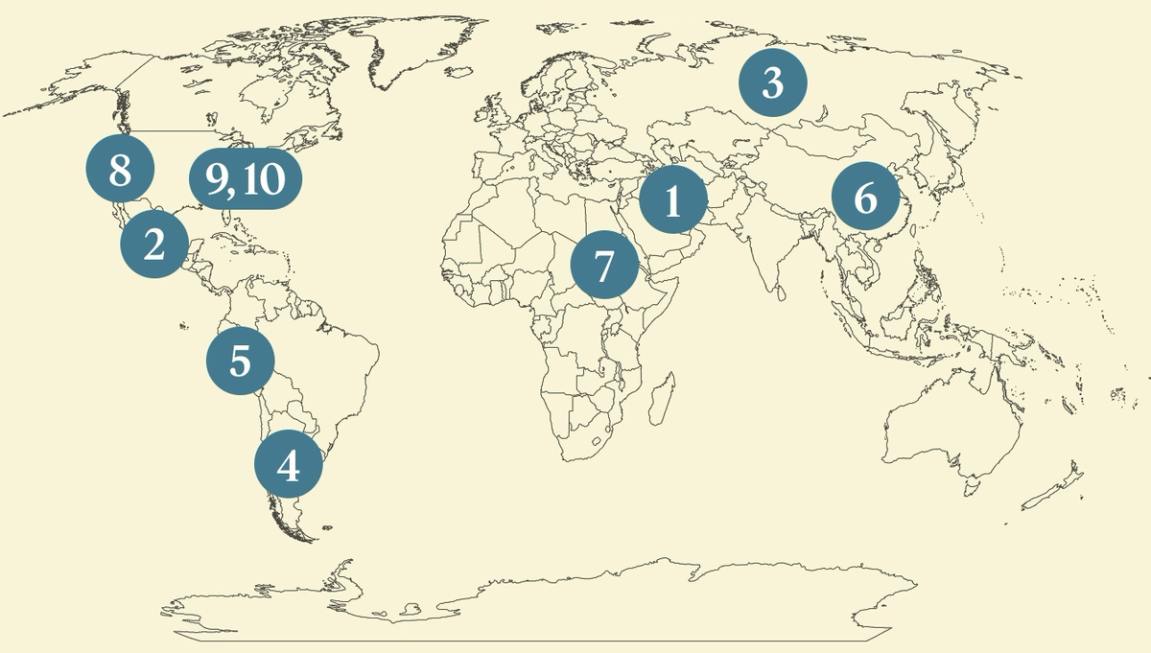 - Trump’s Iran constraints
- The changing energy map
- Russia’s fuel shortage
- The global nuclear revival
- Washington looks to LatAm
- China’s two-track economy
- Genocide warning in Sudan
- OpenAI unveils new model
- Probing solar system’s edge
- Ancient black holes seen
 A recommendation for ‘the most epic song ever written.’ |
|
Hormuz tensions drive oil up |
 Vessels before they were struck in a new wave of US military strikes against Iran on Tuesday. US Central Command/Handout via Reuters. Vessels before they were struck in a new wave of US military strikes against Iran on Tuesday. US Central Command/Handout via Reuters.Oil prices jumped and stocks slid after the US and Iran traded strikes that President Donald Trump said marked the end of the countries’ fragile ceasefire. The renewed conflict has once again brought traffic through the Strait of Hormuz to a halt, with Iran’s top negotiator saying it would only reopen under Tehran’s orders: “Let me be clear: Strike, and you will pay the price.” The fighting pushed up US diesel futures at the quickest pace in four years, compounding the political toll for Trump ahead of November’s midterm elections. However he has left himself with few good options to bring the conflict to an end. “Trump has put himself in a box,” an expert told Reuters. |
|
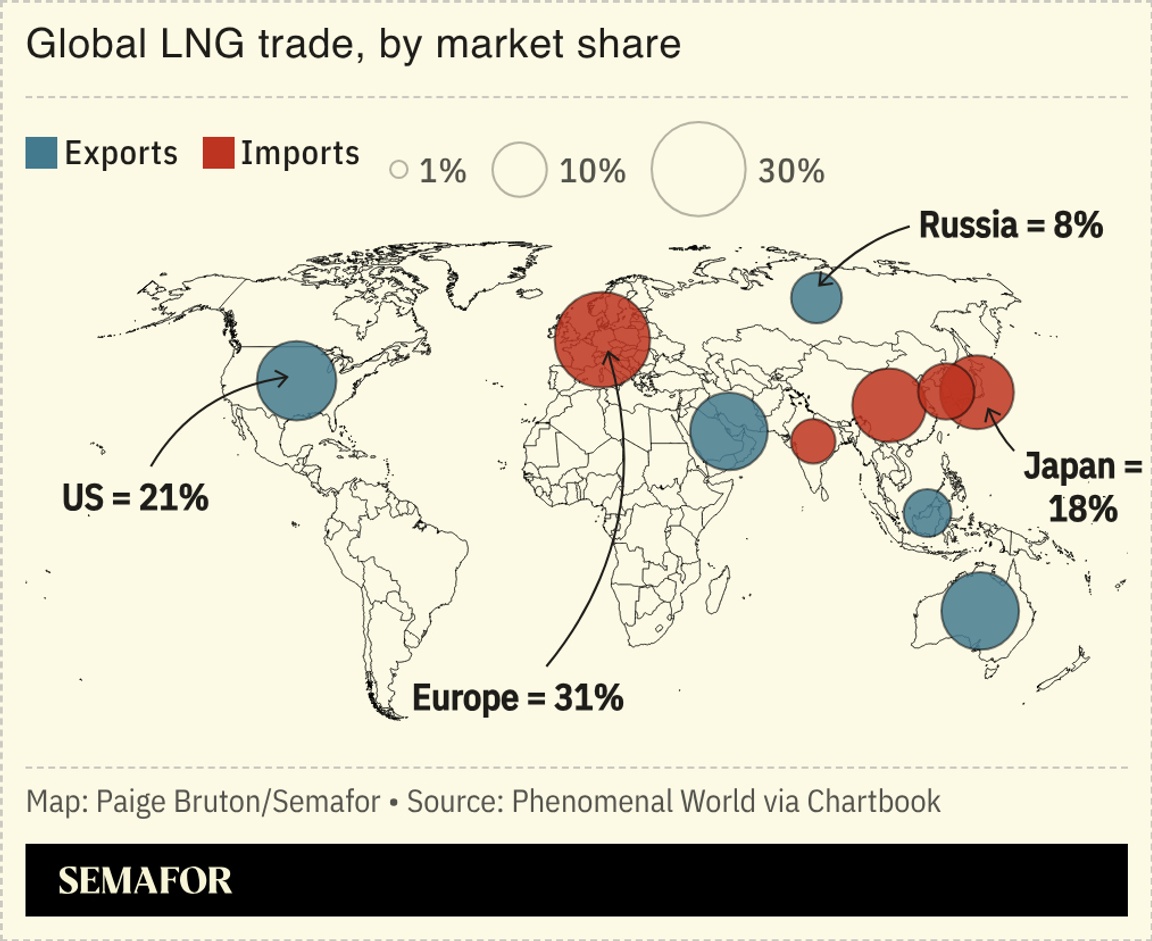 The first shipment of Mexican natural gas to Asia is en route, evidence of the reshaping of global energy markets. Mexico’s new LNG export terminal is one of several developments on the Pacific coast of the Americas, with confidence in traditional export avenues waning. Five years ago, the two main arteries for international oil and gas trade were Russian LNG pipelines to Europe, and the Middle East to Asia via the Strait of Hormuz. But both are profoundly changed, the International Energy Agency chief wrote in Foreign Policy, by Russia’s invasion of Ukraine and the US war in Iran. The implications are long-lasting, Fatih Birol argued, as nations look for ways to minimize risk, including renewables and diversification of supply. |
|
Russia bans diesel exports |
|
A global nuclear expansion |
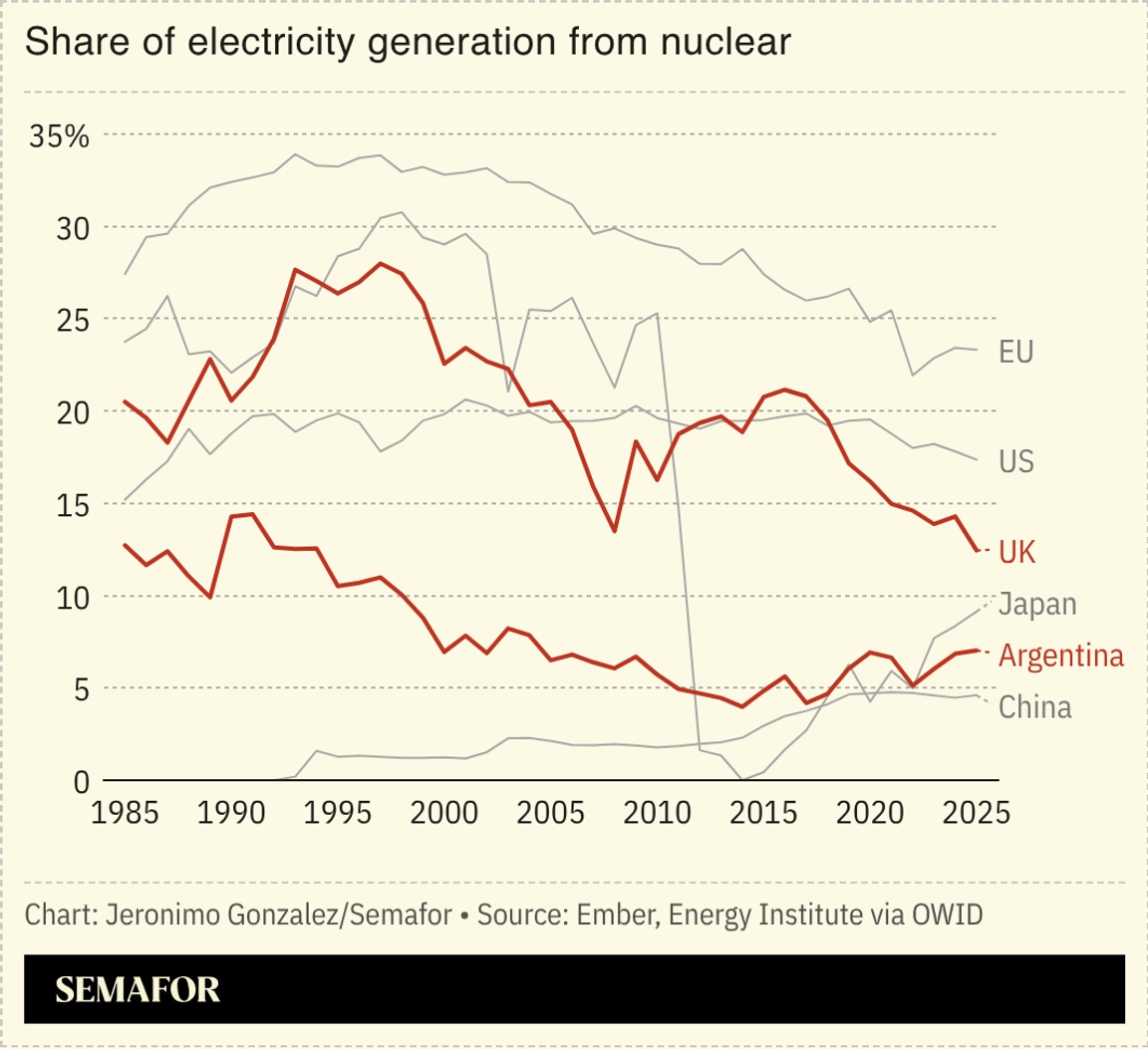 Argentina announced the construction of a new nuclear reactor and the UK extended the life of one of its existing ones, part of a worldwide revival of atomic energy. The Buenos Aires project is backed by $1.2 billion in US money; Britain’s Sizewell B will now run until 2055 rather than 2035. After decades of stagnation, nuclear energy use is expanding fast, BloombergNEF projected: Aggressive efforts to build reactors in China and India in particular are expected to boost global capacity 44% by 2036. China alone had 59 gigawatts of reactors under construction last year, enough to power around 50 million homes, and is on track to surpass the US as the world’s biggest nuclear nation by 2030. |
|
US drives ‘Donroe Doctrine’ |
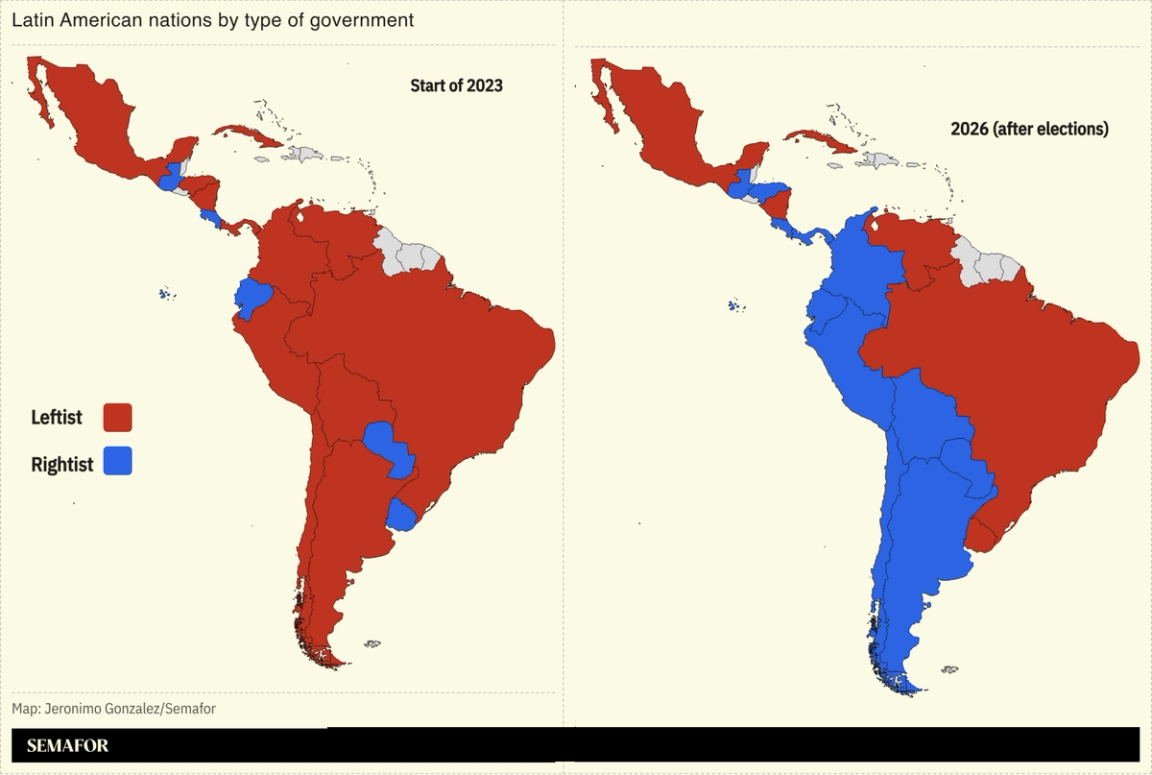 Washington is looking to accelerate the implementation of its “Donroe Doctrine” of dominance over the Western hemisphere, where numerous countries have recently shifted to the right after years of leftist rule. Since the start of his second term, President Donald Trump — wary of rising Chinese influence across Latin America as well as surging drug production in the region — has prioritized reasserting US influence in its backyard. Though many in the region have long criticized American interventionism, the political landscape has shifted rapidly in recent years, with Argentina, Bolivia, Chile, Colombia, Ecuador, and Perú electing leaders friendly to Trump. “We seek your success in securing our neighborhood,” Pentagon policy chief Elbridge Colby, on a visit to Perú, told Latin American officials. |
|
China’s two-track inflation |
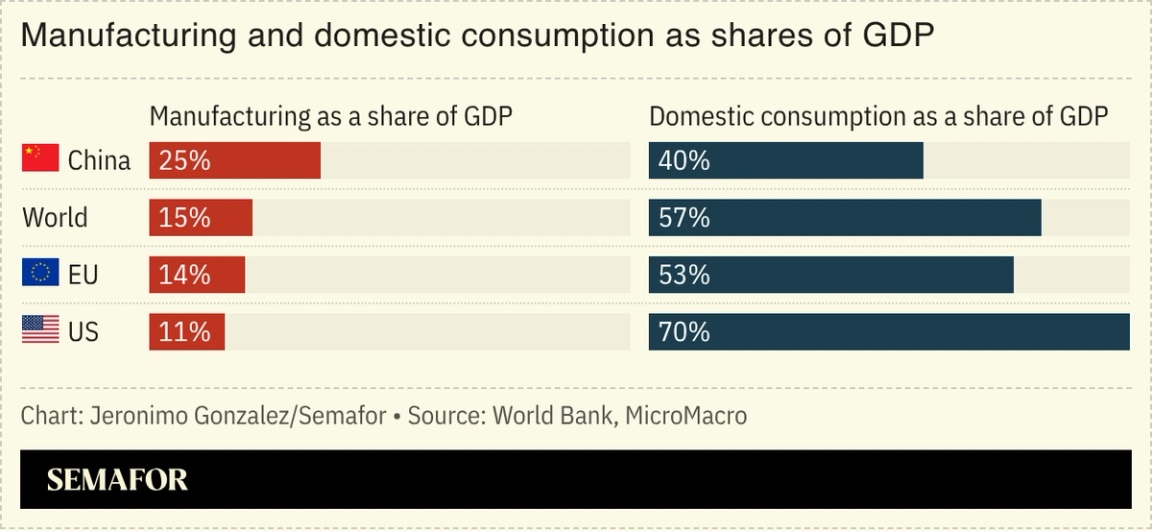 China’s factory gate prices rose at the quickest pace in four years as the war in the Middle East pushed up energy prices, with experts warning price pressures were unlikely to subside as the fragile US-Iran truce unravels. Consumer price inflation, however, was up just 1% last month from a year earlier, providing further evidence that China’s economy is increasingly going along two tracks: While export industries remain strong — the country achieved a record $1.2 trillion trade surplus last year despite US tariffs — inflation of its services industry has flatlined for months, sparking deflationary fears as the fallout of a real estate crash continues to weigh on domestic demand. |
|
UN warns of Sudan genocide |
 Amr Abdallah Dalsh/Reuters Amr Abdallah Dalsh/ReutersThe UN said actions carried out by the paramilitary Rapid Support Forces in Sudan’s civil war amounted to a genocide, with experts warning of further mass atrocities. Human rights investigators said the RSF encircled El Fasher in an attempt to starve its population, while survivors described being raped in rooms where their recently killed family members lay on the ground. The report comes as the RSF lays siege to El Obeid, where analysts say similar barbarity is imminent. There is little sign of an end to the three-year conflict, which has killed tens of thousands and which some describe as the world’s forgotten war. “El Obeid must not become the next crime scene,” the UN said. |
|
 Approaching the 15th anniversary of Occupy Wall Street, a new podcast called Occupy! An Unfinished Uprising gets inside the drama of the movement. Occupy changed the national conversation about capitalism, popularized the language of the 99%, and inspired a generation of activists. You’ll revisit the origins of the “99%” framing and trace how the movement influenced public discourse on inequality and power. Listen now. |
|
OpenAI releases new model |
 Christian Hartmann/Reuters Christian Hartmann/ReutersOpenAI unveiled its new model, GPT-5.6, having first run it by the US government. The public launch follows that of rival Anthropic’s Fable 5, also held back after a weeks-long conflict with Washington. The administration has taken a more interventionist role in AI; it now wants developers to allow agencies to evaluate new releases. The government may have its work cut out, though: Model cycles have accelerated, with frontier releases coming every 11 days, compared to 37.5 days in 2023, and that will not slow down now that SpaceX has entered the market. And even GPT-5.6’s cheaper tiers are highly cyber-capable, with the top tier competitive with Mythos, which Anthropic has refused to release publicly out of security concerns. |
|
Spacecraft set to leave solar system |
|
|


