| | In this edition, huge capital expenditures are collapsing big tech companies’ free cash flow, and an͏ ͏ ͏ ͏ ͏ ͏ |
| |  | Business |  |
| |
|
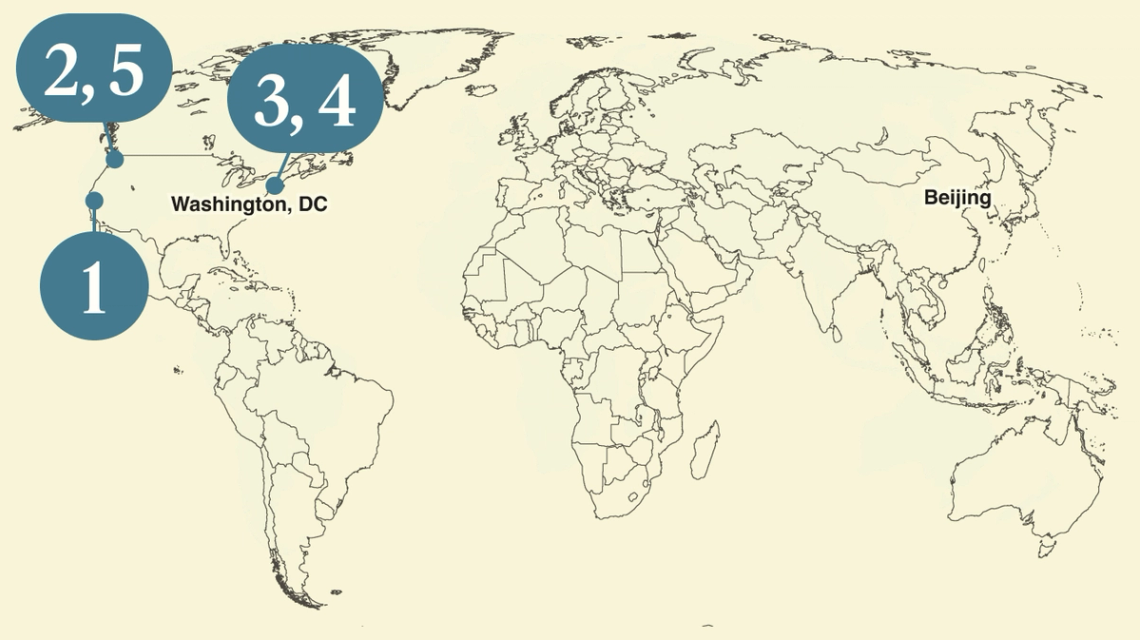 - AI’s generational wealth transfer
- Blue Origin: Us, too
- Kalshi’s court battle
- Pivot to video
- Goodbye, SaaS
 Dueling model release day for OpenAI and Meta … Zuck is posting through it |
|
 A few weeks ago, an Anthropic executive was asked a question on every CEO’s mind: Why should we trust that you won’t steal our business? “It’s a fair question,” Syed Mohiuddin, Anthropic’s head of healthcare, said at a venture-capital event I attended last month on Cape Cod. “Because we are both a frontier lab that’s building models and a product company that has applications.” The edgy mistrust between companies and the frontier labs they are deeply in bed with is bubbling over into a fury channeled by Palantir’s Alex Karp in a chaotic appearance on CNBC last week. “These people are livid,” he said. “They’re like, ‘I am paying for tokens that create no value… and they’re going to get my IP.’” Forward-deployed engineers, dispatched by AI labs to help customers implement their models, will come back to the mother ship with a deep understanding of how banks, consulting firms, retailers, manufacturers, and consultants operate. That customer support, to a suspicious eye, looks a lot like reconnaissance. Anthropic has already launched products for law firms and design firms; the primary losers there are software companies that hawk those services, like Harvey (law) and Figma (design). But what’s to stop the labs, after ingesting enough data, from launching an operating business to compete directly with law firms and design firms? At the same time, open-source models — many Chinese, but also a growing roster of American alternatives like Reflection — are rapidly closing the capability gap at a fraction of the cost. They can be downloaded and run locally without sending data back to the labs. Companies have to use AI labs’ products “to stay in the race, but doing so requires sending all of their IP, and that is a very uncomfortable thing to do with somebody who might be trying to replace you,” Will Wilson, CEO of code-debugging startup Antithesis, told me. (Wilson said he’s “not scared of Anthropic” and is loving Fable 5.) To be clear, the AI labs say they will not do this; here is OpenAI’s terms of service for enterprise customers, and here is Claude’s. But they trained on the internet’s content without asking permission and have a credibility problem. “Claude Code didn’t kill Replit and Cursor,” Anthropic’s Mohiuddin said last month, referring to AI-native coding apps that have flourished in the world Anthropic built. “We’re not trying to be kingmakers and we’re not trying to be market replacers. What we’re trying to do is elevate the floor of what’s possible.” The real question isn’t whether AI labs can move downstream and compete directly with their customers. It’s whether they can make more money by helping companies like Sullivan & Cromwell draft legal contracts, Gensler draw up architectural plans, and Pfizer discover new drugs — or by simply doing all that themselves. |
|
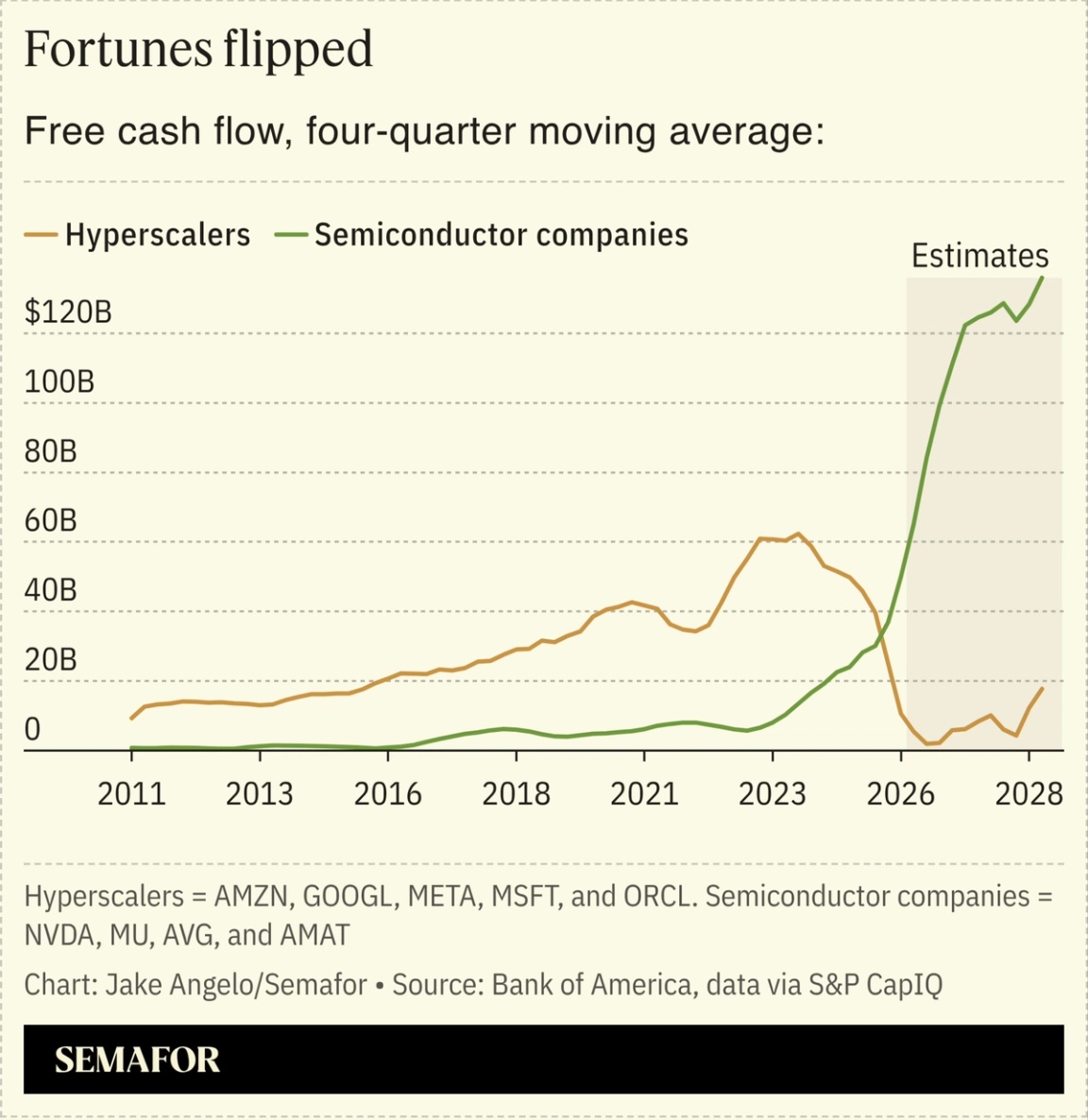 A chart this week from Bank of America ricocheted around Wall Street and Silicon Valley, capturing the “generational transfer” of profits in the AI ecosystem. Huge capital expenditures are collapsing big tech companies’ free cash flow, a metric prized by shareholders. Meanwhile, the less sexy companies that make the processing and memory chips that underpin AI models are raking in cash. As we wrote earlier this week, investors have been chasing the chokepoints around AI in search of the next winner. Bets have shifted from the LLMs themselves (not that they’re having trouble raising money yet) to the infrastructure to house them, the applications to support them and, most recently, to the memory chips that make them work. This trend could ease as hyperscalers outsource more of their costs to private equity and chipmakers ramp up their own capex, but this represents the starkest snapshot we’ve seen of where the value from AI is moving. |
|
Blue Origin’s game of catch-up |
 Joe Skipper/Reuters Joe Skipper/ReutersBlue Origin, Jeff Bezos’ space startup, is seeking to raise $10 billion at a $130 billion valuation, Semafor confirms, hoping to play catch-up with Elon Musk in the space race. Given SpaceX’s head start, record of smooth launches (something Blue Origin has struggled with lately), and huge funding advantage, here are a few ways to think about Blue Origin: - A pure play: For investors who want only space, Blue Origin offers a cleaner story. SpaceX is quickly becoming a conglomerate, with its GPU clusters and AI model Grok competing for capital and attention with its rocket system. That sprawl will only grow if the company pursues a merger with Tesla, as is widely suspected.
- The Lyft to Musk’s Uber: Commentators for years wrote off Lyft, noting Uber’s head start and pricing power. Lyft shed its pink-mustached cars and quirky brand identity, but is still here. It, too, is a pure-play mobility company, without the courier and food-delivery arms that Uber has.
- A political hedge: SpaceX is a major NASA contractor without much of a commercial competitor. A group of civilian experts hired by the Pentagon in 2024 warned against “dependence upon a sole vendor” in its dealings with private-sector space companies. SpaceX has huge geopolitical power, too, which Musk has flexed with Starlink.
|
|
Prediction markets hit a federal snag |
 An SDNY judge dealt a blow to Kalshi and Polymarket this week, ruling that New York’s gambling regulations do apply to Kalshi’s sports-event contracts, and making it all but inevitable that the states will be squaring off against prediction markets operators at the Supreme Court in the future. The decision contradicts another, earlier, appellate ruling that New Jersey’s gambling laws don’t trump the authority of the Commodity Futures Trading Commission. Tuesday’s ruling gives powerful ammunition to the 16 other states that have filed similar claims against the prediction markets, arguing that Kalshi and Polymarket deprive them of revenue from their casinos and gaming operations. Kalshi, Polymarket, and CFTC chair Michael Selig have countered that these markets are not gambling, but are futures contracts — a distinction that critics say is moot. They also say corporations can use their platforms to hedge their business risk more precisely than conventional financial instruments. “We are seeing a ton of institutional interest,” Selig told Semafor last month. — Rohan Goswami |
|
 On Wednesday, July 22, Claire MacIntyre, Chief People Officer at Sam’s Club, will join Semafor’s The World of Work in Washington, DC to explore how AI adoption, workforce transformation, and evolving leadership demands are reshaping the future of work. The lineup also includes Sen. Roger Marshall, R-Kan.; Microsoft’s Katy George, Abbott’s Mary Moreland, Pearson’s Allison Peek Bebo, and more. July 22 | Washington, DC | Request Invite |
|
NYT’s video push feels like déjà vu |
 Joe Kahn with Semafor’s Ben Smith in 2025. Eleanor Kaufman/Semafor. Joe Kahn with Semafor’s Ben Smith in 2025. Eleanor Kaufman/Semafor.In a revealing interview with Peter Kafka this week, New York Times Executive Editor Joe Kahn said the paper is pouring resources into visual content, prompting comparisons to the media industry’s ill-fated “pivot to video” in the 2010s. But there are crucial differences. Back then, publishers were chasing eyeballs on Facebook, which was paying media companies directly to make videos for the platform. Venture capitalists pushed digital-media startups to go all in. It all went away after Facebook retreated, admitting that the audience for video advertising simply wasn’t there. Companies that desperately threw themselves into Facebook digital video, like Mic, Mashable, Vocativ, and MTV News, died or slowly faded away. (It was an early warning about the media industry’s reliance on the tech platforms, a bet that has further unwound in a post-Musk X world.) This time, publishers are playing catch-up to video-addicted audiences. The viewership for short-form video clips across TikTok, Instagram, X, and for long-form videos on YouTube is massive. Whether video is used as a promotional lure to draw viewers to more content (as podcast clips do) or as a show with built-in monetization, publishers like the Times have no choice but to find effective models for it to survive and compete. Publishers weren’t wrong to “pivot to video.” They were just too early. — Max Tani |
|
Inertia slams into AI reality |
 Starbucks CEO Brian Niccol. Brendan McDermid/Reuters. Starbucks CEO Brian Niccol. Brendan McDermid/Reuters.One of the biggest things going for Salesforce, Workday, and the other SaaS companies threatened by AI has simply been inertia. Uber CEO Dara Khosrowshahi told us in May that the market was overreacting, at least in the short term, to the SaaSpocalypse. “It’s easy for me to vibe code a BS to-do app for myself,” he said on an episode of Compound Interest. “Enterprises are much more obsessed with getting things right. And so I think the pace of change in enterprise, especially large enterprise, is going to be slow.” Starbucks may be an early indication that that tide is changing. The CTO of the $120 billion company, which spends about $400 million a year on software, said the consumer giant is now developing in-house AI tools to replace a bunch of inventory, maintenance, and other software it relies on Microsoft and IBM for, Bloomberg reported Thursday. “There’s clear opportunities to reduce the spend in software,” he told an internal forum. — Shelly Banjo Starbucks CEO Brian Niccol discussed his approach to AI and how he jolted the coffee giant back to growth in a recent episode of Semafor’s The CEO Signal. Listen or watch here. → |
|
|
 Approaching the 15th anniversary of Occupy Wall Street, a new podcast called Occupy! An Unfinished Uprising gets inside the drama of the movement. Occupy changed the national conversation about capitalism, popularized the language of the 99%, and inspired a generation of activists. You’ll revisit the origins of the “99%” framing and trace how the movement influenced public discourse on inequality and power. Listen now. |
|
➚ BUY: Jeans. Levi Strauss topped quarterly earnings estimates and showed promise with its pivot to sell directly to shoppers rather than rely on department stores. ➘ SELL: Shorts. Michael Burry isn’t happy with the president’s harsh words for short sellers. “Donald Trump could not in a million years understand or make his way through any of my substack essays,” the Big Short investor wrote in a since-deleted X post. |
|
|


