
|
 |
Hey fam: Just a heads-up, The Secret Show will be a little late today.



 |
1. Commie Gas
By now you have heard about the new red peril that is taking over American politics. Socialism is ascendant and taking over one of our political parties! This is dangerous and un-American!
You realize we’re talking about Republicans, right?
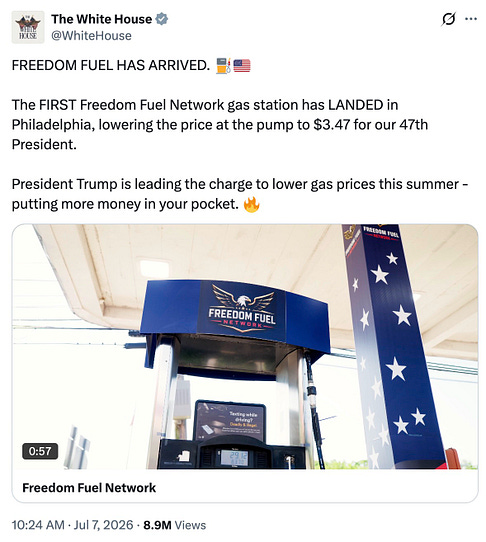
The White House is promoting a chain of seemingly state-run gas stations selling gasoline at below-market costs.¹
 |
Who owns these gas stations? Why are the White House and Trump himself promoting them? How are they able to sell gas at a loss? Excellent questions!
Short answer: No one knows.
The White House comms office claims that the stations are privately owned and receive no government subsidies. But the White House has also claimed that Iran has no military capabilities—and yet we’re back in a shooting war with them. Which is to say: There is no reason to believe that the administration’s statements about Freedom Fuel are true.
The company itself is a mystery. It does not respond to press inquiries and accounts of its corporate structure differ—no one seems to know if it is a chain of independently owned operators or if the locations are all owned by a single entity.
The corporate parent, however, applied for its trademark on the same day Trump first posted about Freedom Fuel—which is either a remarkable coincidence or, you know, close coordination between the White House and this “private” business.
Also, the White House claims to know a great deal about the company’s business strategy:
A White House official told ABC News that the Freedom Fuel Network is a private company not associated with the president, that is “simply reducing their margin to make prices at the pump more affordable for drivers in Philadelphia and New Jersey.” . . .
"There is no other entity or person subsidizing the lower gasoline costs," the official said.
How would the White House official know this information? How would they know that Freedom Fuel stations are still profitable and that the cheap gas is only a reduction of profit margins? Or that no other person or entity was subsidizing a loss on sales?
Seems suspicious to me!
According to industry data reviewed by ABC News, selling gas at that price point, under the current market conditions, would likely eliminate any profit and potentially cost the 25 participating stations a total of more than quarter million dollars every month.
They’ll lose money on every sale, but make it up in volume?
In case you can’t tell, this looks like socialism to me. Someone—either the government or a private entity working in close conjunction with the government.—is subsidizing retail goods sold below market rates. They are doing so to serve what they see as a critical group of consumers whom they believe are being disadvantaged by structural problems in the local market.
Wait a minute. Where have I heard this before . . .
 |