
|
 |



 |
On this week’s Bulwark Goes to Hollywood, I talked to veteran film critic and historian David Thomson about his new book, A Sudden Flicker of Light. I always enjoy having Mr. Thomson on the show (I’ve previously had him on to discuss his book on acting and his book tracing the history of how we think about directors), but I felt a little trepidation this time around because his new book is, to put it bluntly, distraught about film and what it has done to us.
Noting the explosion of attendance at movie theaters by 1930, Thomson writes that “there had never been a time in which such a large part of a nation was seeing the same thing and having its imagination extended yet hived off in the process.” This was a problem, since “the medium cared no more about messages than Fritz Lang felt for people.” Which is to say, not at all. There is an amorality to the artistry of film¹—the facts of lighting and blocking and continuity don’t care about your feelings; there is, as Thomson puts it in a slightly different context, a “stupid neutrality” to the nature of quality filmmaking—and an even more obvious amorality to the business of film. As Thomson writes about early exhibition mogul Marcus Lowe, “No one said he favored one film over others; he wanted whatever the crowd wanted.”
The question Thomson is asking throughout A Sudden Flicker of Light has to do with that amorality and the danger of letting the screens that dominate our field of vision hive off that imagination, to colonize it with ugly nihilism. “Anything with pretensions to being an art or an entertainment has as much duty to serve our nature as photography was once treated as the imprint of reality,” Thomson writes. “This medium has begun to diminish our nature.” Thomson echoes Pauline Kael’s assessment that Citizen Kane is a “shallow masterpiece,” arguing “maybe it is just a shrewd estimate of the whole medium.”
Film led inevitably to television, to Thomson’s chagrin: “It beggars belief that we or our ancestors gave up places like the Granada Tooting and Radio City Music Hall for a screen measured in inches with a picture that looked like ghosts drifting through a blizzard and a soundtrack dredged out of gravel.” But it was free, and it was in your home, and cost and convenience are going to beat out quality nine times out of ten. Eventually, the screens and the transmissions would get bigger and better; nowadays, the screens and resolutions we have in our homes are arguably better than those we deal with in lesser exhibition halls (though few of us have a sound system that can match even a subpar screening room).
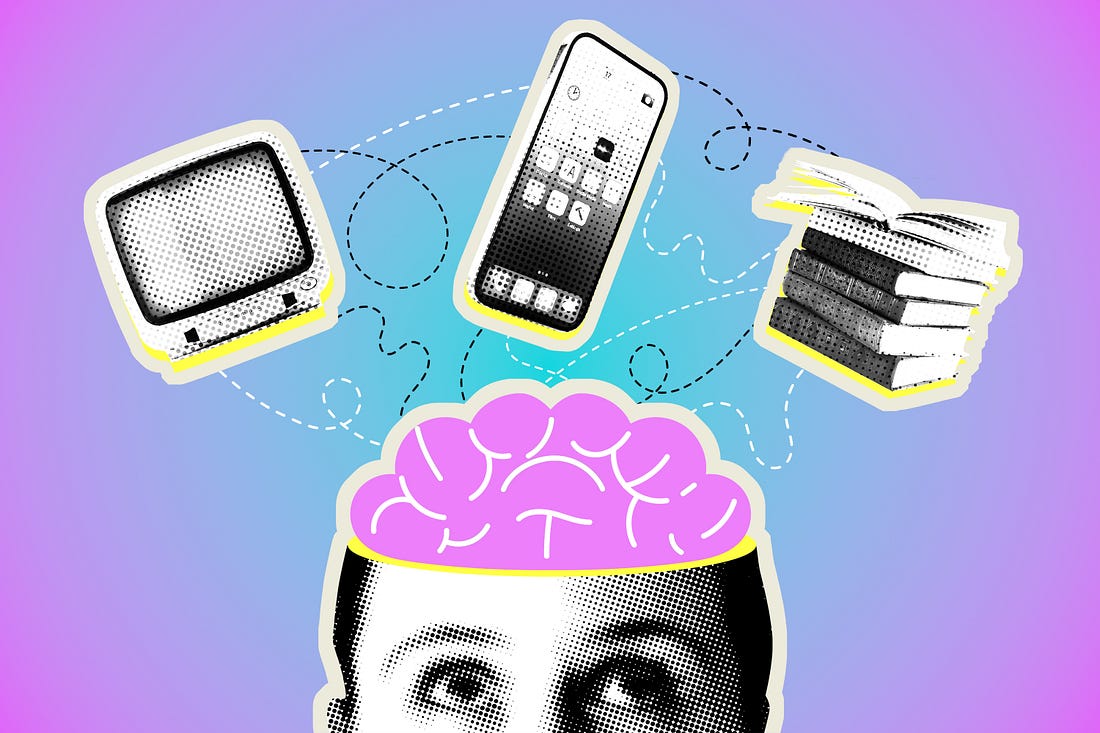
The technology of TV mattered less than how the medium rewired our brains, however. The screens kept getting smaller—from theaters to TV, from TV to PC, from PC to smartphone—and as if in reflection of that diminishment, they demanded less and less of our time and energy in the form of focus. The effects here can only be described as disastrous, at least when it comes to literacy. In a lengthy cover story for the Atlantic ominously titled “The End of Reading Is Here,” Rose Horowitch traced the marked decline in reading comprehension among young people that just so happened to coincide with the rise of smartphones and may only be accelerating in the face of AI adoption.
The facts are startling, though you—almost certainly one of the literate few if you’re reading an essay about reading and writing and watching in a publication where you might even pay to have longform news delivered right to your inbox—are likely familiar with some or all of them. “According to the National Endowment for the Arts, which conducts the most comprehensive survey of the nation’s reading habits, fewer than half of all adults reported having read a book of any kind in 2022,” Horowitch writes. “Only 38 percent read a novel or short story. A study analyzing 236,000 responses to the American Time Use Survey found that the proportion of Americans who read for pleasure on any given day fell from 28 percent in 2004 to 16 percent in 2023.” Sentence lengths in bestselling books are decreasing. Fewer people read the news than ever before. Basic reading skills are in freefall, with roughly a third of high school seniors ranked as “proficient” in analyzing written fiction or arguments. The dagger: “Gambling has become a more common leisure activity than reading a book: Last year, 57 percent of Americans placed a bet.”
Do your part to help fight illiteracy—sign up for a Bulwark+ membership today.
That this is the result of screens is taken as a given and for good reason, as anyone who has lived through the shift to smartphones can tell you from personal experience. Lord knows I can. If I can be so bold as to paraphrase Frank Herbert, fear of missing notifications is the mind-killer. I read more than the average American by a wide margin, and yet even I have trouble focusing fully on a codex. Did my phone just vibrate. What just flashed on the screen. A news alert. A new DM. Oh, someone just Slacked me. What time is it. How long have I been reading. Can I take a break. Can I please get some sweet endorphins yet. Can I look at my screen. Please tell me I can look at my screen.
But the broader point here, the one that dovetails with Thomson’s book, is that the screens are changing the very nature of what we desire to experience, altering what we want to experience out of screens. And I think this is trickling down to TV itself in very obvious, potentially alarming ways. As Bloomberg’s Lucas Shaw noted earlier this week, Netflix is seeing enormous season-over-season drops:
One Piece, one of Netflix’s most-watched shows of 2023, lost more than 30% of its audience for the second season. Season two of Beef suffered a drop of more than 70%. The Night Agent shed 50% of its audience for the second season and another 35% for its third season. These figures are all through the first four weeks of a show’s release and come straight from Netflix. Adding insult to injury, the latest season of Avatar: The Last Airbender, one of Netflix’s most-watched titles in 2024, suffered a drop of more than 60% over week one. That doesn’t bode well for the rest of the month.
Meanwhile, Netflix is responding to this by trying to become more like TikTok via its short video content, expanding offerings in podcasts and its “Clips” feature that highlights bits and pieces of library titles in an easy-to-consume, bite-sized format. As Jessica Toonkel and Ben Fritz reported, concerns about declines in user engagement have also led to Netflix considering the creation of what amount to television channels: “executives at the company have recently discussed adding live channels that would continuously stream certain programs, or shows and films from a certain genre.” And Netflix considers its biggest rivals to be not HBO Max or Paramount+ but YouTube with its shorts and Instagram with its reels.
I’ve written before about Netflix’s push into “second screen” viewing, the idea that you have to dumb down shows enough that people can follow them while simultaneously scrolling on social media. (Indeed, I praised Widow’s Bay precisely for being a “single-screen show.”) It seems now that they want to simply cut out the middleman.
But maybe this is the inevitable endpoint of that sudden flicker of light. In the beginning, there was light. In the end, the light will be with us all the time, blinking at us from our pockets, beckoning to watch one more clip, scroll through one more picture carousel, click on one more caption, like one more reel. The zombified teens of