|
Why I didn't sign the "We Must Act Now" statement (yet)
I'd like to know exactly what the actions are.
|

| |||||||||||||||


 |
“We must do something. This is something. Therefore, we must do this.” — the Politician’s Fallacy
The other day, a friend asked me to add my signature to a statement called “We Must Act Now: A Statement on AI’s Transformation of the Economy”. A bunch of economists, including many famous and influential ones, have been signing it. Here’s the text of the statement:
AI may become radically more powerful over the next 10 years.
This could drive an unprecedented transformation of our economy, larger than the Industrial Revolution, but unfolding over a vastly shorter time frame. It could bring risks, including large-scale job displacement, as well as opportunities such as major gains in living standards.
Economists, policymakers and technology leaders must act now to understand the economics of transformative AI and to build the incentives, guardrails, and institutions needed to steer AI in a direction that complements humans and benefits society.
That’s it. That’s all it is. It doesn’t say what our action ought to be, only that “we must act”. There’s no appendix, no longer manifesto attached below. It just says AI is getting good, AI could be economically important, AI could take people’s jobs and/or make us a lot richer, and that we have to do something to make sure the AI age turns out alright.
But what is that something? What actual policies would I be recommending by signing this statement? None that I can see. It’s completely vague and unspecific.
This might seem like it makes the statement innocuous and bland (so why not sign it?). At some point, however, the authors may decide to release a second statement, with policy specifics. I’ll inevitably be associated with those ideas, even if I don’t sign the second statement. Relatively few people will pay attention to the difference between who signed only the first statement and who signed both. So by signing this first statement, I would essentially be giving my imprimatur to unknown policy proposals. I don’t want to do that. So I didn’t sign.
In fact, the existing statement, vague as it is, does contain at least one clue as to the kind of ideas that the authors will eventually come up with. At the end, it calls for us to “steer AI in a direction that complements humans”. I recognize this as the main idea in the book Power and Progress, by Daron Acemoglu and Simon Johnson.
In fact, not only did Acemoglu sign the statement, but it appears that the authors changed the text in order to get him to sign! He writes:
Why did I sign this statement?…First, I had a hand in revising it, after the organizers reached out to me. I did not feel like I could sign the initial version…[M]ost importantly, I wholeheartedly agree with the ending: “to build the incentives, guardrails, and institutions needed to steer AI in a direction that complements humans and benefits society.”
This is what I have been arguing for over a decade now. Good AI needs to complement humans, and this requires a redirection, because the current focus on AGI is, in all but name, an agenda for displacing humans from meaningful work. That’s why steering AI must be a first priority.
So although Acemoglu doesn’t say which part of the final text he got to insert in exchange for his signature, it’s a pretty good bet that it’s the part about “steering” AI.
As it happens, I think “steering” AI is a bad policy idea. The first reason is that it’s basically impossible; no one actually knows how a technology will complement or substitute for human labor at the time they invent it. Inventors don’t know how their inventions will ultimately be used by businesses — and the more general-purpose a technology is, the less they know. Could James Watt, in 1765, have predicted most of the applications of steam power? Absolutely not. So he had no way of knowing whether the steam engine would ultimately create more jobs than it destroyed.
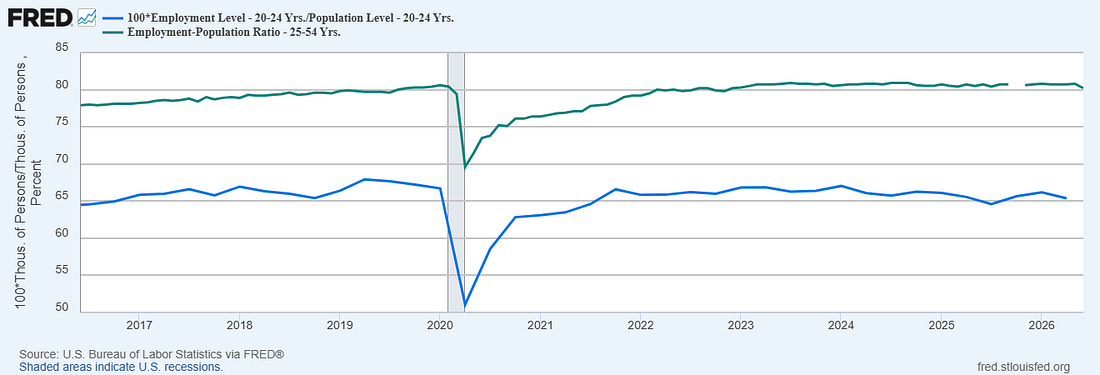
In fact, although AI might eventually be a big job-destroyer, right now it doesn’t seem to be. The employment rates for people age 20-24 and 25-54 are both just about the same as they were before ChatGPT ever existed:
 |
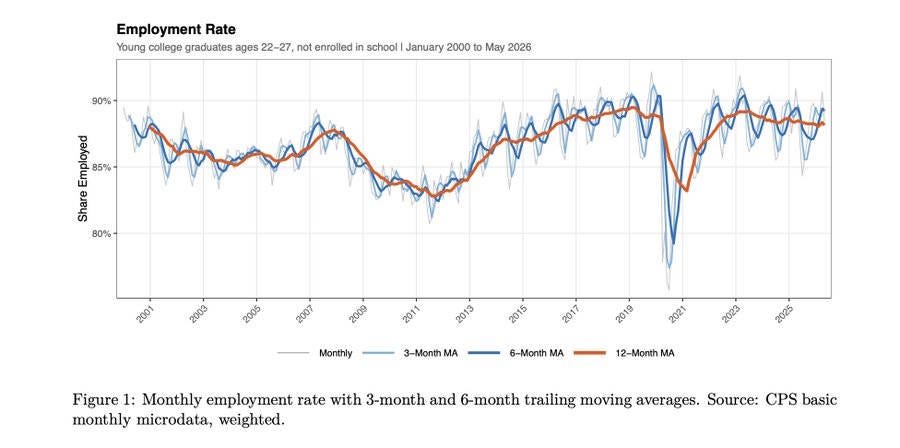
And the employment rate for young college grads — the group everyone thinks is most likely to be hurt by AI — is also basically unchanged:
 |
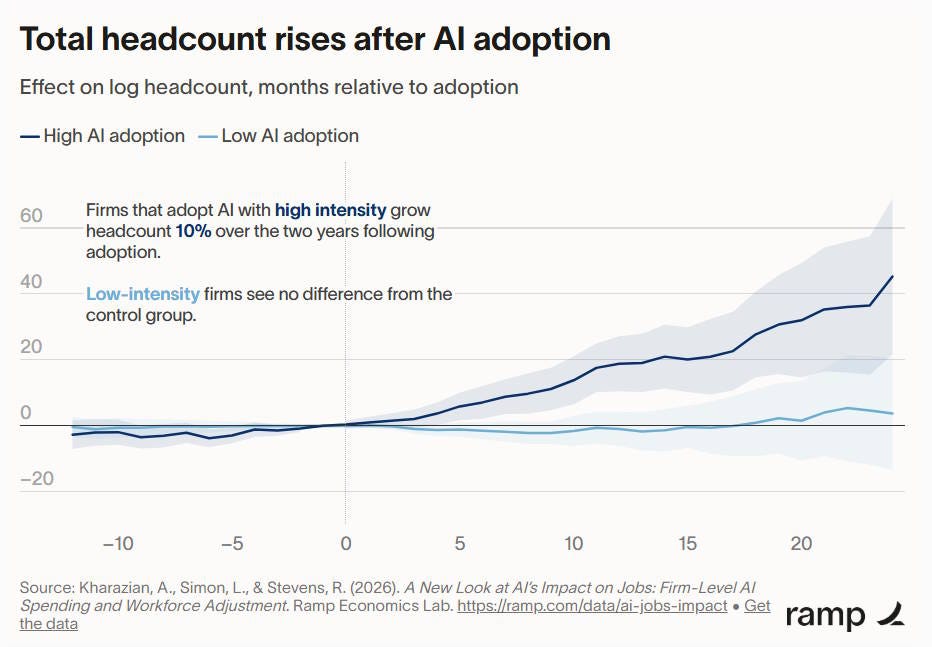
So if there’s any wave of AI job destruction, it’s not visible in the macro data yet. As for the micro data, there are a few studies that show companies reducing their hiring of certain kinds of workers when they adopt AI, but most don’t really find much. In fact, one recent study found that companies that adopt AI hire more workers than other companies in the same industry: