
|
 |
Why Tech Writers Should Use The Content-First + AI Readiness Scorecard
A simple way to determine whether your organization has the structure, discipline, and alignment AI actually requires
|

| |||||||||||||||


Tech writers are being dragged into AI conversations whether they volunteered or not.
One minute we’re trying to fix a broken procedure, standardize terminology, or get one stubborn SME to stop rewriting our approved interface labels. The next minute, someone in leadership is asking whether our content is “AI-ready,” as if that were a setting buried in a dropdown menu somewhere between Export and Panic.
That is why a tool like the Content-First + AI Readiness Scorecard is worth a look. The brainchild of Sarah Johnson, Founder and Strategic Consultant at Content-first Design, the scorecard gives us a way to assess whether our organization is actually ready for AI or not. It helps us spot weak governance, shaky workflows, missing structure, poor feedback loops, and the usual fantasy that better output will somehow emerge from messy inputs.
It also gives us a better way to talk with leadership. Instead of muttering about metadata until the room goes glassy-eyed, we can point to gaps in readiness, consistency, ownership, and review. That shifts the conversation from technical whining to business risk.
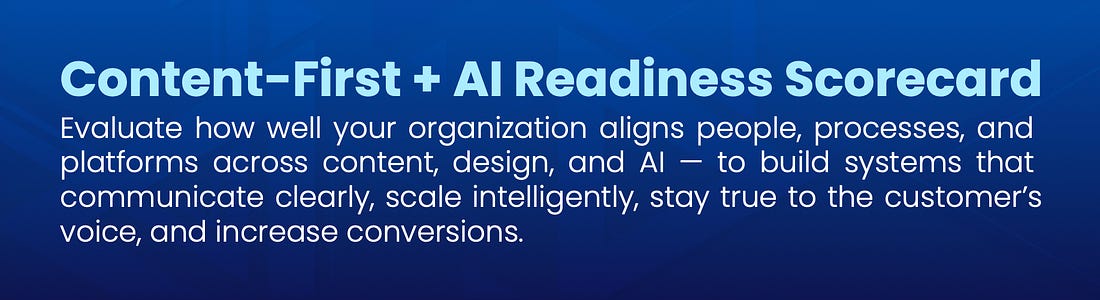 |
For technical writers, that matters. The scorecard frames AI readiness as a content systems issue — which is our turf. It helps us find workflow gaps, make the case for structured content and cross-functional involvement, identify training needs, and ask better questions before bad content starts scaling with machine-speed confidence.
No, it won’t fix governance by itself. It won’t make leadership care. It won’t stop random prompt shenanigans from spreading through the building like office glitter. But it can help us see what’s broken, name it clearly, and start a smarter conversation.
A downloadable (and fillable) PDF of the Content-First + AI Readiness Scorecard can be found at the end of this post.
Section 01: Framework And Process Maturity
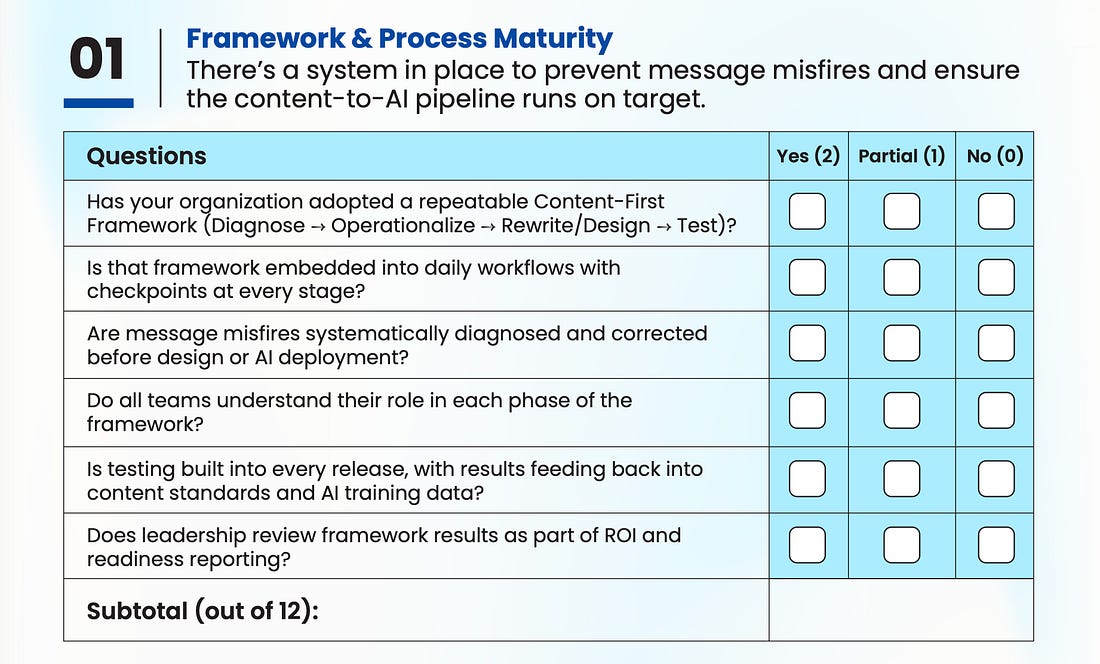 |
This part of the scorecard checks whether our organization has a real, repeatable way to get content in shape before we dump it into design systems, publishing workflows, or AI experiences and pretend that was a strategy. It asks whether we have an actual framework, whether we use it in day-to-day work, whether we catch message problems early, whether we understand our roles, whether our testing improves our standards and training data, and whether leadership actually reviews the results.
In plain language, this section is asking: Do we have a real process, or are people mostly winging it and hoping AI won’t notice?
Why This Matters For AI Readiness
AI is only as reliable as the content operations behind it. If our organization doesn’t have a repeatable way to spot content problems, fix them, test the results, and feed those lessons back into standards, AI won’t improve much of anything. It will just help bad content move faster and sound weirdly sure of itself on the way out the door.
This section of the scorecard shows whether our tech docs team is mature enough to support trustworthy AI. Strong scores suggest we have a disciplined workflow, clear checkpoints, defined ownership, and feedback loops that improve both human-written content and machine-generated output over time. Weak scores suggest the opposite: inconsistent processes, fuzzy accountability, and the kind of chaos that produces polished answers right up until they mislead someone who matters.
What Tech Writers Should Pay Attention To
Tech docs pros should read this section as a test of whether our operation is serious or just wearing glasses and hoping no one asks questions. It’s not only asking whether our content gets written; it’s asking whether it gets governed — whether we know when we’re involved, what we’re responsible for, and how we catch quality problems before they turn into design issues, support messes, or AI hallucinations.
It also makes one of the scorecard’s clearest points: documentation isn’t just a deliverable. It’s part of the system that determines what AI can safely say.