| | In today’s edition: Houthis join the fight, Bahrain eyes nuclear power, and why Saudi men are drowni͏ ͏ ͏ ͏ ͏ ͏ |
| |  Riyadh Riyadh |  Sanaa Sanaa | Ras El Hekma |
 | Gulf |  |
| |
|
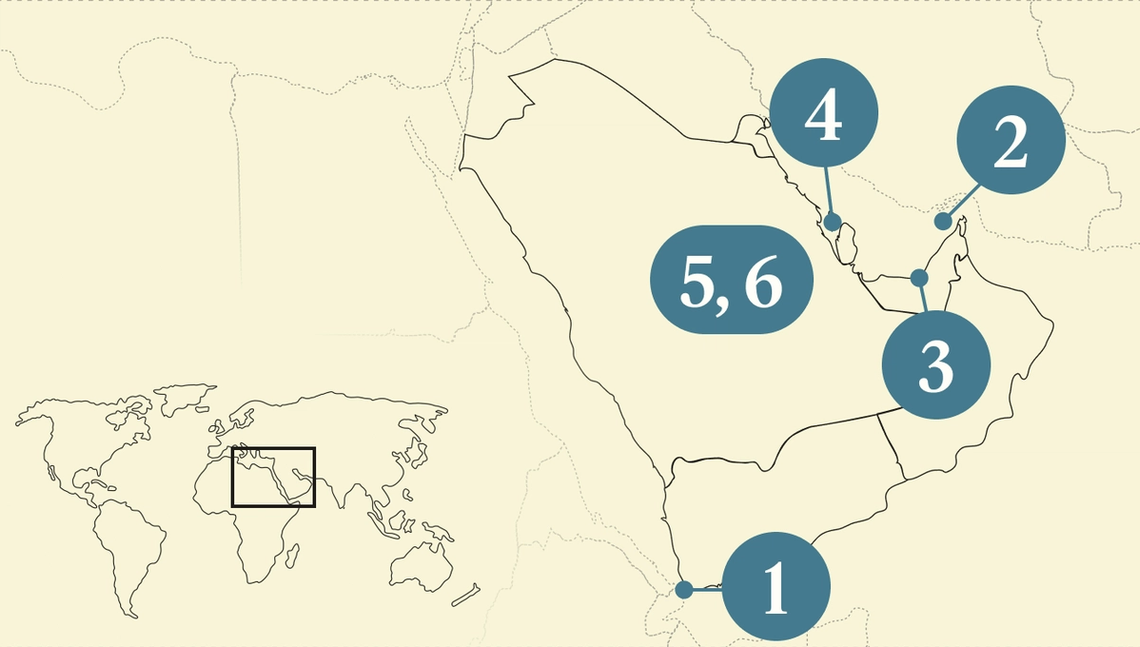 - Houthis join the fray
- Islands in the crosshairs
- ADNOC gas expansion
- Bahrain eyes nuclear power
- Foreign investors buy Saudi
- Saudi men drowning in debt
 Deciphering the mood in Moscow from Dubai’s ‘Marinagrad.’ |
|
Houthis take aim at Saudi shipping |
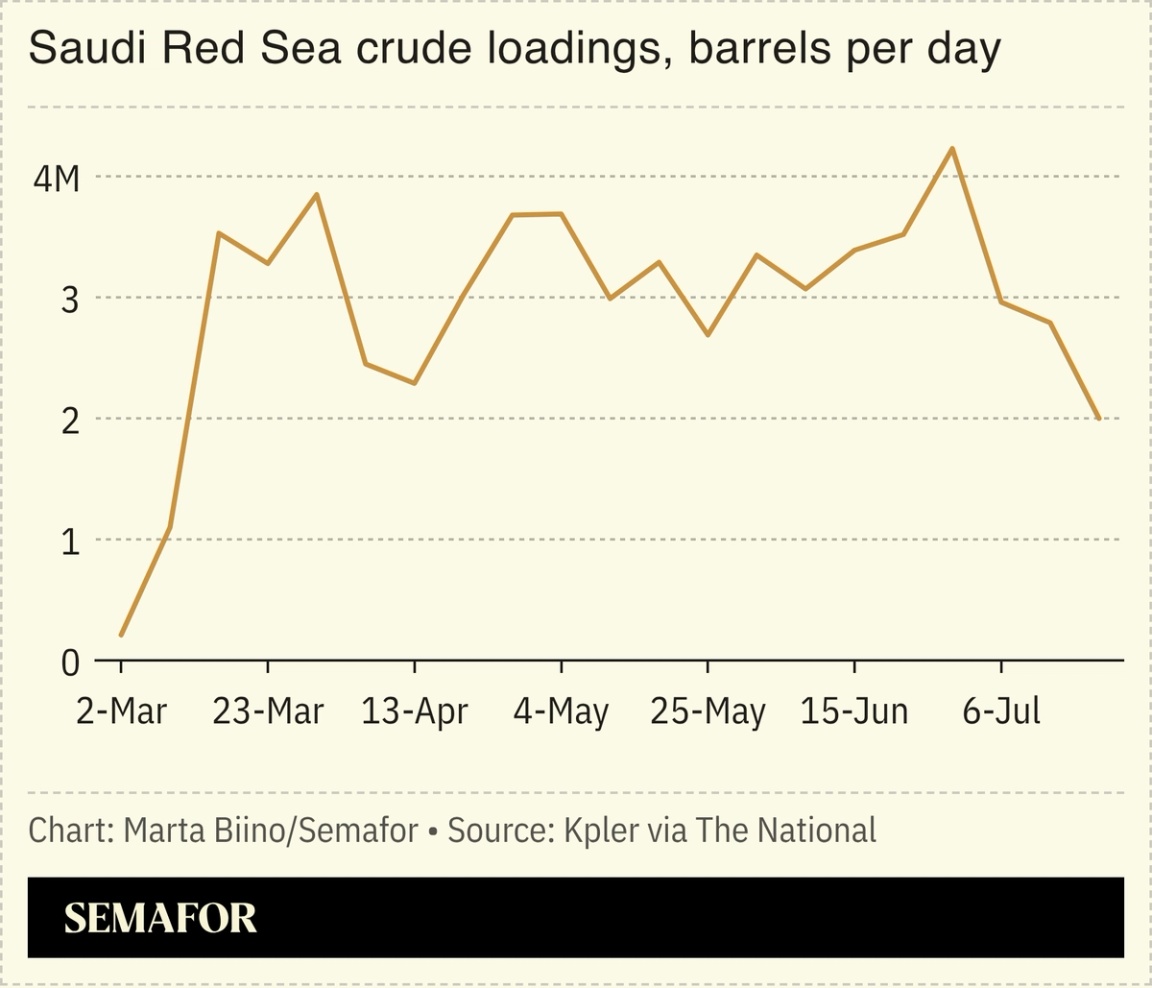 Yemen’s Houthis announced a maritime blockade of Saudi Arabia, threatening the kingdom’s oil exports and adding to the risk of the Iran war expanding around the region. A Houthi spokesman said it was responding to Saudi restrictions on its ports — a charge rebutted by Riyadh, which said hundreds of vessels had docked at Houthi-controlled ports this year. Saudi crude flows through Bab el-Mandeb were already sliding amid wider Houthi threats to shipping, but they could now grind to a halt, forcing shipping between the kingdom and Asia to sail around Africa via the Suez Canal. Imports from Asia would be similarly affected. Meanwhile, the US and Iran continue to trade blows. US missiles struck Iran for a 10th consecutive night, while Iran hit a tanker in the Strait of Hormuz, and said it bombed an Amazon data center in Bahrain, and US bases in Kuwait and Jordan. Some in Iran are now predicting a US ground invasion. |
|
The disputed islands controlling Hormuz |
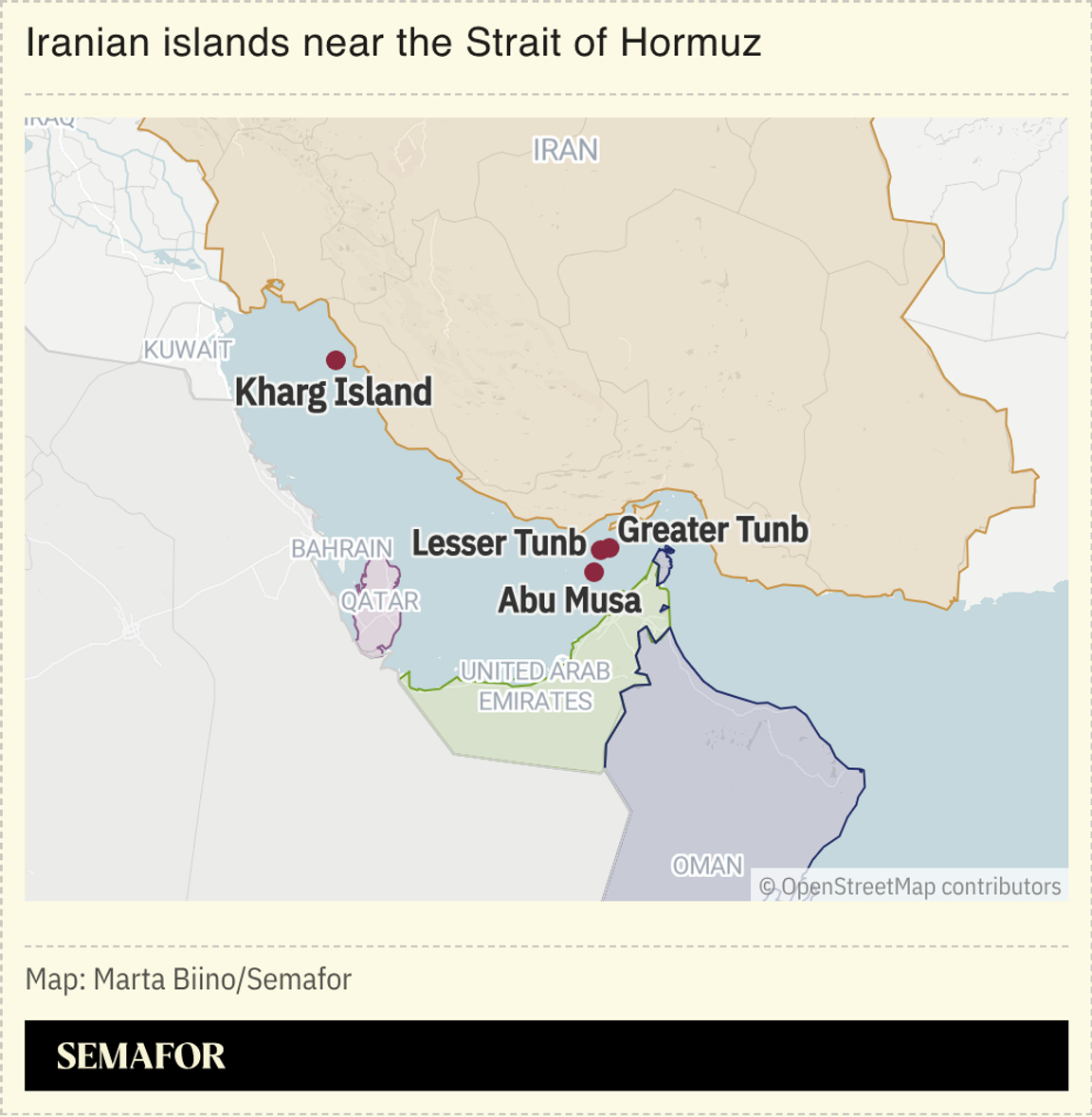 With little sign of momentum in peace talks between the US and Iran, attention has returned to three small islands that are crucial to controlling the Strait of Hormuz. Lying at the mouth of the Gulf chokepoint, the islands — Abu Musa, Greater Tunb, and Lesser Tunb — have been held by Iran since 1971, but are claimed by the UAE. They have come under US fire over the past week. “If external powers look for ways to reshape security in the Strait of Hormuz, these islands are an obvious focal point — with relatively limited diplomatic cost given the ambiguity around sovereignty,” writes H.A. Hellyer, a fellow at the London-based Royal United Services Institute. |
|
Abu Dhabi invests in domestic gas project |
 Abu Dhabi National Oil Company plans to invest $6.2 billion to develop natural gas at its offshore Umm Shaif field, alongside France’s TotalEnergies, Italy’s Eni, and China National Petroleum Corp. The project is expected to produce more than 600 million cubic feet of gas a day from 2030, equivalent to almost 10% of the UAE’s current daily consumption. The expansion fits within the company’s global gas strategy and is part of a broader effort to meet rising domestic demand driven by industrial growth and AI infrastructure, while expanding liquefied natural gas exports from the UAE and ADNOC-backed LNG projects in Argentina and the US. Abu Dhabi also aims to reduce its reliance on gas imports from Qatar before the Dolphin pipeline agreement expires in 2032, according to the Financial Times. |
|
Bahrain studies nuclear power option |
 A digital visualization of the small modular nuclear reactor planned by Rolls-Royce. Rolls-Royce/Handout via Reuters. A digital visualization of the small modular nuclear reactor planned by Rolls-Royce. Rolls-Royce/Handout via Reuters.Bahrain is studying whether to build a small modular nuclear power plant, the Middle East Economic Digest reported, with the state-owned Bapco Energies leading the effort through its venture capital arm. If it goes ahead, it would be the first nuclear plant in the kingdom, which holds the Gulf’s smallest hydrocarbon reserves. Bahrain is joining a Gulf-wide bet on small modular reactors. The UAE — currently the only Gulf country to generate nuclear power — Saudi Arabia, and Qatar are all also studying or investing in the largely unproven technology, attracted by its faster build times in the face of surging power demand from AI data centers. |
|
Saudi market stands alone |
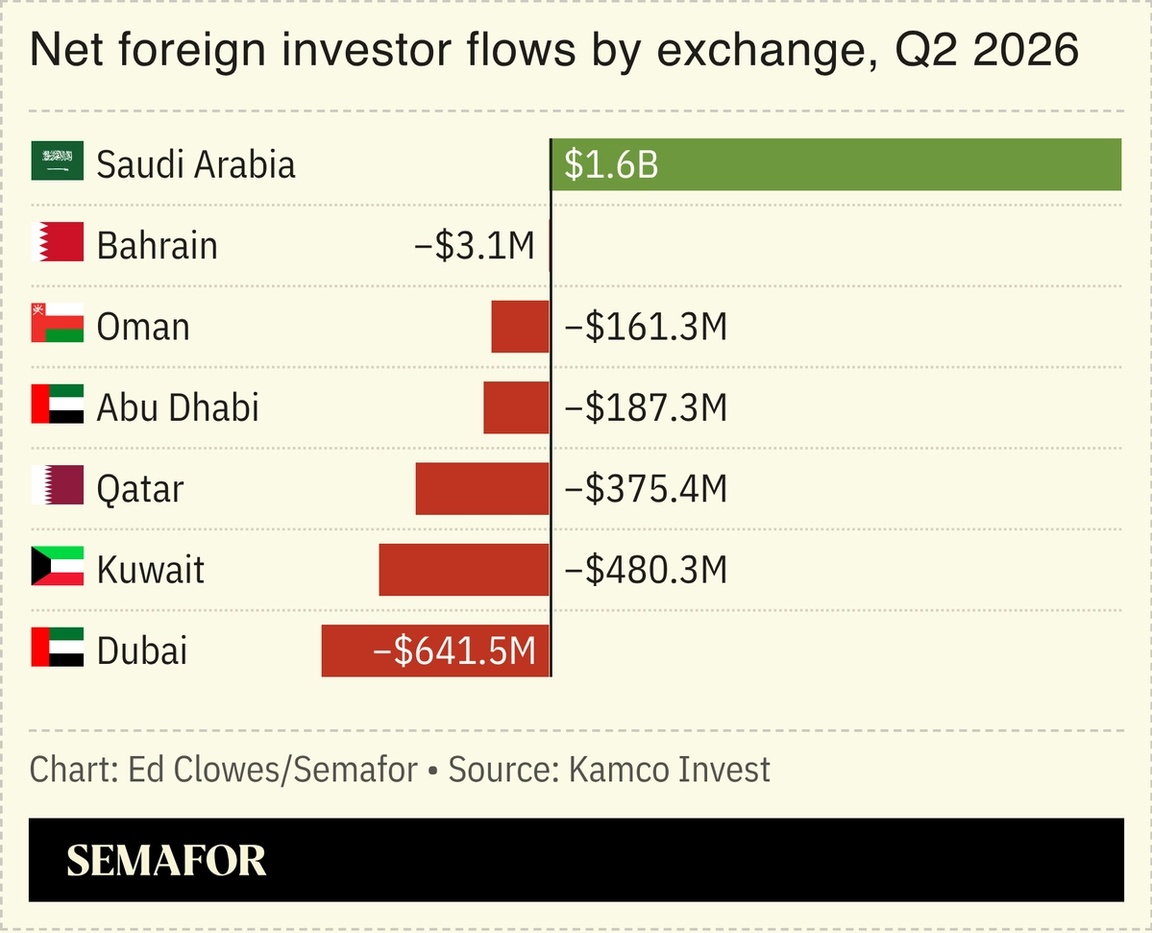 Overseas investors poured $1.6 billion into Saudi Arabia’s stock exchange in the second quarter, the only Gulf market to post an increase in net foreign buying, according to Kamco Invest’s latest trading activity report. The interest was driven in part by the kingdom’s decision to open its market to all overseas investors from Feb. 1, helping to lift foreign net buying by 75% year-on-year in the first half of 2026. The prospects for the Tadawul, as the Saudi market is known, could be further enhanced if the kingdom’s regulator delivers on a promise to lift foreign ownership limits, currently capped at 49%. The market’s performance also reflects the fact that Saudi Arabia has weathered the US-Iran war better than many other Gulf countries, and its economy is still expected to grow this year. — Ed Clowes |
|
View: Why Saudi men are falling behind |
  Ali Jarekji AJ/WS/Reuters Ali Jarekji AJ/WS/ReutersSaudi Arabia’s success in bringing women into the workforce has had unintended consequences that are now showing up in the courts, Saudi economy specialist Wael Mahdi writes in a column for Semafor. Female private-sector employment has grown at more than twice the pace of male employment in recent years, but the legal obligations on men have not changed and they remain solely responsible for household costs, whether or not they are the main earner. In a more competitive labor market, some men are finding it harder to secure jobs. They are borrowing more and some struggle to service their debts: Last year, Saudi courts received 1.6 million claims covering more than $44 billion in unpaid financial obligations — an indication of a social framework creaking under pressure it was never designed to bear. “The courts are applying a law written for a world in which women did not work. That world no longer exists,” he writes. |
|
 America’s biggest retailer is quietly getting into banking. After previous misfires in financial services, Walmart is back at it with OnePay, which has 7 million customers, $50 billion in annual payment flow — and virtually zero in acquisition costs. On this week’s episode of Compound Interest, presented by Amazon Business, OnePay CEO Omer Ismail joins Liz and Rohan to discuss why he thinks the company can succeed where other fintechs have floundered and whether the big box titan can really compete with the big banks. |
|
 Deals- Mubadala Capital has agreed to buy French holiday rental operator Pierre et Vacances in an all-cash deal, having secured commitments from shareholders representing 80% of the company, which runs 45,000 properties across Europe. — The National
- An Abu Dhabi-backed consortium including MGX and BlackRock’s GIP has closed its $40 billion acquisition of Aligned Data Centers, one of the largest private digital-infrastructure deals in history and the first investment by their AI Infrastructure Partnership.
Real Estate- Qatari Diar has hired the architects behind Burj Khalifa to masterplan a $30 billion city on Egypt’s Mediterranean coast, the latest in a wave of Gulf investment reshaping the country’s shoreline. — AGBI
- A penthouse at the Waldorf Astoria Residences in Ras Al Khaimah has sold for $35.4 million, the most expensive residential transaction ever recorded in the emirate.
Telecoms- UAE telecoms company e& has reportedly sold assets — including $6 billion in Vodafone stock and a stake in a super app managed by ride-hailing platform Careem — as part of a pivot from trying to build a global tech company to focusing on its “core telecoms business, where returns are steadier and easier to manage.” — Reuters
|
|
 Superyacht Luna, owned by Russian billionaire Farkhad Akhmedov, is docked in Dubai. Christopher Pike/Reuters. Superyacht Luna, owned by Russian billionaire Farkhad Akhmedov, is docked in Dubai. Christopher Pike/Reuters.One of the peculiarities of living in Dubai is that its international population offers a window into some of the world’s most reclusive states. Journalist Frank Kane — a longtime Dubai resident and the “honorary dean” of its foreign correspondent corps — has long tracked the mood in Russia through neighbors in Dubai Marina, which he has dubbed “Marinagrad” because of its large Russian community. Russians recently returning to Dubai describe a country that feels exhausted, anxious, and increasingly resigned rather than patriotic. Ukrainian drone attacks, airport closures, fuel shortages, and daily disruptions are eroding public confidence. While Dubai remains a refuge for many Russians, Kane warned that Moscow’s support for Iran during the conflict could cool the UAE’s welcome, raising questions about whether future waves of Russian expatriates will be received as warmly as those who arrived after the Ukraine invasion began. |
|
|


