| | In today’s edition: Riyadh and Abu Dhabi signal a thaw, Trump greenlights Saudi nuclear plans, and s͏ ͏ ͏ ͏ ͏ ͏ |
| |  Riyadh Riyadh |  Abu Dhabi Abu Dhabi | Jerusalem |
 | Gulf |  |
| |
|
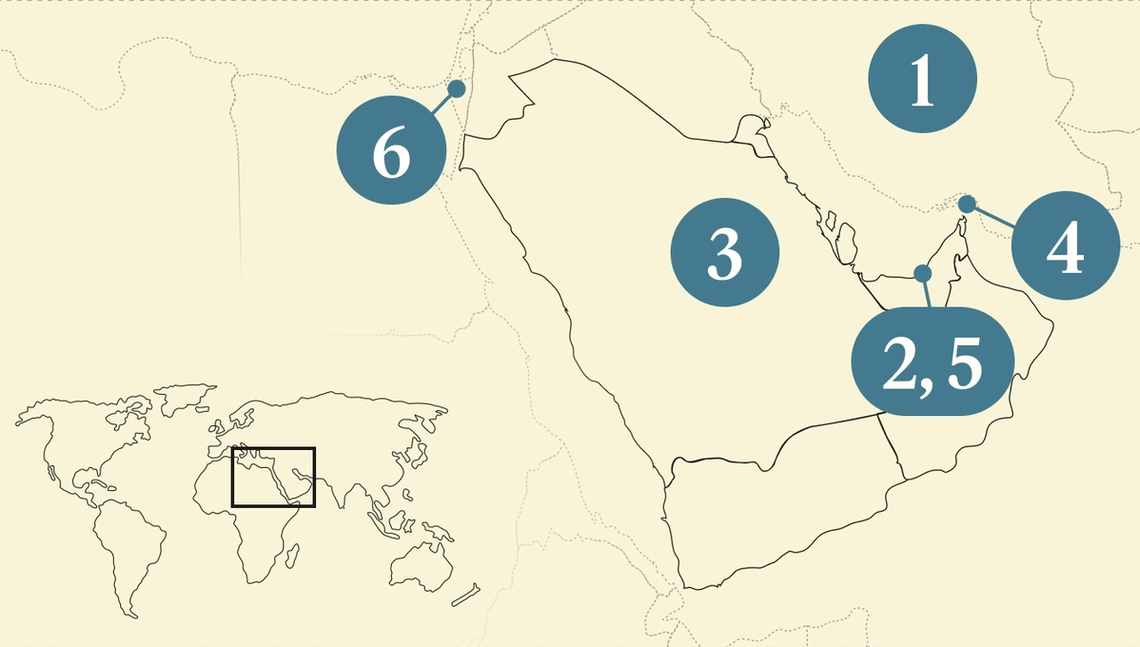 - Iran war spirals
- UAE-Saudi tensions ease
- Saudi gets US nuclear deal
- Shipowners’ risk and reward
- The UAE’s hiring slump
- An Israeli ode to Dubai
 Tanker wars, then and now. |
|
Gulf patience wears thin as war spreads |
 Houthi supporters rally in Sanaa. Khaled Abdullah/Reuters. Houthi supporters rally in Sanaa. Khaled Abdullah/Reuters.Gulf states are reportedly chafing at the intensifying US-Iran conflict, which is spilling over to Saudi Arabia’s west coast and the Bab el-Mandeb waterway, and risks metastasizing further. Regional countries have already borne the brunt of Iranian attacks, including repeated strikes this week on Kuwait’s power and water infrastructure. Now the war threatens another crucial lifeline for the kingdom’s oil exports along the Red Sea, as Houthi fighters in Yemen begin a maritime blockade of the strait. At least six ships reversed course on Tuesday following the threats. Gulf nations “are frustrated, but powerless in stopping either of the belligerents,” Ali Vaez, director of the Iran Project at the International Crisis Group, told Bloomberg. US President Donald Trump suggested the war would continue for some time as he reportedly weighs a broader military campaign against Iran, with plans ranging from heavier air attacks to a ground invasion of Iranian islands overlooking the Strait of Hormuz, according to The Wall Street Journal. Continued fighting in the region risks sending oil prices to $120 a barrel by the end of the year, Goldman Sachs said, particularly if attacks start on shipping in the Red Sea. Economists have previously warned that severe disruption to the trade route could also affect commodity prices and drive up inflation. |
|
Saudi, UAE tone down tensions |
 Saudi Defense Minister Khalid bin Salman and UAE Vice President and Deputy Prime Minister Sheikh Mansour bin Zayed. @Turki_alalshikh/X. Saudi Defense Minister Khalid bin Salman and UAE Vice President and Deputy Prime Minister Sheikh Mansour bin Zayed. @Turki_alalshikh/X.Senior Saudi and UAE officials praised their countries’ shared history, “wise leadership,” and “brotherly relations,” signaling that both sides are trying to move beyond tensions that spilled into public view last year. The online posts followed the release of a photo showing the Saudi defense minister and the UAE’s deputy prime minister smiling with their arms around each other’s shoulders. It is unclear when and where the image was taken, but it echoed an event around the easing of Qatar’s rift with its neighbors in 2021, when a casual photo of the Saudi crown prince, Qatar’s ruler, and the UAE’s national security adviser (two of the three in shorts) helped signal reconciliation. The Saudi-UAE split was driven by disputes over Yemen, Sudan, and broader economic and geopolitical rivalry. But the Iran war has brought their shared security threat into focus, making the other differences — though largely unresolved — appear secondary to the need for regional unity. — Mohammed Sergie |
|
Riyadh wins US nuclear concessions |
 Evelyn Hockstein/Reuters Evelyn Hockstein/ReutersUS President Donald Trump has reportedly approved allowing Saudi Arabia to build a civil nuclear program, potentially letting the kingdom develop its own enrichment facilities. The 30-year deal, first reported by The Wall Street Journal, could be worth tens of billions of dollars to US companies and shuts out Chinese and Russian firms from Saudi’s nuclear power ambitions. Saudi Arabia has been lobbying for years for approval to enrich its domestic uranium deposits. The Biden administration tied any possible deal to the kingdom normalizing ties with Israel, and sought to impose restrictions on uranium enrichment and the reprocessing of spent fuel. The latest deal does not include such caveats, offering a major win for Crown Prince Mohammed bin Salman. Still, those terms are likely to spark fears of regional nuclear proliferation, and face opposition in the US Congress. Saudi Arabia has said in the past that it will pursue a nuclear weapon if Iran gets one, and the ability to enrich and reprocess offers it a pathway to do so. — Matthew Martin |
|
Hormuz strikes offer big profits for shippers |
 Amirhosein Khorgooi/ISNA/via WANA via Reuters Amirhosein Khorgooi/ISNA/via WANA via ReutersThe latest Iranian attacks in the Strait of Hormuz show that some shipowners are still willing to send their tankers into the world’s most dangerous waters in pursuit of outsized profits. On Monday, Iran struck two vessels owned by Greece’s Dynacom as they passed through the strait; a Kuwaiti tanker was hit on the same day. Dynacom, owned by billionaire George Prokopiou, has been instrumental in ferrying oil out of the Gulf during the war — at windfall prices of up to $500,000 per vessel. Ships need sailors though; supertanker owner Sinokor Group has offered a six-month bonus to crew willing to navigate through the strait. “The premium now from just being able to sell cargoes can’t be overstated,” said Ian Ralby, senior security fellow at the Center for Maritime Strategy think tank. — Tim McDonnell |
|
UAE companies cut back on hiring |
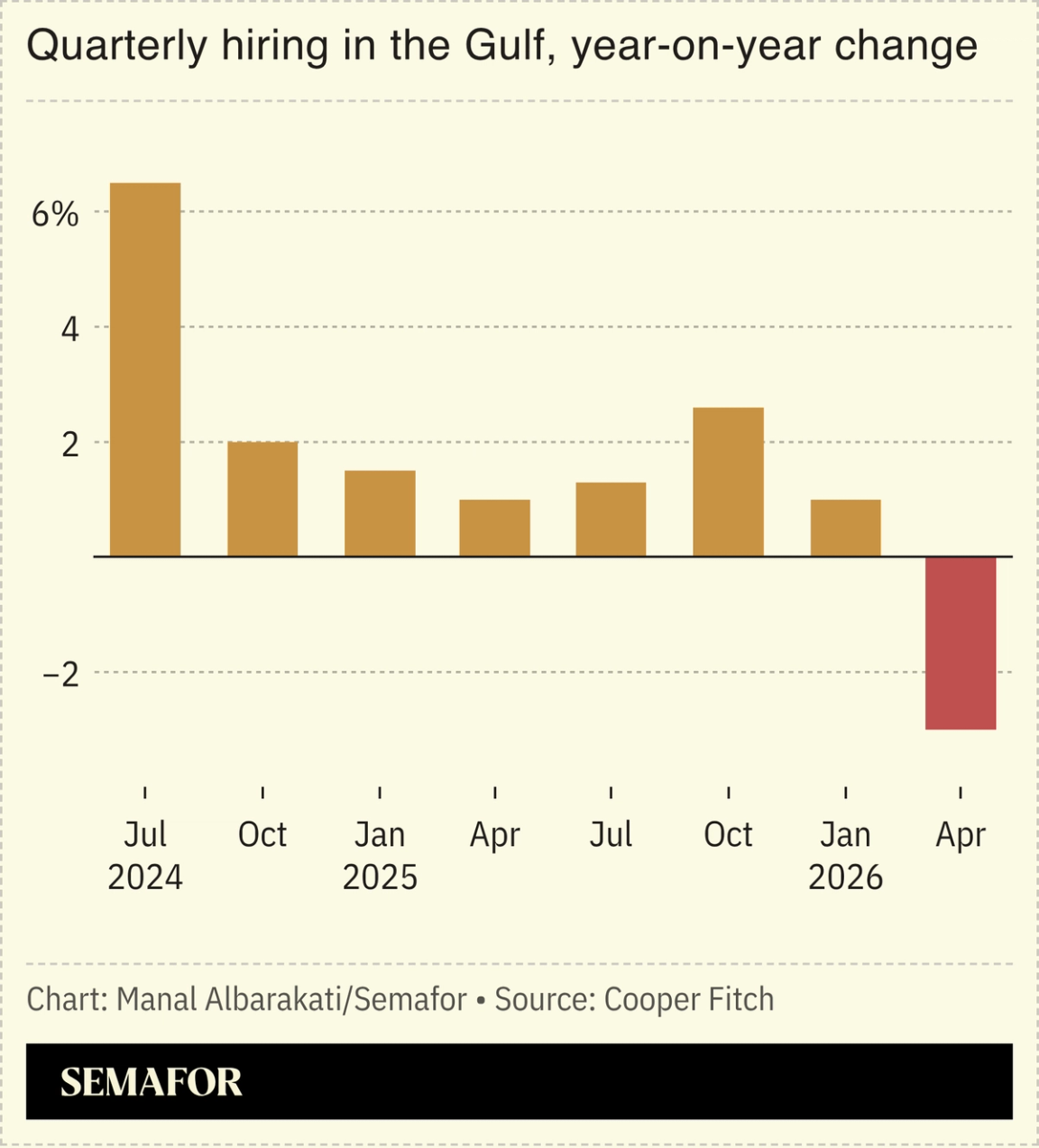 Private-sector hiring in the UAE shrank in the second quarter — the first fall in more than four years, according to recruitment consultancy Cooper Fitch. The decline comes after months of reported layoffs and economic uncertainty stemming from the Iran war. New hiring fell 4% in the UAE, faster than the Gulf average. Bahrain, Kuwait, and Qatar also saw activity dip, with only Saudi Arabia and Oman adding jobs. When the conflict started in late February, companies in the region tried to retain staff by trimming pay and hours and handing out unpaid leave in the hope the disruption would soon pass. That patience has thinned as the fighting has ebbed and flowed, and a quarter of companies now plan cuts, a survey by staffing firm ManpowerGroup found. — Manal Albarakati |
|
View: Israel diplomat reflects on Dubai |
 Christopher Pike/Reuters/Semafor Christopher Pike/Reuters/SemaforIsrael’s top diplomat in Dubai is nearing the end of her tour in the city, a stint marked by multiple wars that ultimately proved the Abraham Accords haven’t been a “fragile, fair-weather agreement, bound to shatter at the first sign of Middle Eastern turbulence,” she wrote in a column for Semafor. During her tenure, Liron Zaslansky, Israel’s first consul general in Dubai, said she picked up lessons from the UAE’s vision, leadership, and governance. Israelis have also flocked to Dubai in recent years, with many choosing to stay during the conflict rather than return home. “In Dubai, more than 200 nationalities coexist in peace, security, and prosperity because tolerance is actively enforced, leaving zero room for extremist ideologies,” Zaslansky wrote. “The ultimate proof is the local Jewish community — virtually the only one globally that is actively growing and becoming younger.” |
|
 Banking- Payments firm Network International has extended acceptance of Jaywan, the UAE’s domestic card project, to online transactions, opening the central bank-backed card to thousands of e-commerce merchants across the country. — The National
Checking In- Ryanair profits fell 34% in the second quarter as the Iran war hit consumer confidence, forcing the budget carrier to cut fares even as its unhedged fuel costs doubled. — FT
- Even Oman, which captured much of the passenger traffic in the first weeks of the war, hasn’t escaped an aviation slowdown. Passenger traffic fell 9.3% in the first five months of 2026.
Property- Villa prices in Riyadh fell 13.4% year-on-year in the second quarter and residential land dropped 5.1%, extending a correction set off by Crown Prince Mohammed bin Salman’s measures to cool the capital’s property market after years of surging prices. New home lending is feeling the pinch too, falling 41% in May. — Al-Eqtisadiah
Trade- The UAE is close to completing trade deal negotiations with Canada — one of seven agreements it could complete this year. Talks with Rwanda, Ghana, and Zambia are also in the final stages, but negotiations with the EU are moving slower than expected.
|
|
 Ulli Michel/Reuters Ulli Michel/ReutersIn July 1987, an American flag was installed on a 400,000-ton Kuwaiti supertanker — renamed the Bridgeton — so the US Navy could escort it through the Gulf, where Iran was targeting vessels carrying oil from Iraq and its allies. Decades later, a similar exercise is playing out in the Gulf. Back then, Tehran had laid a string of mines in the Gulf, with one blowing through the Bridgeton’s outer hull. The attack set in motion the largest naval convoy operation since World War II, a 14-month mission, in which the US protected Kuwaiti-owned tankers and helped end the Tanker War. Iranian mines went back into Gulf waters this year, causing a ne |
|
|


