
|
 |



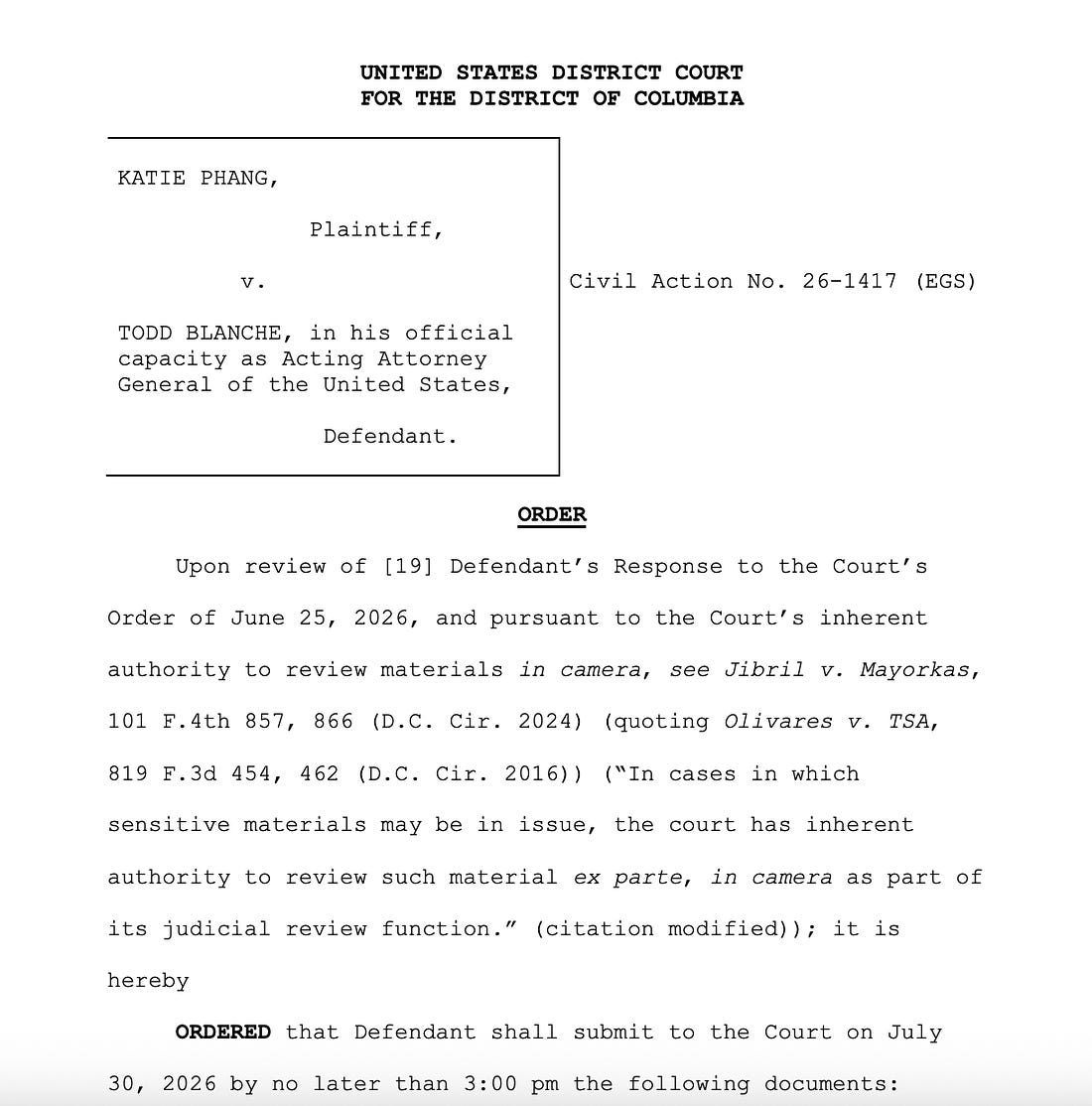
This afternoon, federal District Judge Emmet Sullivan did something unexpected. Noting that courts, “In cases in which sensitive materials may be in issue,” have the “inherent authority to review such material ex parte, in camera as part of its judicial review function,” Judge Sullivan gave acting Attorney General Todd Blanche five days to provide him with unredacted copies of documents in the Epstein Files that the Justice Department continues to withhold. In camera review refers to a process where the Judge would review documents in chambers, without the public or the press present, and an ex parte proceeding in this context is one where the judge reviews sensitive information in the possession of one party without the other party present to determine what, if anything, should be turned over.
Judge Sullivan asked for the following items:
Eight emails along with supporting documentation to confirm DOJ’s representation that the names that are redacted in the published version of the documents are the names of victims.
A document with the names in the “to” and “from” lines redacted, and documentation to support DOJ’s claim that those names are of law enforcement personnel.
A document along with support for DOJ’s claim that the names that are redacted in the published version are the names of victims.
This is in the case filed by Katie Phang, which we discussed here.
 |
The Judge previously entered an order that required the government to turn over specific categories of documents it was required to make public by the Epstein Files Transparency Act that became law on November 19, 2025, but has so far failed to disclose. Instead of complying with the court’s order, DOJ asked for two additional months, writing that the government “strongly disagrees” with the court’s order.
Of course, many litigants disagree with decisions judges make. The proper course of action is appealing them. Unless that judge or a higher court issues a stay, the government, like any other party, is obligated to comply.
Before Trump and during the Biden administration, courts were able to rely on representations made by the Justice Department. Every lawyer for the government understood they owed the courts a duty of candor; everything they said in court must be true to the best of their knowledge and swiftly corrected if they subsequently became aware of additional information. The government obeyed court orders, even the ones it disagreed with.
But that’s no longer the case. The presumption of regularity is essentially no more. The presumption is the “‘general working principle’ that means courts will ‘insist on a meaningful evidentiary showing’ before entertaining doubts about the integrity of official acts or documents.” It was commonly used to advance the idea that in the absence of evidence to the contrary, courts should presume government employees, including DOJ lawyers, acted properly in the execution of their duties. Now it’s on life support and Judge Sullivan’s order is another nail in its coffin.
This most recent order suggests that Judge Sullivan doesn’t believe the government when it says something is the case, even when that “something” is as simple as the identity of the person in a “to” line in an email. But the government has acted like it has something to hide, even after Congress passed the Transparency Act and Trump signed it into law. So the Judge isn’t accepting what the government has represented to it as truthful, and is requiring documentation to support its claims. Under any other president, the Attorney General would have been disturbed by the suggestion prosecutors couldn’t be trusted. There would be disciplinary review. But here, the acting Attorney General is the defendant in the case. It’s paradigmatic of how far DOJ has fallen.
Phang v. Blanche is significant because it’s the only lawsuit seeking to enforce the Epstein Files Transparency Act that is moving forward. But it also is taking its place on the list of cases where the courts have found reason to distrust the Justice Department; everything from the deportation case where Judge Boasberg in the District of Columbia opened contempt proceedings against the government (whether they can proceed is currently pending en banc review before the Court of Appeals) to the slush fund case where a court concluded DOJ was party to a settlement designed to benefit Trump in his family in a lawsuit that was a “sham.”
When I was an Assistant United States Attorney, I argued cases in front of the Eleventh Circuit Court of Appeals frequently. One of my favorite judges would always point to the lights the court used to keep track of the lawyers’ time: green meant you could keep talking, yellow meant you were almost out of time, and red meant stop. This Judge liked to emphasize that last part, telling lawyers that when the red light came on, they were out of time and needed to stop arguing. Knowing that some lawyers would try to keep going, he would emphasize, with a hint of a smile, that “The red light is not aspirational.”
His gentle humor took some of the tension out of the room. But the advice holds in a much more serious context, minus the levity: Complying with the law and with court orders isn’t aspirational either. It’s one of the bedrock principles that makes our democracy possible. It’s been that way for 250 years.
The Trump administration doesn’t seem to see it that way. For them, the law is at best a speed bump in the road when it gets in the way of what they want to do. Court orders are mere suggestions. There is a great deal of concern about the moment where a court directly orders the government to do something and it refuses to. But the reality is, we have been dancing on the precipice of that moment virtually since this administration got underway. There is no longer anything to be gained by bending over backward to give the administration multiple chances to comply. Courts may not have armies to enforce their orders, which is, perhaps, why they have tried to avoid a direct confrontation. But the government must comply with the law, just as all other litigants must follow a judge’s dictates. We are past the point where special treatment and multiple chances make sense.
Thanks for being here with me at Civil Discourse and for your support and subscriptions, which make the newsletter possible. At this time last year, many people were asking whether we were approaching or in a constitutional crisis. My answer then was yes. The fact that courts are still struggling, a year later, with what they can do to convince the Trump administration to comply with the law confirms it. Your commitment to understanding these issues and sharing what you know with people in your circle as the midterm elections approach is essential. A Republic, if we can keep it.
We’re in this together,
Joyce
You're currently a free subscriber to Civil Discourse with Joyce Vance . For the full experience,