




 |
Detroit, Michigan
ANOTHER JOLT JUST HIT the highest-profile Democratic Senate primary in the country: Big Gretch entered the conversation.
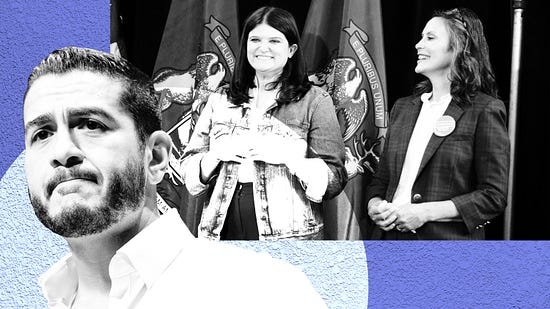
That’s the affectionate nickname for Gretchen Whitmer, the two-term Democratic governor who is by most reckonings the most popular statewide elected official in Michigan. On Friday, she announced that she was endorsing Haley Stevens, the four-term House Democrat who has been running in a tightly contested, increasingly bitter campaign against former Detroit and Wayne County public health director Abdul El-Sayed.
Whitmer made the announcement in a video—and then in person about three hours later, during a campaign event at a Teamsters union hall in Detroit, where she said “Michiganders need a fighter in Washington.” Never once in either case did she mention El-Sayed. But she alluded to him indirectly during the speech when she said the top priority for Democratic voters was keeping the open Senate seat—now occupied by Gary Stevens, who is not seeking re-election—in the party’s hands.
“Democrats cannot take back the Senate without winning the state of Michigan,” Whitmer said, as a crowd of about a hundred supporters cheered. “We don’t hold this seat, we can’t fight back against Medicaid cuts. We can’t fight back against tariffs, against skyrocketing gas and grocery prices. We can’t fight back against the chaos and division and political gamesmanship that have consumed our country for too long.”
That argument cut right to the heart of the question that for many Michigan Democrats is the most important: Which candidate has the best chance of winning? Supporters of Stevens have said she’s the one, citing her record of winning in swing districts and the difficulties El-Sayed would have defending a left-wing platform in a closely divided state. El-Sayed’s backers counter that his populist message actually speaks to many conservatives, while Stevens’s support from wealthy outside groups ties her to an establishment that infuriates voters across the ideological spectrum.
Whitmer at the Friday appearance didn’t have to spell out which side of the argument she finds compelling. But she did drop a reminder of why she has some authority to speak on the matter—as “someone who won statewide twice,” pausing and drawing out that last word for emphasis, and holding up two fingers for effect.
Just how seriously Michigan voters will take this advice is a separate question. Endorsements certainly don’t have the power they did in the old days. Just ask the editors of the Detroit Free Press, whose compelling endorsement of the campaign’s third candidate, state Sen. Mallory McMorrow, appeared exactly six days before she dropped out of the race.
Meanwhile, more than 690,000 Michiganders have already voted via mail or absentee ballot, according to official figures.¹ And Whitmer’s reputation has recently taken a hit thanks to in-state controversies over her support for data-center construction and her veto of several budget amendments. The former has pissed off progressives, environmentalists, and local activists. The latter has pissed off longtime Whitmer allies in the state legislature and key interest groups like labor.
But there are still plenty of reasons to think Whitmer’s endorsement will matter, maybe quite a lot.
We know—paywalls are a pain. But there’s an easy way around this one: Sign up for a free trial of Bulwark+ membership. You’ll be able to read the rest of this newsletter covering the Michigan primary, participate in the comments section, and enjoy our other locked content for two weeks without paying a penny. We bet you’ll like it.