




By all appearances, the war in Iran is back on hold. After nearly two weeks of nightly bombing, the United States abruptly paused further strikes on Iran on Friday, ostensibly in order to create space for further peace talks. The pause reportedly came after Chairman of the Joint Chiefs of Staff Gen. Dan Caine raised concerns Friday about America’s dwindling munitions stockpile. It’s all going great! Happy Monday.
Join Will Sommer and Sam Stein for MAGA Mondays today at 10:00 a.m. EDT on Substack and YouTube.
 |
A Surreal Spectacle at the WHCD
by Andrew Egger
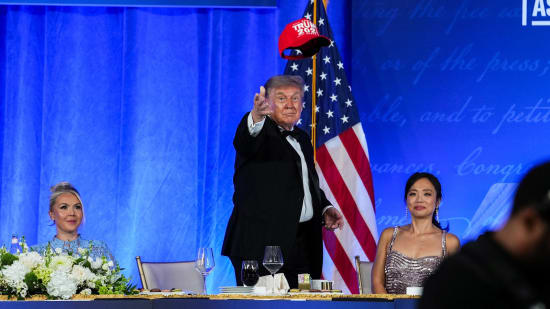
Donald Trump, it was clear, really, really wanted to have his moment at the White House Correspondents Dinner. He’d skipped them during his first term, but had been looking forward to this year’s—until the April event ended in chaos and panic after a would-be assassination attempt. Even then he’d wanted to continue. “We held out right till the end,” he said in the aftermath. “But they didn’t want to take a chance.” But he promised they’d reschedule: “I am ready, willing, and able. And I was all set to really rip it,” he said. “So I’ll have to save it.”
Trump finally got his rescheduled dinner on Friday. And, as promised, he ripped it, after a fashion. In his rambling, hour-long speech, Trump heaped insults on the reporters in the room, went after his political enemies with a host of colorful epithets (that they’re fat, mostly), insisted he’d won the election in 2020, and joked (?) that he’d run again in 2028.
And yet even as he delivered it, it was plain the speech wasn’t shaping up as he imagined it would. To his apparent surprise, a room full of journalists he’s spent a decade deriding as “the enemy of the people” makes for a pretty tough crowd. As punchline after punchline landed with a thud, Trump started openly grousing about the bad jokes he’d been given.
“The other day, a senator I know got a text—a great guy—from his wife,” Trump said. “And she said, when you get home, I want to have you immediately come up the stairs and make love to me. And he said, I can’t do both.” Crickets.
“In other words, can’t go up the stairs and make love,” Trump explained. “Does anybody get that? Well, I thought that was actually pretty good. That was actually the only thing I thought was good in this whole frickin’ stupid speech that they wrote. That was the only good one, and that went down with not exactly great laughter.”
He tried one more time: “I think, you know, in other words, you can’t go up the stairs and make love to a woman. So we’re looking for term limits. Does anybody understand this stuff?”
And so on and so on. Nobody likes to bomb on stage, but you have to imagine it was a particularly distasteful experience for Trump, who spends his entire life these days nestled snugly in a cocoon of over-the-top praise and adulation from the people he surrounds himself with—his staff, his online fans, his rally crowds, the business tycoons and world leaders who know how much he loves to be buttered up. Every room he’s in is happy to guffaw the second they sense he’s even attempting a joke, so why not this one? Must just be this terrible material his speechwriters handed him, the president decided.
The silly spectacle of the WHCD has always loomed large both in Washington’s psychology and in Trump’s own. Fifteen years ago, at the 2011 dinner, Trump sat stone-faced in the audience suffering roast after roast from President Barack Obama and emcee Seth Meyers. It’s long been speculated that Trump’s grievance over that night helped fuel his ultimate decision to run for president for real, ushering us all into this deeply stupid chapter in American history.
Since then, Trump has succeeded beyond his wildest imaginings in twisting the country and the world into his own clownish image. And yet it’s remarkable how much this would-be great man of history still cares about the two-bit prestige of what he perceives as America’s elite institutions like the WHCD. He’s spent his presidency raking in billions of dollars and luxuriating in the obeisance of the wealthiest and the most powerful people in the world. And yet somehow he still has a hunger to go into a black tie event to try to win the affection of people he sees on TV, no matter how hopeless his prospects. What does it profit a man to gain the whole world if he can’t even get a chuckle out of Wolf Blitzer?
You Don’t Have to Love ’Em to Vote for ’Em
by William Kristol
To begin the week, just a brief thought on political parties.
In modern politics, you can’t really live without them. But it’s a pain to live with them.
We know that bold leaders don’t fit comfortably in them. Churchill switched parties (twice!), and then spent the 1930s fighting against the disastrous policies of the party he’d returned to. Reagan switched parties once, but then went so far as to challenge the sitting president of his adopted party for the nomination. The senators I’ve known the best and admired the most, Pat Moynihan and John McCain, were willing to take on their own parties.
Even we ordinary citizens have a difficult time with political parties. If you like to think for yourself, you chafe at party orthodoxy. If you like strong leadership, you chafe at party timidity.
This is all a way of saying that if you, dear reader, find today’s Democratic party annoying and frustrating and exasperating, there’s nothing wrong with you. Quite the contrary. You’re most likely a reasonable person.
And you’re not alone. A majority of Americans look set to choose the Democratic party over the Republicans this fall. But they share your doubts about the Democratic party, which clocks in at only about 38 percent approval.
Still, most Americans seem to realize that, whatever its problems, there’s only one party that stands ready to check a reckless administration that threatens our well-being and to oppose an authoritarian movement that threatens our freedoms. They accept the fact that what the 2026 election is about is whether Donald Trump will for the next two years have a Congress run by Republicans who will continue to bow to him and enable him, or one run by Democrats that will challenge and check him.
It’s frustrating to loyal Democrats that they’re not universally loved. But asking Americans who aren’t thrilled with either party suddenly, in the summer of 2026, to become huge fans of the Democrats, is asking too much. All Democrats have to do is to win their vote this November.
Democrats won’t want to tell this hoary old joke out loud, but they might keep it in mind:
Two friends are in the woods, having a picnic. They spot a bear running at them. One friend gets up and starts running away from the bear. The other friend opens his backpack, takes out his running shoes, changes out of his hiking boots, and starts stretching.
“Are you crazy?” the first friend shouts, looking over his shoulder as the bear closes in on his friend. “You can’t outrun a bear!”
“I don’t have to outrun the bear,” said the second friend. “I only have to outrun you.”
Democrats don’t have to enchant the American public over the next three months. They just have to put on their sneakers and outrun Republicans burdened with authoritarian gear and cloddish hiking boots. After that, Democrats will have to deal with the bear in the woods. But sufficient unto the day is outrunning the other guy.