
|
 |



Stick with me tonight. This is a long one, but the prosecution of Jim Comey—for the second time—poses a real risk to the First Amendment. Love him or hate him, it’s important for us to understand the argument the defense is making to dismiss the indictment.
An indictment because a man posted this on Instagram:
 |
It’s ridiculous.
Today, Jim Comey’s lawyers argued “ridiculous” in 42-pages of legal prose, asking the Judge to dismiss the prosecution because it fails to allege “A true threat.” That’s an essential element of the charge prosecutors have brought against the former FBI Director.
Normally, whether the prosecution can prove a “true threat” is a factual issue for the jury to decide. Juries decide issues of fact, while judges decide issues of law. Here, the defense argues that the government’s position is so deficient that, as a matter of law, the government’s indictment doesn’t allege a threat. That, they argue, means there is nothing for a jury to decide here, and the Judge can dismiss the indictment purely on legal grounds.
As I’ve frequently mentioned, the table of contents in a brief is a great way to preview the argument in before getting into the details. That’s the case here.
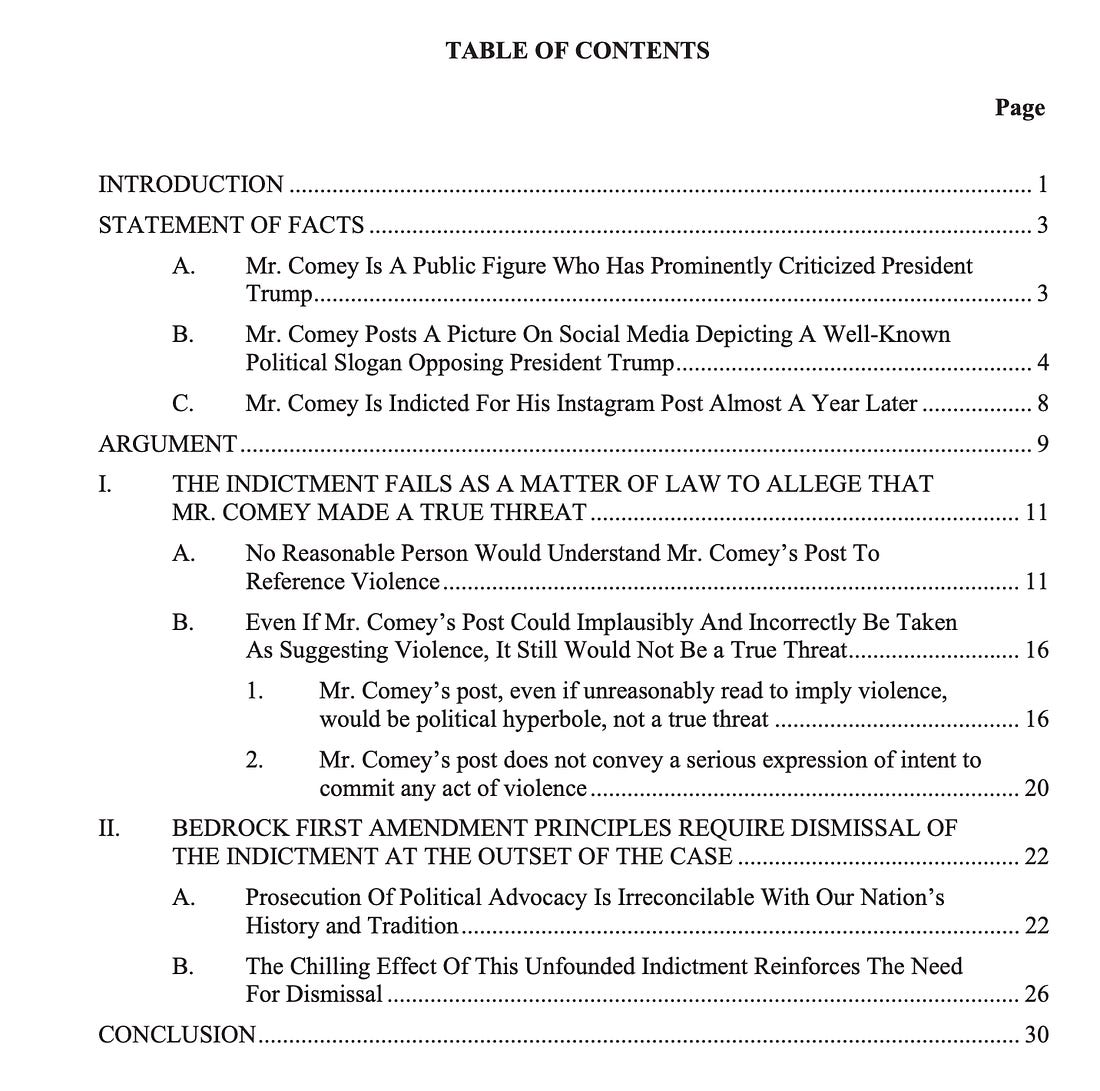 |
You know it’s going to be an interesting brief when, in addition to three and one-half pages of court cases the defense lists as support for its position, its section on “other authority” includes not only very old sedition and treason statutes, but an Amazon.com listing for “86 46 Impeach Biden” T-shirts.
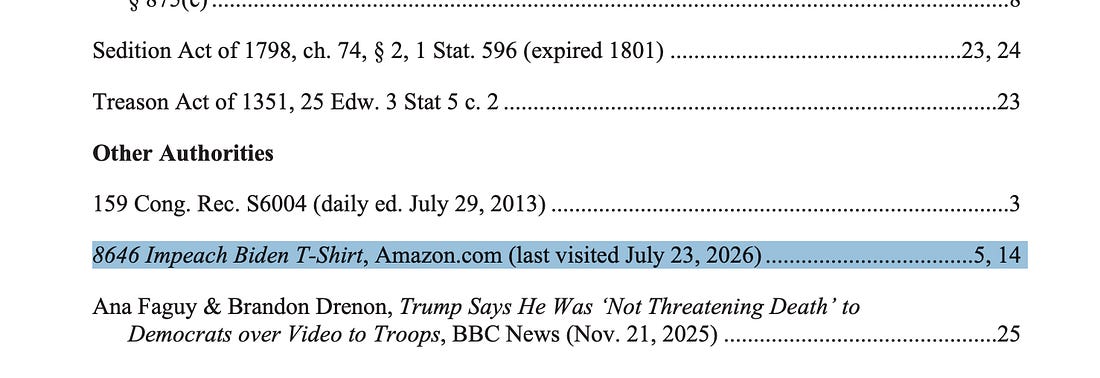 |
They even quote a Matt Gaetz tweet, from before the former Florida Representative’s bid to be Attorney General failed and he left Washington. Comey’s brief notes that “after several Republican leaders were ousted from leadership roles, a former member of the House of Representatives posted: ‘We’ve now 86’d: McCarthy McDaniel McConnell Better days are ahead for the Republican Party.’ Matt Gaetz (@mattgaetz), X (Feb. 28, 2024, at 17:27 ET).”
The brief begins with an eloquent statement of the defense’s core reason the indictment should be dismissed:
“This indictment targets protected speech at the heart of the First Amendment. Mr. Comey, an outspoken critic of President Trump, posted a photograph of seashells spelling out “86 47,” a well-known political slogan that expresses opposition to the President. In fact, thousands of items featuring this slogan have been sold on the internet and are available to this day, and the slogan was commonly displayed at protests around the country in the months preceding Mr. Comey’s post. But the government now singles out Mr. Comey to prosecute one of the President’s most prominent critics for publishing another person’s statement of political opposition. That attempt to suppress core political speech contravenes both the statutes at issue and the First Amendment.”
The two-count indictment was filed on April 28, 2026. Comey is charged with making a threat to Donald Trump almost a year before he was charged with it by posting the seashell picture “which a reasonable recipient who is familiar with the circumstances would interpret as a serious expression of an intent to do harm to the President of the United States.” That would violate 18 USC 871(a), which makes it a crime to threaten the president. He is also charged with violating 18 USC 875(c), which makes it a crime to transmit “any threat to injure the person of another,” in interstate commerce (an Instagram post would count, if it were actually a threat). The essence of both charges is making a threat, and Comey’s lawyers argue that not only would a jury refuse to find the seashell photo qualifies, but there are clear legal reasons the Judge should reject it too, and dismiss the indictment now instead of forcing Comey to go through additional legal proceedings.
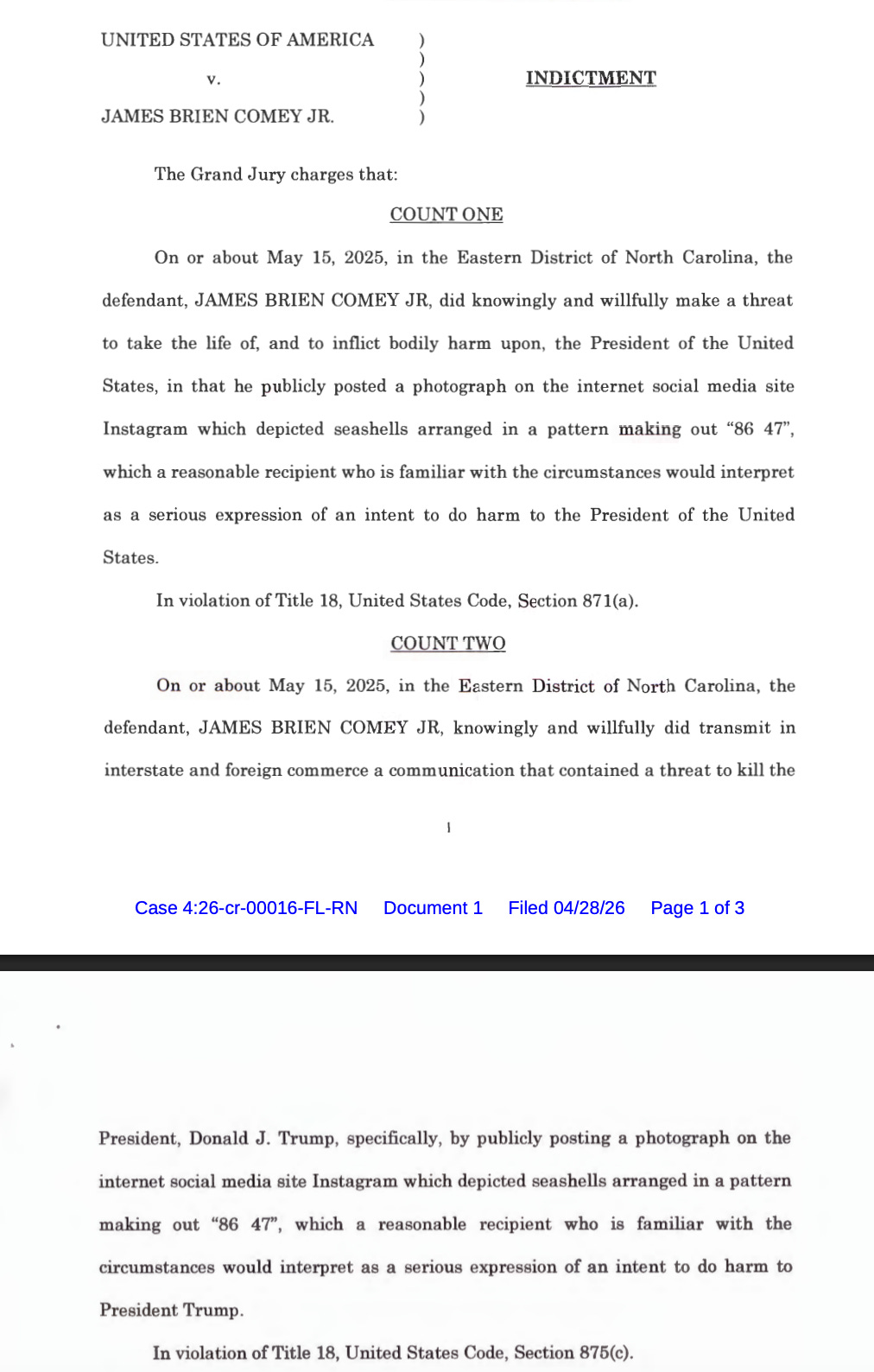 |
They say that the allegation that “86 47” amounts to a threat “is contradicted by every possible source of meaning: dictionaries, context, precedent, and common sense.” They argue that 86 means to reject or get rid of something and the phrase “has no violent connotation except in the most uncommon usages.” Even the most generous reading the court might give the indictment leads to the conclusion Comey’s post is “protected political hyperbole,” that if it is not a threat there is no case against Comey, and that “Courts have regularly dismissed indictments alleging statements far more ‘threatening’ than Mr. Comey’s social media post.” That’s the result they say should pertain here.
Next comes a little jab—or perhaps it’s outreach anticipating they will win the motion to dismiss and the government will appeal—at the Supreme Court: “Allowing this prosecution to proceed would sharply depart from our Nation’s history and tradition.” The Court has infamously used the “history and tradition” test in recent terms to reach the result-oriented outcomes it has landed on in culture wars cases like Dobbs, the abortion case, and Bruen, the Second Amendment case. Here, they flip it back at the government, writing, “Under British law, citizens could be prosecuted and executed for speaking about the death of the King. B